




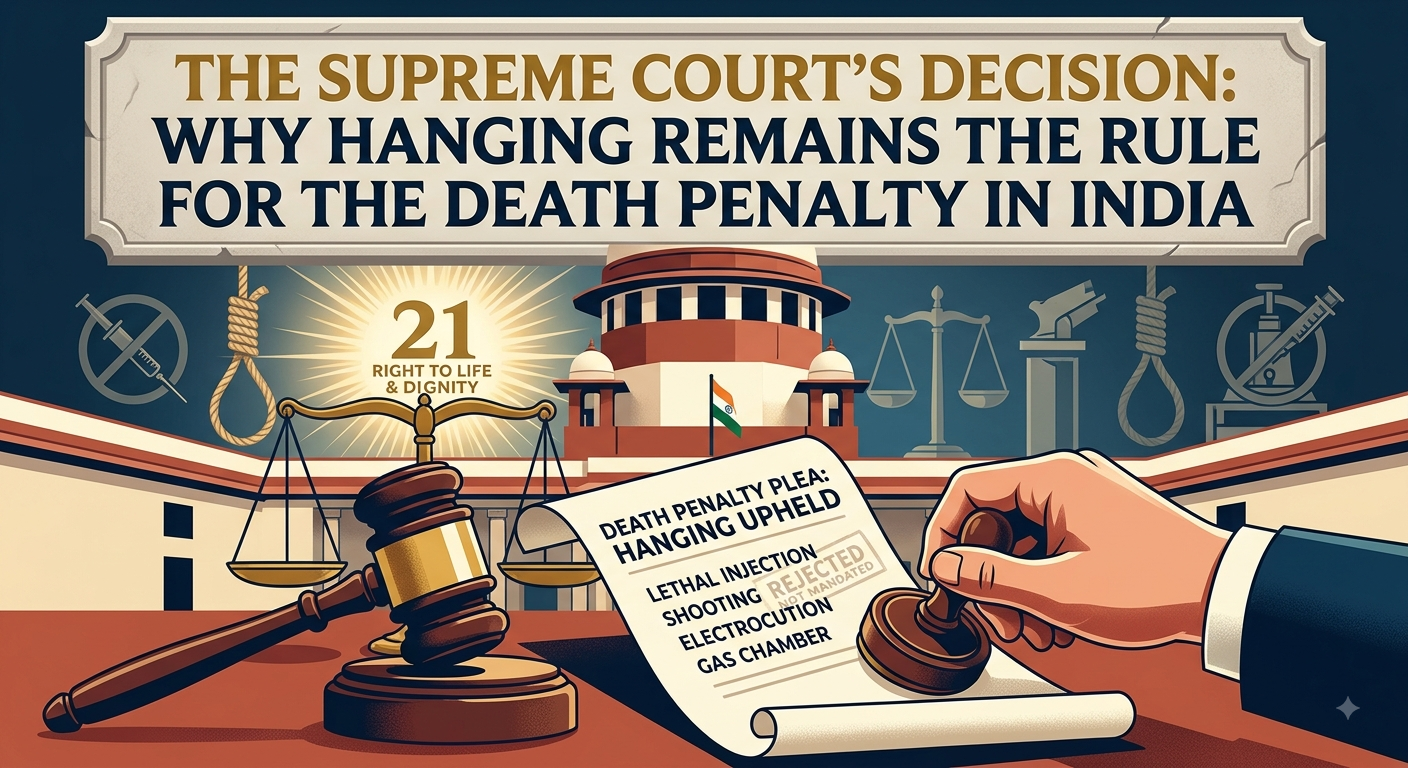
In India, when a criminal is given the death penalty for a very rare and serious crime, the law states they must be hanged. Recently, a petition was taken to the Supreme Court to ask a big question: Is hanging too painful, and should India use a more modern, less painful method?
Here is a simple breakdown of what the Supreme Court decided and why the rules are staying the same for now.
What Did the Supreme Court Decide?
A plea (called a Public Interest Litigation, or PIL) was filed asking the court to stop the practice of hanging. The Supreme Court bench, led by Justice Vikram Nath and Justice Sandeep Mehta, rejected the plea.
They stated that the current method of hanging is perfectly legal and matches the rules of the Constitution. However, the judges did make one thing clear: if the Central Government wants to create a special team of experts to study other methods, they are completely free to do so. The court simply will not force them to change it.
The Law Behind Hanging
Under Indian law (specifically Section 354(5) of the older CrPC and Section 393(5) of the new BNSS), the rule states that a person sentenced to death must be “hanged by the neck till he is dead.”
The person who filed the case argued that this goes against Article 21 of the Indian Constitution, which protects a person’s right to life, personal liberty, and dignity. The argument was that everyone, even a criminal on death row, has the right to die with dignity and minimal pain.
Why Did the Petitioner Want a Change?
The lawyer who filed the case, Rishi Malhotra, argued that hanging is a slow and painful process. It can take up to 40 minutes for a person to be officially declared dead after being hanged.
He suggested that India should look at faster alternatives that might cause less suffering. The suggested options included:
Lethal Injection (a deadly medical shot)
Shooting (firing squad)
Electric Shock (electrocution)
Gas Chamber
The main idea was that these methods work much faster than hanging, which might mean less physical pain for the prisoner.
What Happens Next?
Back in March 2023, the Supreme Court had actually asked the Central Government to gather data on whether other execution methods were less painful.
However, with this latest decision, the court has made it clear that it is not their job to rewrite the laws on how the death penalty is carried out. For now, hanging remains the only legal method for execution in India. If a change is ever going to happen, it will be up to the Indian Government to research it and pass a new law.