

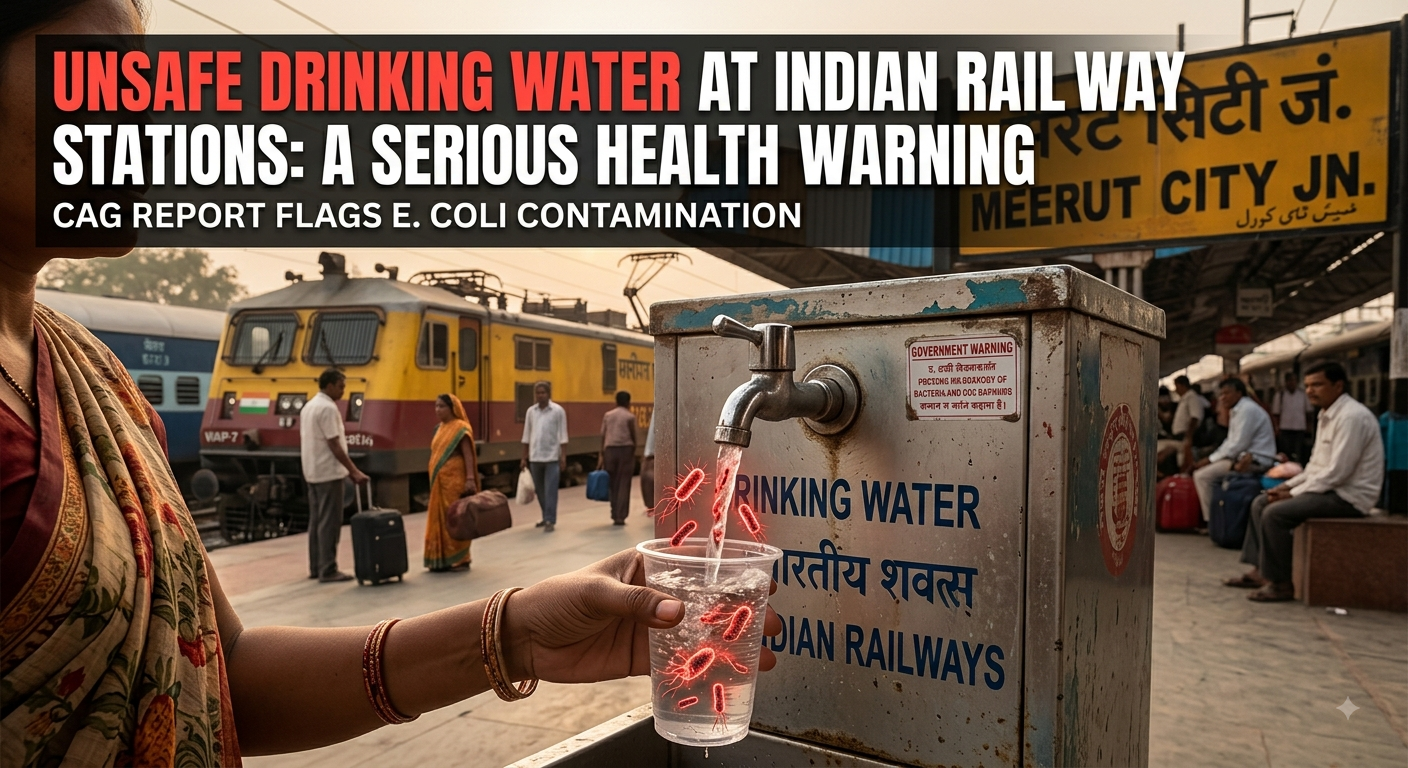
Recently, an official government audit by the CAG revealed a major problem at Indian railway stations: the drinking water coolers contain a harmful bacteria called E. coli. Since thousands of travelers refill their bottles at these stations every day, this discovery raises huge concerns about public health and safety.
How Big is the Problem?
During recent checks, the audit tested water from 49 different railway stations. They found that water coolers at 8 of these stations tested positive for E. coli. In response, government auditors have instructed the railways to strictly test their water and fix their supply systems to ensure passenger safety.
What is E. Coli and How Does it Get in the Water?
E. coli is a type of germ that naturally lives in the human digestive system. When this bacteria is found in drinking water, it means the water has been mixed with human waste or sewage.
How does this happen? The main cause is old, damaged infrastructure. At many busy railway stations, the clean water pipes and the dirty sewer lines run right next to each other underground. If these old pipes crack or leak, the sewage simply flows into the drinking water supply.
Why is This Dangerous?
You only need to swallow a very small amount of E. coli to get severely sick. The health risks include:
Stomach Problems: Painful cramps, extreme vomiting, and diarrhea.
Other Infections: It can cause urinary tract infections (UTIs) and infect open wounds.
Severe Blood Infections: If the bacteria enters the bloodstream, it can cause a deadly reaction called sepsis, which requires emergency hospital treatment.
The Challenge of “Superbugs”
Treating E. coli infections is becoming much harder today because of a problem called Antimicrobial Resistance (AMR).
Many people take antibiotic pills for minor illnesses like common colds, even when they shouldn’t. Because of this overuse, bacteria are learning how to survive these drugs. If a passenger gets sick from the railway water, standard medicine might not work at all, forcing doctors to use stronger, injected drugs to save them.
Strict Rules That Are Being Broken
India has very clear laws regarding drinking water, which means the current situation is a major violation:
Zero Germs Allowed: Government standards state that drinking water must have absolutely zero E. coli. Even the tiniest trace makes the water legally unsafe to drink.
Mandatory Cleaning: To keep pipes safe from germs, authorities are required to maintain a small, safe level of chlorine (0.2 mg per liter) in the water by the time it reaches the tap.
Summary
The discovery of human waste bacteria in railway water coolers is a massive warning sign. It highlights the urgent need to replace old underground pipes and strictly monitor water quality. Clean drinking water is a basic right, and fixing this issue is essential to protect millions of daily travelers from dangerous diseases.