

Recently, there has been a lot of discussion about how India divides its voting districts. This conversation sparked again after states like Tamil Nadu asked the central government to permanently keep the number of Members of Parliament (MPs) at the current total of 543. To understand why this is such a hot topic, we need to look at a process called “delimitation.”
What Does Delimitation Mean?
Delimitation is simply the process of redrawing the map of voting areas (called constituencies). The main goal is to make sure that each MP represents roughly the same number of people. This keeps the democratic process fair, ensuring that every citizen’s vote carries the same weight.
Why Were the Seat Numbers Frozen?
To understand today’s debate, we have to look back to the 1971 Census. At that time, India’s population was growing very quickly. To encourage states to promote smaller families, the government decided to “freeze” the number of Lok Sabha (lower house) seats based on the 1971 population numbers. The logic was straightforward: if a state didn’t control its population growth, it wouldn’t be rewarded with more MPs and political power.
The Big Clash: Equal Votes vs. Fairness to States
This freeze is set to be reconsidered after 2026, which has created a massive dilemma because states grew at very different rates over the last 50 years:
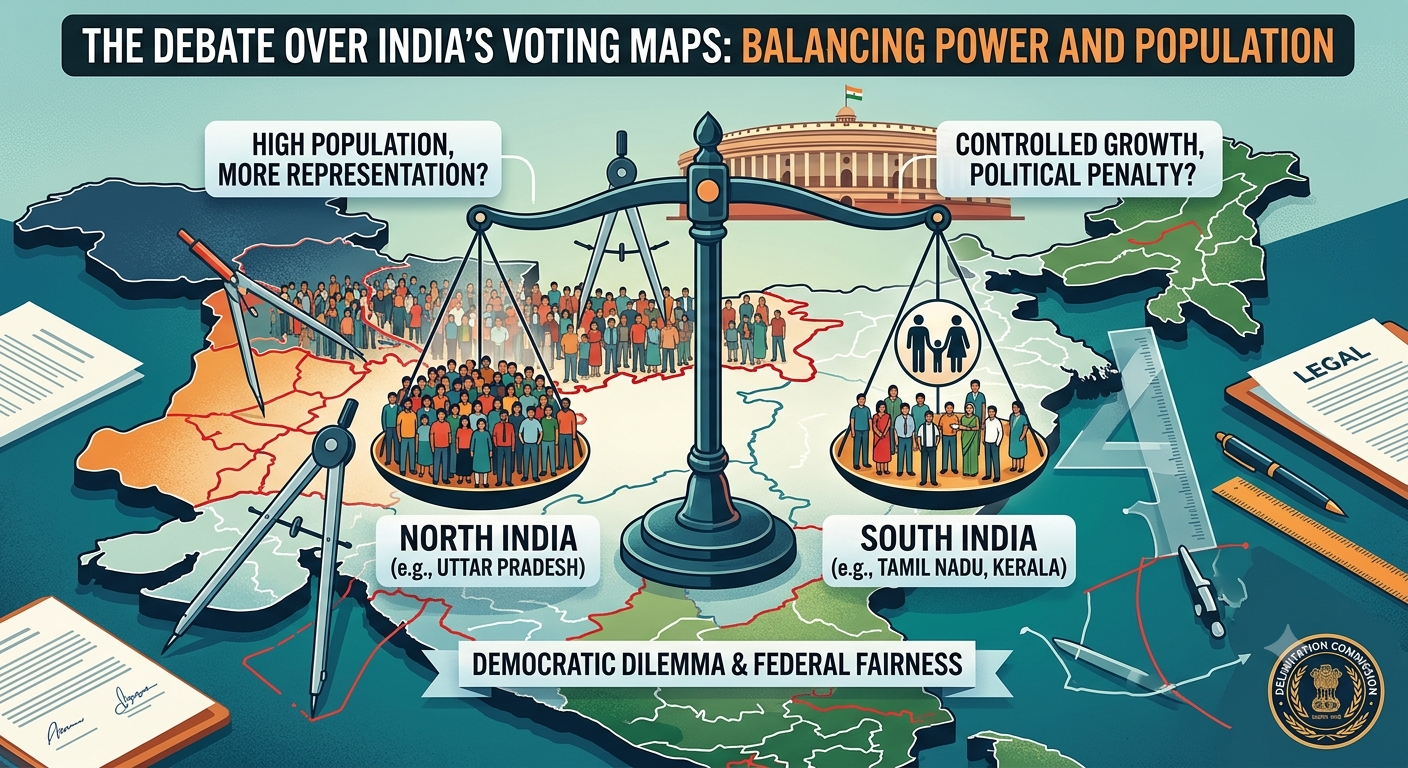
Highly Populated States: States like Uttar Pradesh saw massive population growth. Because their number of MPs is frozen, a single MP there now represents a huge number of people (projected at over 30 lakh people per MP by 2026).
States with Controlled Populations: States like Kerala and Tamil Nadu successfully followed the government’s advice and slowed their population growth. As a result, an MP there represents far fewer people (around 18 lakh).
If the maps are redrawn strictly based on today’s population, the states that successfully controlled their population will lose a large chunk of their power in Parliament, while states that grew rapidly will gain power. This creates a difficult clash: do we prioritize giving every single citizen an equally weighted vote, or do we protect the political power of the states that followed the rules?
Why Not Just Add More Seats?
One suggested fix is to simply increase the total number of MPs in the Lok Sabha. This way, no state loses the MPs they already have. However, this creates new problems:
Loss of Influence: Even if a southern state keeps its current number of MPs, their overall percentage of power drops. Having 40 out of 543 MPs gives a state more influence than having 40 out of a newly expanded 850-seat Parliament.
Imbalance of Power: India’s Parliament has two houses. If the Lok Sabha grows massive while the Rajya Sabha (the upper house that represents the states) stays the same, the states’ voices become heavily outnumbered at the national level.
Less Time to Work: More MPs mean less time for each person to speak. This could lead to rushed laws and a lack of proper debate in Parliament.
The Legal and Constitutional Rules
The Indian Constitution has specific guidelines for this map-drawing process:
Articles 81, 82, and 170 lay out the rules for how seats in the Lok Sabha and state assemblies should be organized and adjusted after a census.
Articles 327 and 329 give Parliament the power to make laws regarding these voting borders and prevent the courts from interfering with the final decisions.
Past Rule Changes: The 42nd, 84th, and 87th Amendments are the specific legal changes that created the freeze on seat numbers and extended it until after 2026.
How This Affects Women’s Reservation
In 2023, India passed the 106th Amendment to reserve one-third of government seats for women. However, this cannot be put into action until the new delimitation map is finished. The government first needs to know exactly how many voting areas there are, and where their new borders lie, before they can decide which specific areas will be reserved for women.
Who Draws the Maps?
This complex job is done by a special, independent group called the Delimitation Commission. It is important to note that they are completely separate from the Election Commission. While the Election Commission actually runs the voting process on election day, the Delimitation Commission’s only job is to organize and draw the borders of the voting areas.
Conclusion
The upcoming process of redrawing India’s voting maps is one of the country’s most complicated political hurdles. Lawmakers must figure out a solution that honors the democratic rule of “one person, one vote,” without unfairly punishing the states that successfully helped the country manage its population.