




The Magnitude of the Shift
Managing a system that operates upwards of 25,000 trains daily, transporting over two crore passengers alongside massive freight loads, is a formidable task. A single weak point across the 1.37 lakh-kilometer network can cause cascading delays. To combat this, Indian Railways has aggressively shifted from a reactive repair model to a proactive, technology-led strategy.
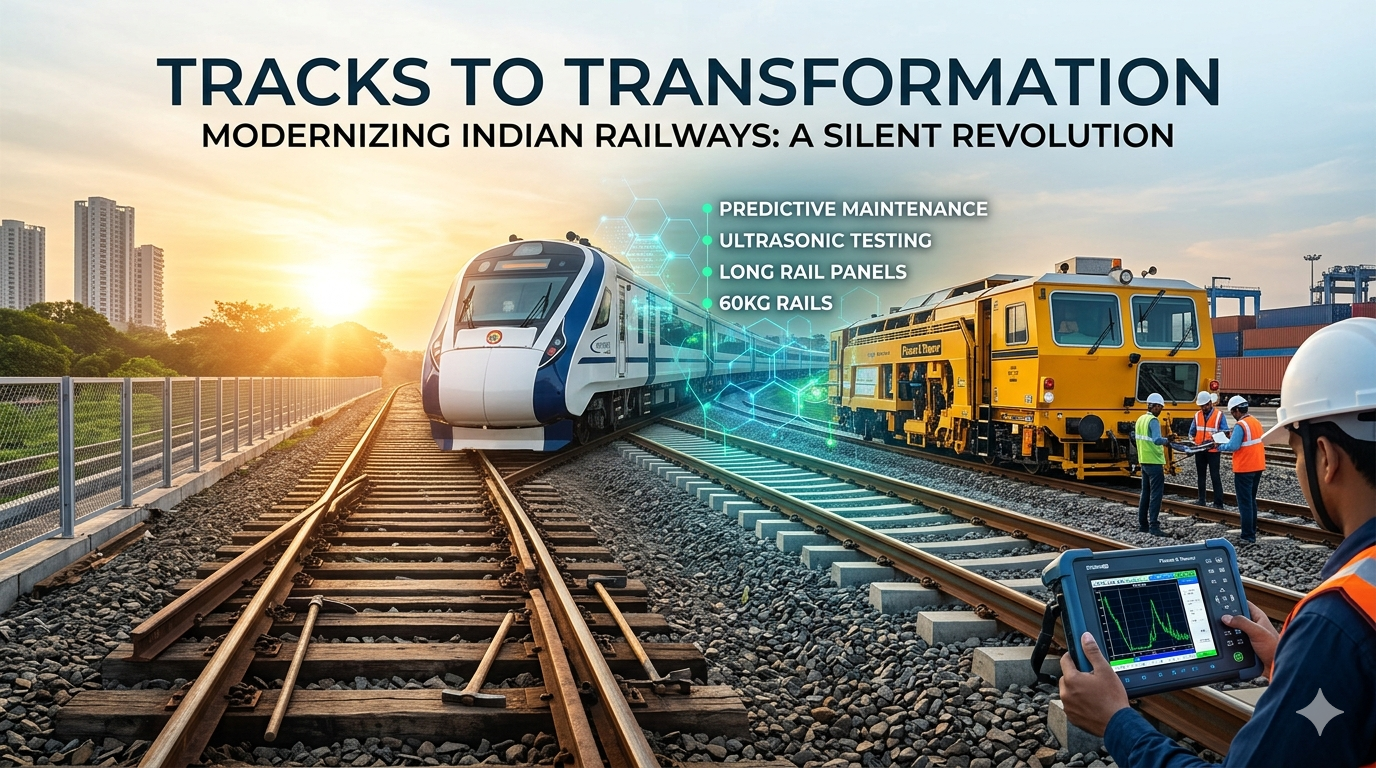
Over the past decade, the scale of track renewal has been unprecedented. Approximately 55,000 kilometers of tracks have been entirely renewed. To ensure long-term stability and high-speed endurance, stronger 60-km rails have been deployed across 80,000 kilometers. Furthermore, the integration of 260-meter-long rail panels has drastically minimized track joints, guaranteeing a significantly smoother and safer passenger experience.
Tech-Driven Maintenance
The era of purely manual track upkeep is rapidly fading. The railways’ fleet of specialized track maintenance machines has more than doubled since 2014, allowing for mechanized operations that require minimal downtime.
Today, engineers rely on predictive technologies like Ultrasonic Flaw Detection (USFD). Deployed across over 36 lakh track kilometers, this technology acts like an X-ray for the railways, identifying microscopic internal weaknesses in the metal before they can deteriorate into actual failures. Automated ballast cleaning equipment and precision rail grinding machines are also used in careful sequence to ensure the foundation remains resilient and the rail surfaces stay perfectly aligned.
A Catalyst for the Economy
A robust track foundation is not just a matter of passenger comfort; it is the lifeblood of freight logistics. Businesses require absolute certainty that their goods will arrive on time and without incident. Upgraded, deeply resilient tracks mean that freight trains can travel faster, carry heavier loads, and maintain highly predictable schedules. By shrinking maintenance windows and increasing the distance trains can safely travel between check-ups, the railways are directly boosting the national economy’s efficiency.
Unprecedented Enhancements in Safety
Perhaps the most remarkable outcome of this infrastructural overhaul is the dramatic enhancement in safety. The rate of consequential train accidents has plummeted by nearly 90% over the last ten years.
This success is rooted in several comprehensive policy and physical upgrades. Unmanned level crossings, once a major source of tragic collisions, have been completely eliminated. Additionally, to protect both the trains and local populations, the government has installed over 17,500 kilometers of safety fencing along routes where trains exceed 110 km/h. This crucial step prevents cattle and unauthorized individuals from wandering onto the tracks, effectively removing unpredictable hazards for locomotive pilots.
Looking to the Future
The next phase of this evolution focuses heavily on maximizing speed and embracing full digital integration. Currently, the percentage of tracks capable of handling speeds of 110 km/h and above has jumped from 40% to 80%. Moving forward, the priority is to upgrade high-density routes to consistently support speeds over 130 km/h.
Backed by a highly sophisticated, web-enabled track management system that coordinates manpower, machinery, and materials, the maintenance ecosystem is becoming fully digitized. By continuously reinforcing its foundational infrastructure, Indian Railways is cementing its role not just as a transportation lifeline, but as the primary engine driving India’s future growth.