



In a thriving democracy, the stability of the government is crucial. Historically, Indian politics faced significant challenges due to “horse-trading“—a practice where elected representatives would switch their political affiliations for financial incentives or lucrative cabinet positions. This volatile political culture, famously dubbed “Aaya Ram, Gaya Ram,” threatened the very foundation of democratic mandates. To curb this opportunism and ensure stable governance, the Anti-Defection Law was introduced.
Here is a simplified, comprehensive breakdown of how this crucial constitutional mechanism works, perfect for anyone building their foundational knowledge of Indian polity.
The Constitutional Framework
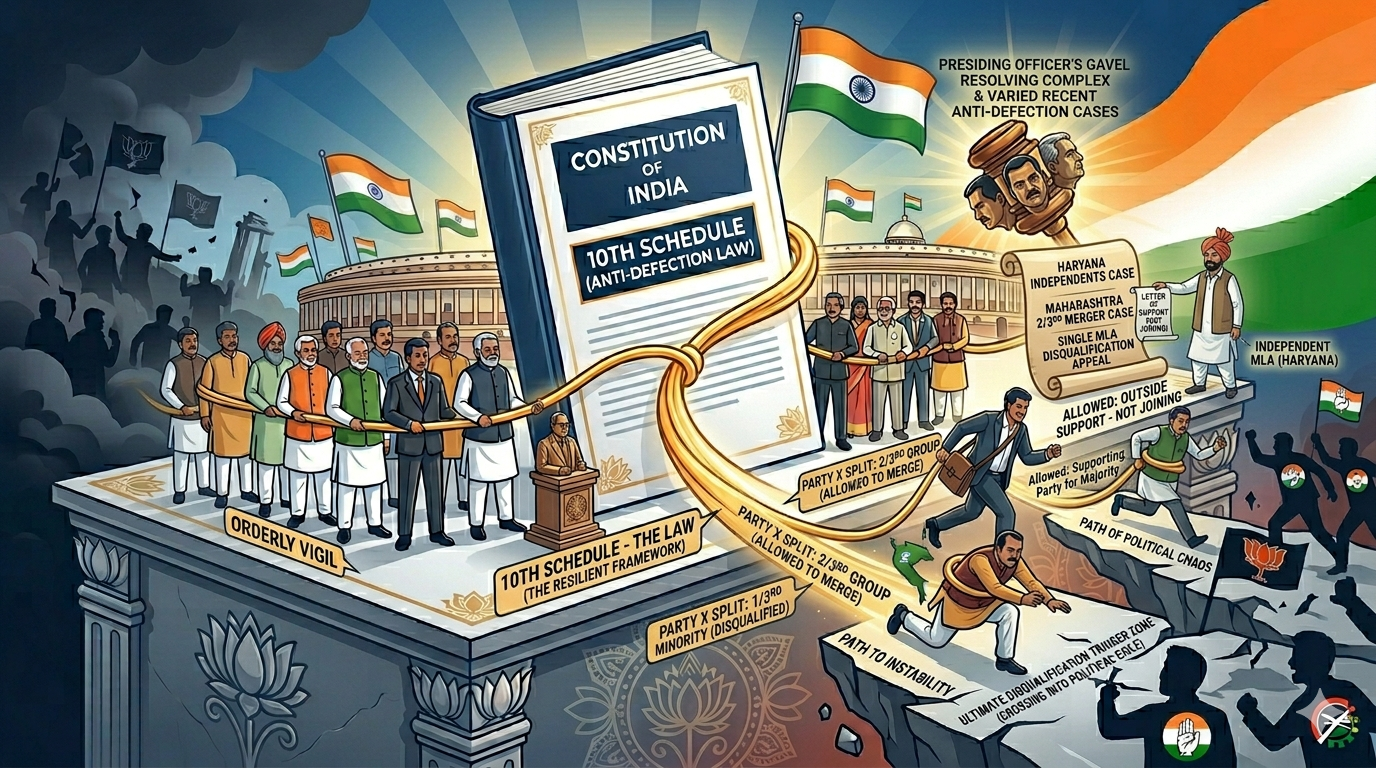
The Anti-Defection Law was officially embedded into the Indian Constitution in 1985 through the 52nd Constitutional Amendment Act, which resulted in the addition of the 10th Schedule. Its primary goal is to deter legislators—both Members of Parliament (MPs) and Members of Legislative Assemblies (MLAs)—from casually jumping ship to rival political factions.
Rules of Disqualification
The law establishes specific guidelines depending on how a representative was elected to their seat:
1. Representatives of Political Parties
For a candidate elected on a specific political party’s ticket, disqualification occurs under two primary conditions:
Voluntary Departure: If the legislator voluntarily gives up their membership in their original political party.
Defying the Whip: If the legislator votes contrary to the strict instructions (the “whip”) issued by their party, or abstains from voting without obtaining prior permission.
A Crucial Nuance: If a political party expels one of its members for disciplinary reasons, the expelled member does not automatically lose their seat in the house. However, if that expelled member officially joins a new political party, they will immediately face disqualification.
2. Independent Representatives
Independent candidates are chosen by voters specifically for their non-partisan status. Therefore, if an independent legislator formally joins any political party after winning their election, it is viewed as a breach of the voters’ trust, and they are disqualified. They are, however, legally permitted to offer “outside support” to a ruling government without officially joining its ranks.
3. Nominated Representatives
Members nominated to the house (such as those in the Rajya Sabha) are granted a six-month grace period to decide if they wish to align with a political party. If a nominated member joins a political party after this six-month window has closed, they will be disqualified under the law.
The Concept of the “Whip”
The term “whip” frequently appears in discussions about defection. A whip is essentially a binding directive from a party to its members. However, not all whips trigger the Anti-Defection Law. They generally serve three purposes:
Informational: Notifying members about upcoming sessions or the party’s stance.
Attendance-based: Requiring members to be physically present in the house.
Voting-based: Mandating members to attend and cast their vote in a specific direction.
Only the defiance of a voting-based whip provides grounds for disqualification under the 10th Schedule.
The Mass Merger Exception
While the law strictly penalizes individual party-switching, it makes an exception for broad ideological shifts within a party. According to the 91st Constitutional Amendment Act, if at least two-thirds (2/3rds) of a party’s elected legislators decide to break away and merge with another political party, it is recognized as a legitimate political merger rather than a defection. In this scenario, the lawmakers involved keep their seats.
Who Holds the Power to Decide?
The authority to adjudicate defection cases does not lie with the Election Commission or the courts initially. The power rests entirely with the Presiding Officer of the respective legislative house (the Speaker or the Chairman).
The Presiding Officer cannot initiate this process on their own; another member of the house must file a formal complaint. Once the Presiding Officer makes a final decision on the disqualification, that decision is subject to judicial review, meaning the Supreme Court or High Courts can evaluate the legality of the Speaker’s ruling.