




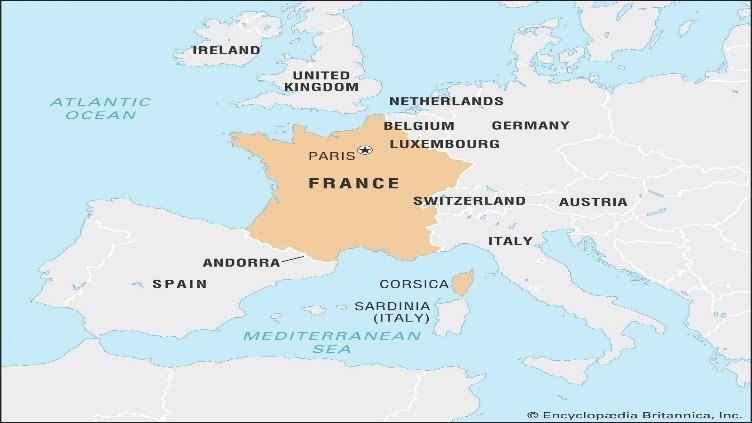
About France
What is it?
France is a historically and culturally significant nation in Northwestern Europe, recognized as a major industrial power and a country that plays a central role in global affairs. It is one of the world’s oldest nations and a centralized state, which also serves as a “special global strategic partner” to India.
Location:
It is situated at the western edge of the Eurasian landmass, bounded by the Atlantic Ocean, the Mediterranean Sea, the Alps, and the Pyrenees mountains.
Capital:
Paris — one of the world’s premier cultural and commercial centers.
Bordering Countries:
France shares its borders with Belgium, Luxembourg, Germany, Switzerland, Italy, Monaco, Spain, and Andorra.
Geographical Features
1. Hercynian Massifs:
The physical structure is composed of ancient mountain blocks, such as the Massif Central — a vast plateau covering approximately one-sixth of the country, and the rugged Massif Armoricain in the Brittany region.
2. Paris Basin:
This is a major sedimentary region containing layers of limestone, sand, and clay. It forms fertile, flat plateaus such as Beauce and Brie.
3. Great Lowlands:
This includes the Aquitaine Basin in the southwest, known for its fertile river valleys and the sandy plains of the Landes, as well as the Alsace plain located along the Rhine River in the east.
4. Young Fold Mountains:
This includes the Alps, home to Mont Blanc (15,771 feet), and the Pyrenees, which form a natural border approximately 280 miles long between France and Spain.
5. Volcanic Features:
Within the Massif Central, the Chaîne des Puys features several volcanic cones and craters that were formed about 10,000 years ago.
Significance
France acts as a crucial geographical, economic, and linguistic bridge connecting Northern and Southern Europe.
It is a permanent member of the United Nations Security Council, possessing veto power and wielding significant influence on a global scale.