




When we think of countries running out of people, we usually picture South Korea or Japan, where a lack of babies is causing serious shortages in the workforce and the military. For decades, Indians have been taught the exact opposite: that the country has too many people. However, the reality on the ground has completely changed.
Recent government data reveals that India’s average birth rate has silently dropped to 1.9. To keep a population perfectly stable, a country needs a birth rate of exactly 2.1. This means India is now producing fewer children than it needs to replace its current population. This massive change wasn’t forced by strict laws; it happened naturally as more women gained access to education and better healthcare.
The Great Divide
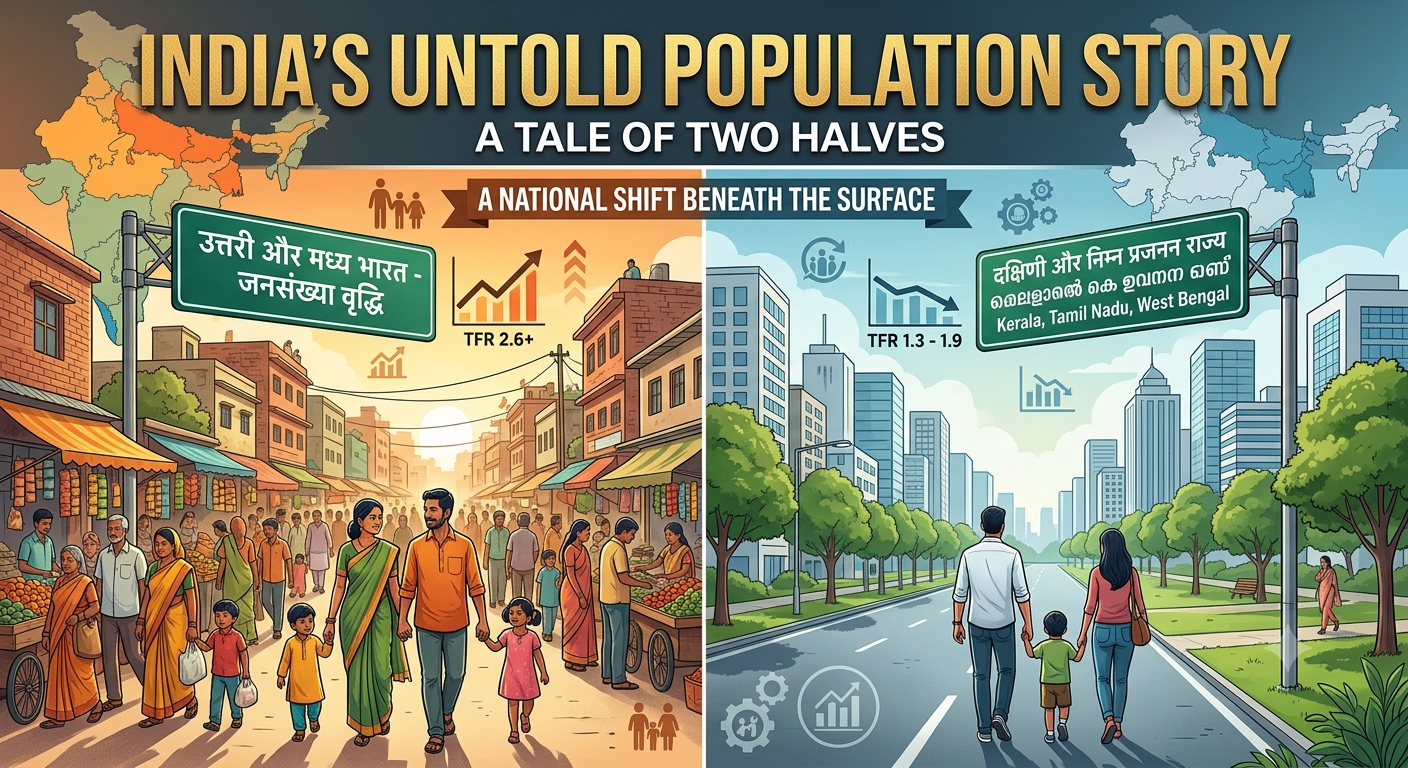
While the national average is 1.9, looking closely at individual states tells a totally different story of two contrasting Indias:
The South: States like Kerala, Tamil Nadu, and Andhra Pradesh have incredibly low birth rates, hovering around 1.3 (which is even lower than Japan’s). They achieved this by heavily investing in schools, hospitals, and family planning decades ago.
The North: Meanwhile, states like Bihar and Uttar Pradesh are still growing rapidly, with birth rates well above the 2.1 stability mark.
In most countries, a shrinking population creates economic headaches. In India, it is creating a massive political puzzle.
In a democracy, the number of seats a state holds in Parliament is decided by its population. More people means more seats and more power. Back in the 1970s, the Indian government realized that if they updated the seats, the states that successfully controlled their populations would lose their political voice. To be fair, the government “froze” the seat numbers based on the 1971 population count.
Here is the problem: that freeze is scheduled to end after 2026.
A Tough Democratic Choice
If Parliament seats are rearranged based on today’s numbers, the Northern states will gain a huge amount of political power, and the Southern states will lose theirs.
Southern leaders are naturally upset. They feel they are about to be punished with less power simply because they successfully educated their people and controlled their population like the central government asked them to. It has gotten so tense that some Southern politicians are now actively encouraging their citizens to have larger families just to protect their political future.
On the flip side, the core promise of democracy is “one person, one vote.” Because of the old 1971 freeze, a politician in the North today represents millions more people than a politician in the South. This means a Northern vote technically holds less weight right now.
As the deadline approaches, the country has to figure out how to balance these two very real truths.
What are your thoughts on how a democracy should solve a problem like this—should power be strictly based on current population, or should states be protected for successfully managing their growth?