




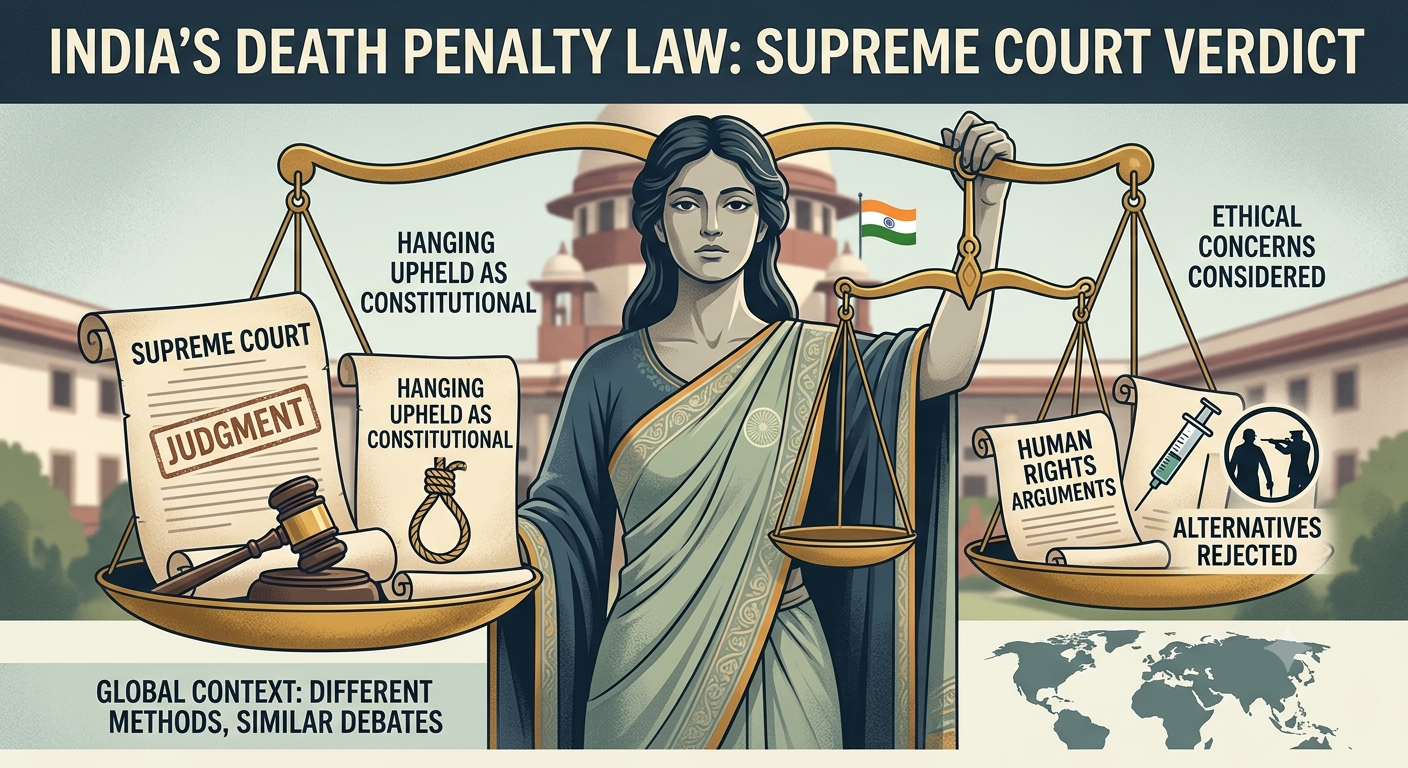
Recently, the Supreme Court of India was asked to look at how the death penalty is carried out. A legal challenge argued that hanging is cruel and asked for a different method. However, the Court decided that hanging will stay as the official method. Here is a simple breakdown of the debate.
The Argument Against Hanging
A petition was filed claiming that hanging goes against a person’s right to a dignified death. The main arguments were:
Too Much Suffering: Critics argued that hanging can take a long time and causes unnecessary trauma.
Alternative Options: The petitioners suggested that methods like a lethal injection or a firing squad would be much faster and more humane.
Why the Supreme Court Said No
The Supreme Court refused to change the law right now, citing a few key reasons:
Lack of Proof: The people who filed the complaint did not provide strong scientific or medical evidence to prove that hanging is actually worse than other methods.
Open to Future Reviews: The judges noted that their decision is final for now, but they are willing to look at the issue again in the future if someone brings solid, scientific proof.
The Government’s Defense
The government strongly defended hanging by pointing out the major flaws in the suggested alternatives:
Reliability: Hanging is considered a certain and reliable method that works in one go.
Injection Risks: In places that use lethal injections, there are many cases where the drugs fail. This can cause the person to wake up in pain, requiring a second injection, which is heavily traumatic.
Medical Ethics: Doctors often refuse to administer lethal injections because they take an oath to save lives, not end them.
How Other Countries Handle Executions
Around the world, countries have very different rules for capital punishment:
United States: Mostly relies on lethal injections, but struggles with drug shortages and failed attempts.
Japan: Also uses hanging, but the government keeps it a complete secret, giving the prisoner and their family no advance warning.
Saudi Arabia: Continues to carry out public executions, frequently using a sword.