




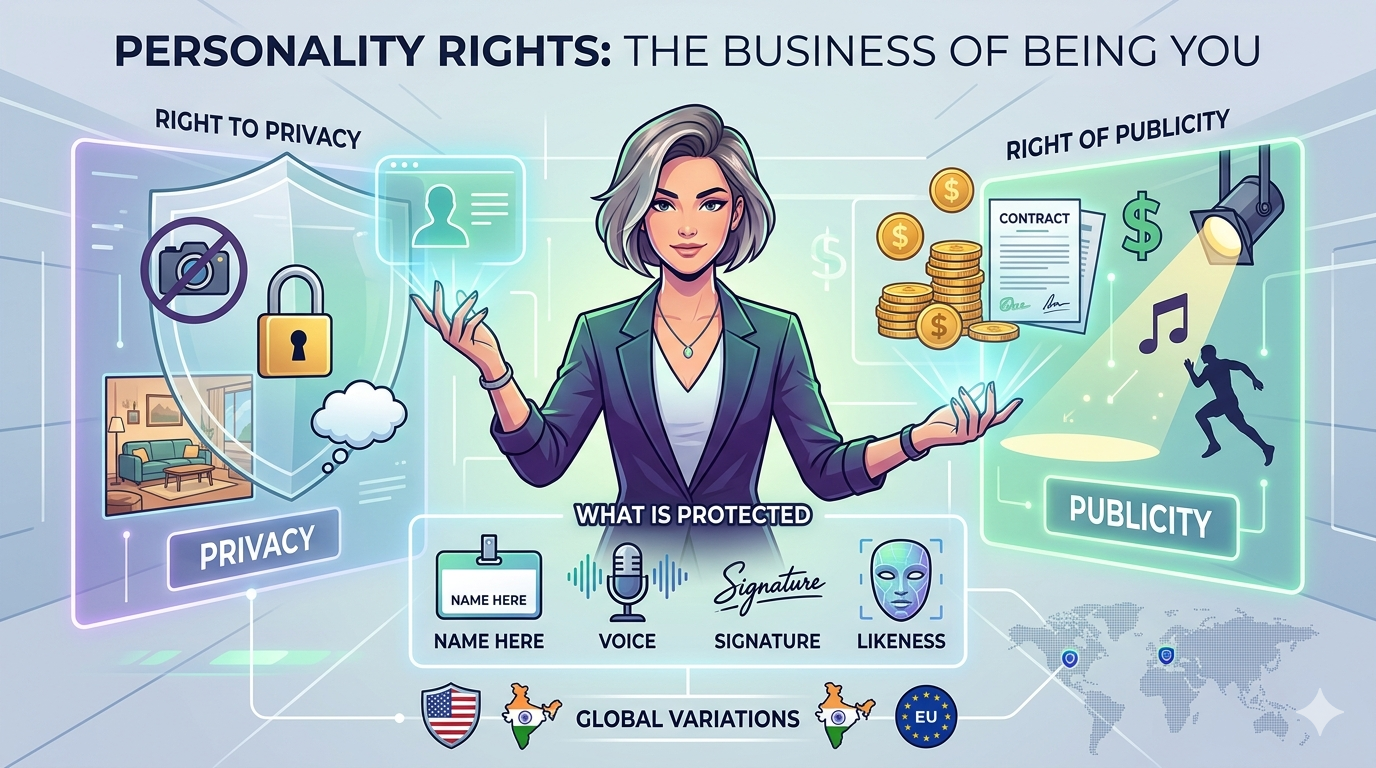
Have you ever considered who legally “owns” your identity? If a brand decides to use your face or voice to market their latest product, what is stopping them? The legal shield protecting you is known as personality rights, frequently referred to as the right of publicity. This foundational concept ensures that individuals retain control over the commercial exploitation of their unique persona, preventing unauthorized entities from cashing in on who they are.
The Two Pillars of Personality Rights
Personality rights are not a single, blanket law. Instead, they are typically divided into two distinct legal branches that protect both your wallet and your well-being:
The Right of Publicity (The Property Aspect): This branch is all about economics. It grants individuals a property right over their own identity, allowing them to control and monetize it. Because it is treated as property, many legal jurisdictions allow this right to be inherited by a person’s heirs after they pass away (known as post-mortem rights).
Example: If a beverage company uses an unauthorized photo of a famous musician to sell a new energy drink, they are infringing on that musician’s right of publicity.
The Right to Privacy (The Personal Aspect): This branch focuses on human dignity. It protects your fundamental right to be left alone and ensures your identity isn’t exploited in a way that causes embarrassment or intrusion. While publicity is about financial value, privacy is about emotional peace.
Example: A paparazzi photographer secretly capturing and publishing images of a person inside their private home.
What Exactly is Protected?
The law generally protects any clear and unequivocal identifier that makes you recognizable to the public. This typically includes:
Name: This safeguards your legal birth name as well as any widely recognized aliases, nicknames, or stage names.
Likeness: This covers your physical appearance in photographs, illustrations, and increasingly relevant digital mediums, such as AI-generated “deepfakes.”
Voice: Your distinct vocal patterns are protected. Hiring a voice actor to perfectly mimic a celebrity’s voice in a commercial without permission can trigger a legal violation.
Signature: This encompasses your actual handwritten signature, unique personal marks, and sometimes highly specific catchphrases tied solely to you.
Where the Boundaries Lie: Limitations and “Fair Use”
While your personality rights are powerful, they are not absolute. They must constantly be balanced against freedom of expression. Courts generally permit the unauthorized use of a person’s identity in a few specific scenarios:
News and Reporting: Journalists and media outlets can freely use your name or image when reporting on factual, newsworthy events.
Artistic Expression: Creators are frequently given leeway when using a persona for parodies, satires, or biographical storytelling, though this remains a heavily debated legal gray area.
Public Interest: If the information regarding an individual is deemed crucial for the general public to know, the right to broadcast it often supersedes individual personality rights.
A Global Perspective
The strength and scope of your personality rights depend heavily on where you live, as there is no universal global standard:
United States: Protection is largely handled at the state level rather than federally. States like California and New York offer exceptionally robust legal frameworks, largely due to the historic presence of the film, music, and broader entertainment industries.
India: While there is no single, dedicated statute defining personality rights, the Indian Supreme Court has established that these rights are an inherent facet of the broader Right to Privacy, protected under Article 21 of the Constitution.
Europe: In many European countries, these protections are deeply tied to the concept of “moral rights.” Furthermore, strict overarching data privacy laws, most notably the General Data Protection Regulation (GDPR), provide a strong layer of defense against the unauthorized use of personal identifiers.