



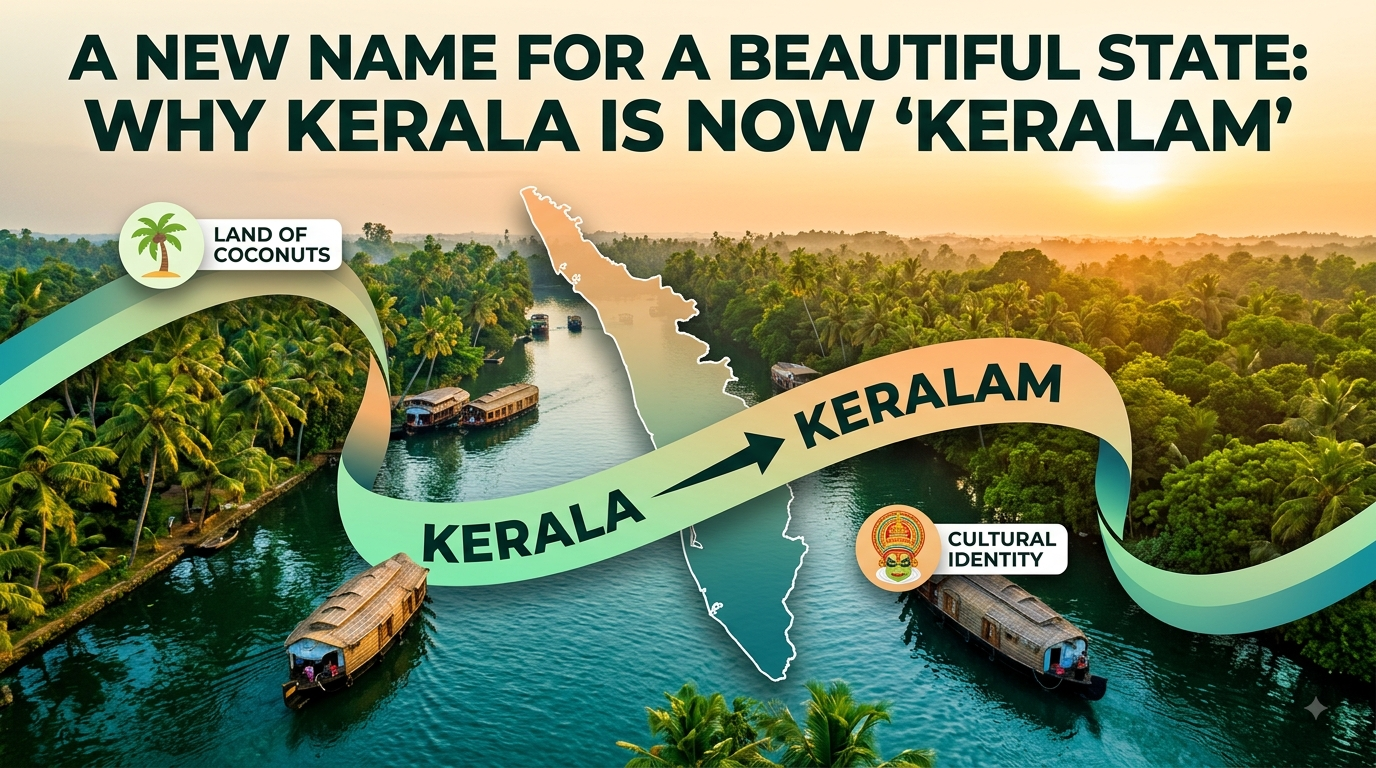
After years of requests, the Indian state of Kerala has officially been renamed “Keralam.” This change is a big step for the state to celebrate its local language, history, and culture. Here is a simple guide to why this happened and how a state gets a new name in India.
Why Change the Name?
For the people living there, the state has always been “Keralam” in their local language, Malayalam. The name “Kerala” was actually an English version created during British rule. By changing it back, the state is dropping an old colonial habit and embracing its true roots.
The name “Keralam” has a beautiful meaning tied to nature. It comes from two words:
Kera: which means coconut tree.
Alam: which means land.
So, “Keralam” literally means the “Land of Coconuts.” It is also linked to the ancient Chera kings who once ruled the area.
How Do You Change a State’s Name in India?
You might think a state’s government can just pick a new name, but it isn’t that simple. According to Article 3 of the Indian Constitution, only the national Parliament in New Delhi has the power to change a state’s name or borders.
Here is the simple, four-step process they followed:
The State Asks: First, the state’s leaders (the State Assembly) vote to show they want a new name. This tells the national government what the people want.
The President’s Permission: A special document, called a bill, is written by the central government. Before it can be shown to Parliament, the President of India has to give permission.
Voting in Parliament: The bill is then presented in both houses of Parliament (the Lok Sabha and the Rajya Sabha). For it to pass, it only needs a “simple majority”—meaning more than half of the voting members must agree.
Final Signature: Once Parliament votes yes, it goes back to the President. Because the President already approved it earlier, they have to sign it. After that, the government releases an official notice, and the name is officially changed.
Has This Happened Before?
Yes! India has a long history of renaming cities and states to match their original, local names. Here are a few famous examples:
Madras changed to Tamil Nadu in 1969.
Mysore became Karnataka in 1973.
Uttaranchal was renamed Uttarakhand in 2007.
Orissa changed its spelling to Odisha in 2011 to match how locals pronounce it.
Even small territories have done this, like when Pondicherry became Puducherry in 2006.
Summary
The change from Kerala to Keralam is much more than just fixing a spelling. It is about honoring the state’s true identity and history. It also gives us a great look at how India’s laws work, allowing states to protect their local culture while following national rules.