

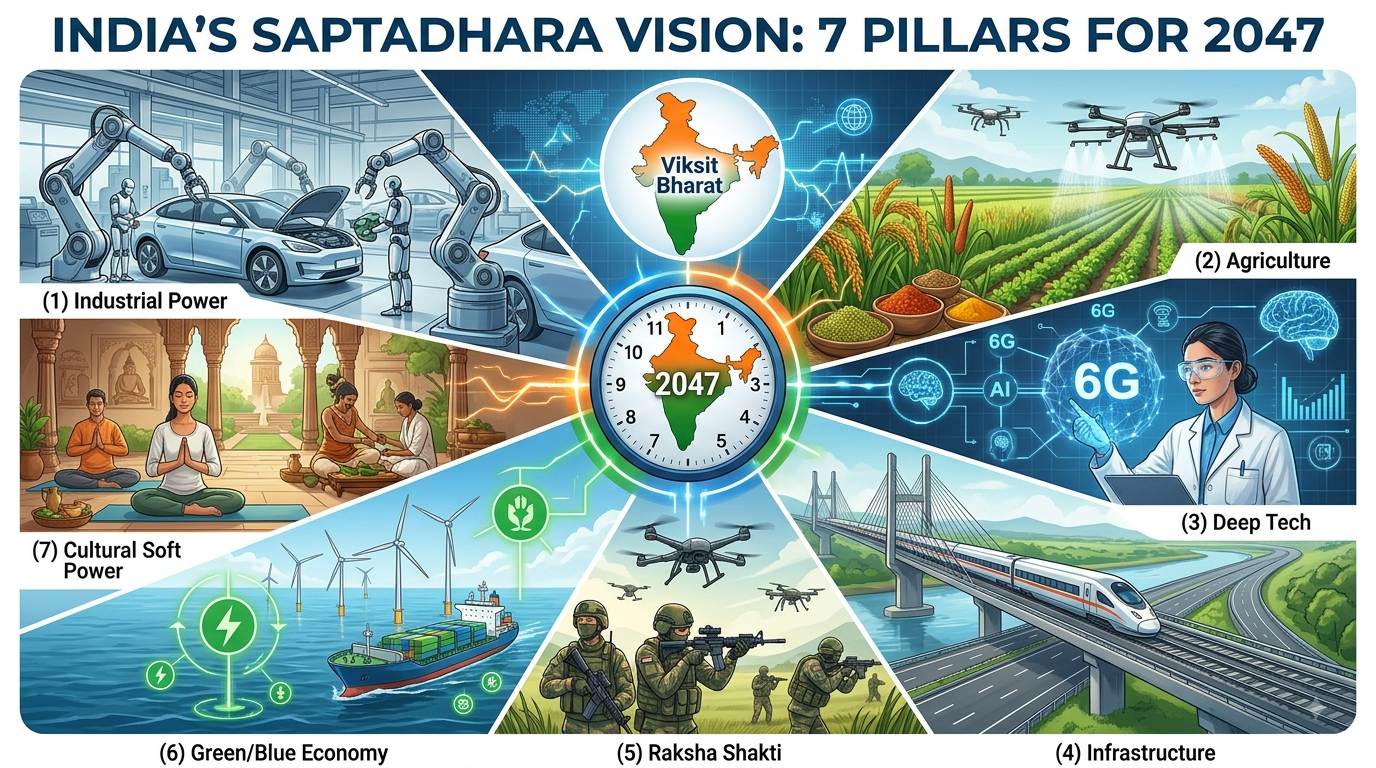
The Indian government has launched a new roadmap called the “Saptadhara Vision” (Seven Streams Vision) to help India become a fully developed nation by the year 2047. Inspired by the ancient cultural concept of seven flowing streams, this plan links different parts of the country’s economy together so they can grow side by side.
Here is a simple breakdown of the seven key areas (or pillars) of this vision:
1. Manufacturing and Industry
The Goal: Instead of just putting parts together, India wants to build products entirely from scratch.
The Plan: The focus is on creating high-quality goods with zero defects. By doing this, India aims to become a central hub for global supply chains, meaning more countries will rely on India for top-tier products.
2. Farming and Food
The Goal: To help farmers earn more by selling their crops directly to other countries without relying on middlemen.
The Plan: The government wants to turn local Indian crops—like millets, spices, and organic foods—into famous global brands. This will boost rural incomes and make Indian agriculture a powerhouse on the world stage.
3. Technology and Innovation
The Goal: To change India from a country that simply uses technology into a country that invents it.
The Plan: India is putting a lot of energy into futuristic tech, such as Artificial Intelligence (AI), space exploration, and creating its own 6G networks. The aim is to be a leader in the global tech world.
4. Infrastructure (Gati Shakti)
The Goal: To build a super-connected country with smooth transport systems.
The Plan: By building high-speed trains, better roads, and modern cities, the government hopes to make travel and trade faster and cheaper. Good roads do more than just move cars; they connect remote villages to water, electricity, and hospitals, which changes lives for the better.
5. Defense and Security
The Goal: To stop relying on other nations for military equipment and start making and selling weapons globally.
The Plan: India is heavily focused on self-reliance in defense. By building advanced tech like drones and cybersecurity systems, India is already starting to attract buyers from other countries.
6. Environment (Green and Blue Economy)
The Goal: To grow the economy rapidly without destroying nature.
The Plan: Economic growth can often hurt the environment, so this pillar focuses on balance. India is investing in clean energy, like green hydrogen, and looking at ways to use ocean resources responsibly (the blue economy) while keeping emissions as low as possible.
7. Culture and Soft Power
The Goal: To share India’s rich history, traditions, and knowledge with the rest of the world.
The Plan: India is using its cultural treasures—like Yoga, Ayurveda, and traditional arts—to build global friendships. Medical tourism is also booming, as people from all over the world travel to India for natural and holistic treatments.
The Big Picture: Everything is Connected
The most important part of the Saptadhara Vision is that these seven goals are not separate; they all work together as one giant ecosystem.
For example, if you build a new road (Infrastructure), a local factory can ship its goods faster (Manufacturing). This creates local jobs, which gives people money to spend on better food and healthcare. By connecting all these pieces and using the energy of its large youth population, India is setting a strong foundation to reach its ultimate goal of becoming a fully developed country by 2047.