




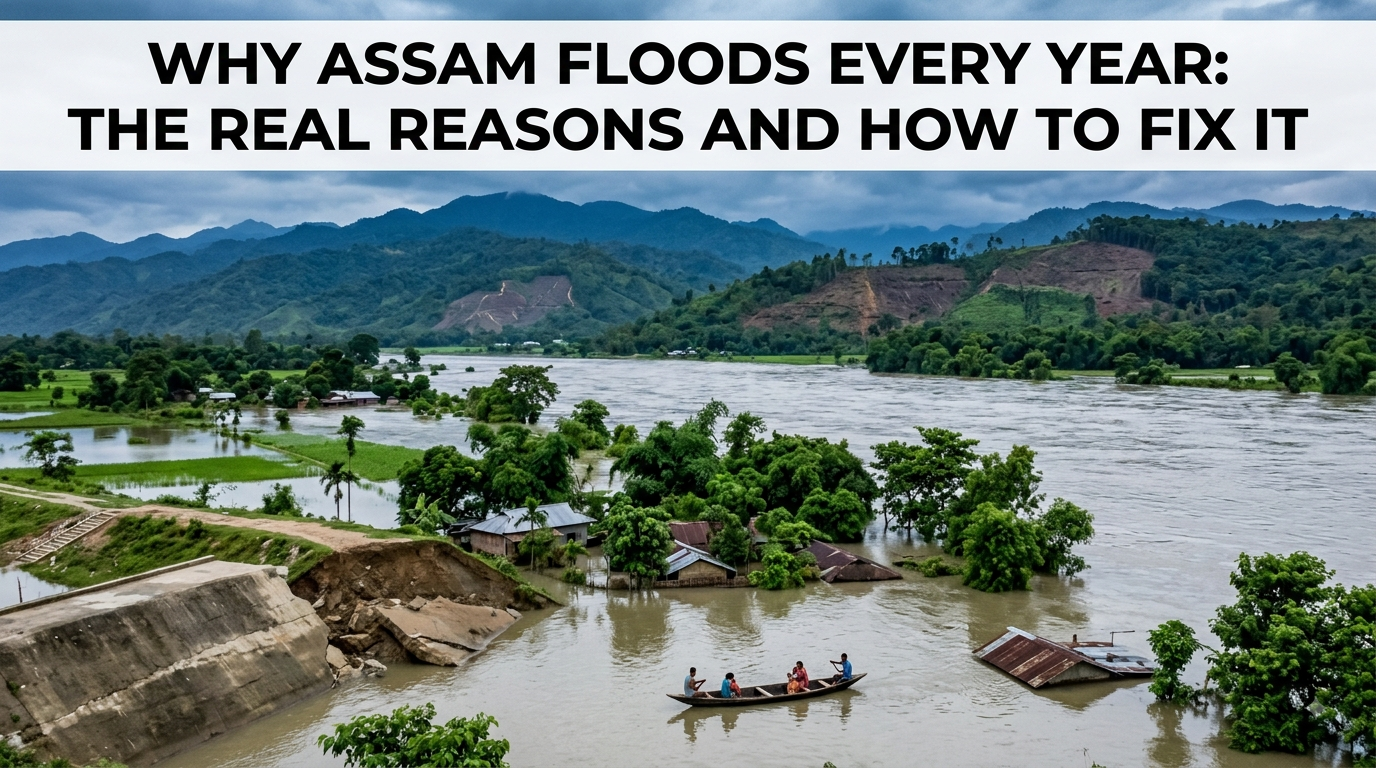
Every year, the state of Assam faces terrible floods that destroy homes, disrupt lives, and cause massive damage. When this happens, it is easy to put all the blame on heavy monsoon rains and climate change. But if we look closely, rain is only part of the story. The truth is that while floods are a natural event, the massive disasters we see today are mostly caused by human actions.
Here is a simple breakdown of why Assam floods so badly and what is really going wrong.
The Geography: Why Assam Gets So Much Water
First, it helps to understand where Assam is located. The state sits in a low-lying valley surrounded by high mountains, including the Himalayas to the north. At the same time, strong monsoon winds blow in directly from the ocean (the Bay of Bengal) in the south, bringing heavy rain.
Because Assam is shaped like a bowl surrounded by hills, all the rainwater from the higher areas naturally flows right down into it. While this means floods have always been a part of nature here, human mistakes have made them much worse.
The 4 Human-Made Causes of the Disaster
1. Ignoring the “Bigger Picture”
When the government makes plans to control the floods, they usually only focus on Assam. But water does not respect state borders. The rivers flowing into Assam start in higher neighboring states like Arunachal Pradesh and Nagaland. Any rain that falls up there comes rushing down into Assam. To fix the flooding, authorities need to look at the entire path of the river, not just the part that flows through Assam.
2. Destroying the “Natural Sponge”
Hundreds of years ago, the region was covered in thick forests. Trees and plants act like a giant, natural sponge. When it rained, the forests would soak up the water and release it slowly. Over the years, these forests were cut down to make room for tea gardens, roads, and growing cities. Without trees, there is nothing to soak up the rain, so it rushes straight into the lower plains.
Furthermore, people have heavily mined sand, stones, and rocks from the rivers. These rocks used to act as natural “speed bumps.” Without them, the water flows dangerously fast.
3. The Trap of River Walls (Embankments)
Decades ago, tall walls called embankments were built along the sides of the rivers to keep the water out. While this seemed like a good idea, it created a false sense of safety. Believing the walls would protect them, people built houses and towns on land that used to flood regularly.
Before these walls existed, floodwaters would rise very slowly, giving people plenty of time to pack up and leave. Today, the water builds up behind these walls. When a wall finally breaks under the immense pressure, a massive wave of water violently crashes into the towns in an instant, giving no one time to escape.
4. The Way it Rains has Changed
Global warming has changed the way monsoons behave. Hotter air can hold a lot more moisture. In the past, Assam might have received a steady, manageable amount of rain spread out over 20 or 30 days. Now, because of climate change, the sky holds onto that water and dumps it all at once.
Imagine pouring a cup of water down a sink slowly—it drains perfectly. But if you dump a massive bucket of water into the sink all at once, it overflows. That is exactly what is happening to Assam’s land and rivers during these short, intense bursts of rain.
How Do We Fix It?
Flooding is a natural part of the earth’s cycle, but disasters are not. We cannot stop the rain, but we can change how we handle it.
Quick fixes, like simply building taller river walls, will not work anymore. To truly protect Assam, we need a long-term plan that involves everyone. We need to plant more trees to restore the earth’s natural sponge, stop the harmful mining of riverbeds, make joint plans with neighboring highland states, and respect the natural flow of rivers instead of trying to trap them behind walls.