




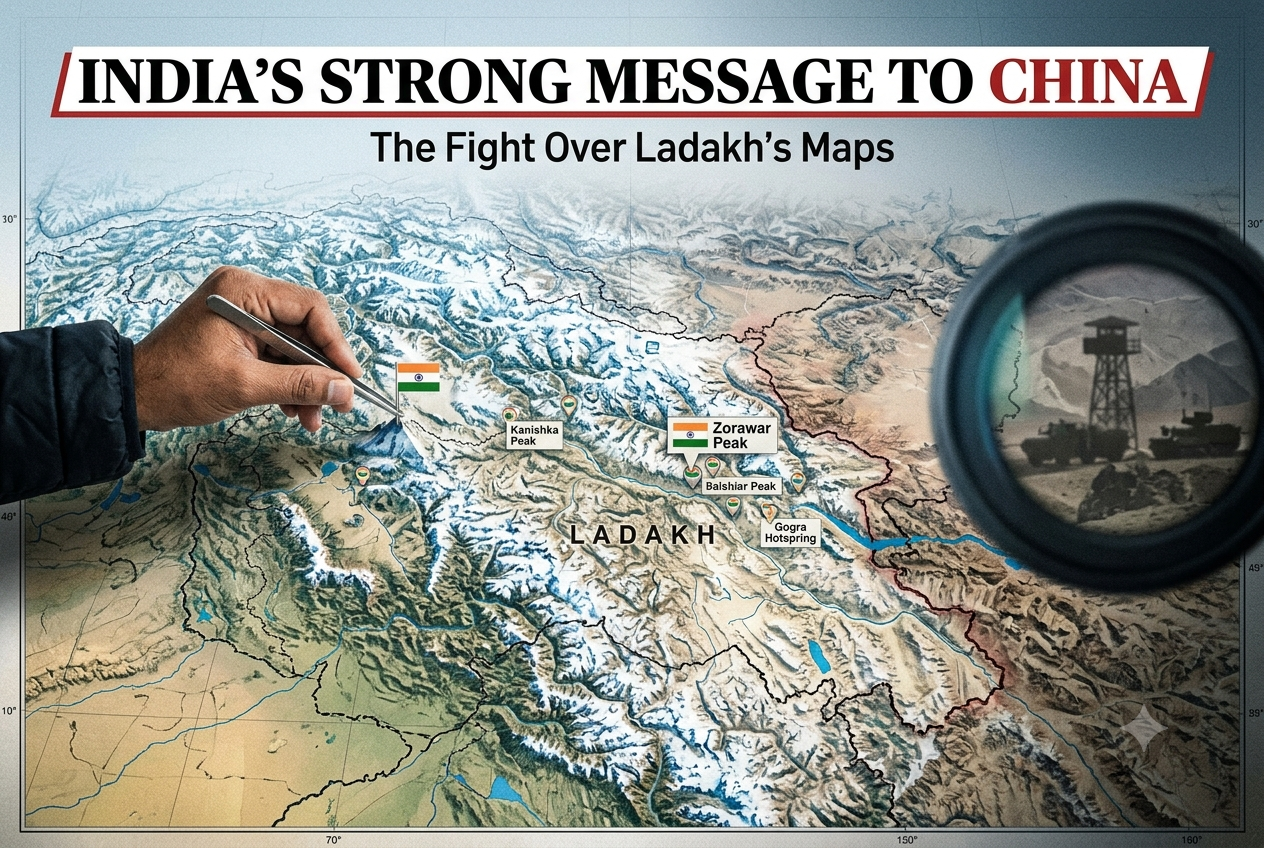
Maps are more than just drawings of land; they are powerful tools. Recently, India officially updated its maps to include the standard names of 28 places in Ladakh, including lakes, valleys, and mountain peaks.
China quickly objected to this update. However, India gave a strong and clear reply: Ladakh is firmly a part of India, and India has the right to manage its own territory.
Why Do Map Names Matter?
You might wonder if changing the name of a mountain or a valley actually does anything. In international politics, it does. Putting official names on a map is a way for a country to clearly state, “This land belongs to us.” It helps the government keep better records, but more importantly, it sends a strong message to other countries.
A Quick Look at History
To understand why China cares about this, we have to look at the past. India and China have disagreed about their borders for decades, especially over an area called Aksai Chin.
In the 1950s, China built a road through Aksai Chin to connect two of its own regions, Tibet and Xinjiang. India protested because Aksai Chin is Indian territory. This disagreement eventually led to a war in 1962. Even today, while India claims Aksai Chin, China physically controls it, and the two countries still don’t have a fully agreed-upon border.
Why is Ladakh So Important?
The location of Ladakh and Aksai Chin makes them extremely important for national security. This region is located right where India, China, and Pakistan meet. It is also very close to the Siachen Glacier and Pakistan-Occupied Kashmir (PoK). Because the area is surrounded by neighbors who have had conflicts with India in the past, whatever happens in Ladakh affects the safety of the whole region.
What Should India Do Next?
Updating maps is a great first step to claim territory, but it is not enough on its own. To truly secure its borders, India needs to focus on four things:
Clear Maps: Continue keeping accurate and official records of its land.
Better Roads: Build more roads, bridges, and infrastructure in border areas so people and supplies can move easily.
Strong Defense: Keep the military well-prepared and equipped in the region.
Peaceful Talks: Keep talking with China through diplomats to eventually find a permanent, peaceful solution to the border problem.
In short, naming these 28 places is India’s way of standing its ground. It shows that protecting a country’s border isn’t just about soldiers on the ground—it is also about building roads, holding talks, and putting your foot down on the world map.