




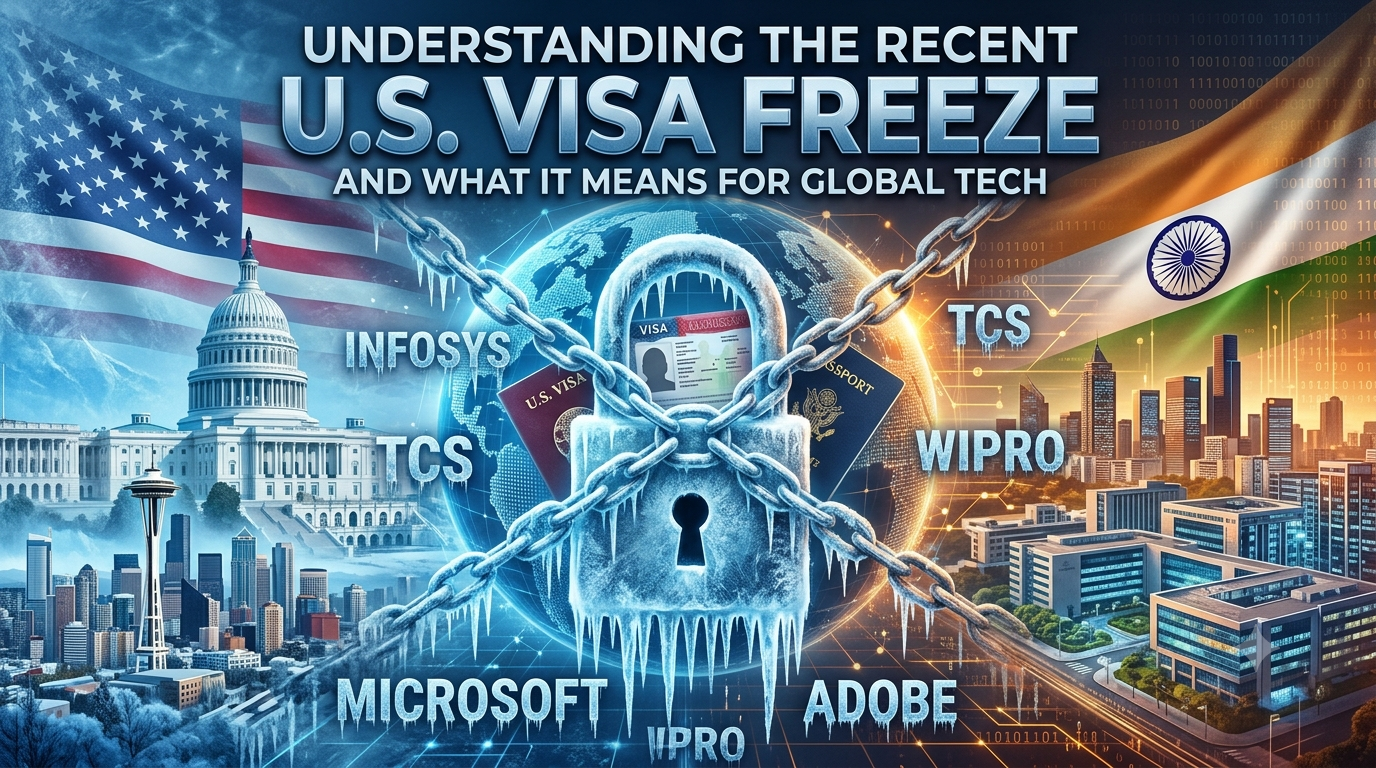
Recently, the U.S. government announced a sudden pause on the permanent residency (Green Card) process for employees of several major tech companies. This list includes well-known Indian firms like TCS, Infosys, and Wipro, alongside major American corporations like Microsoft and Adobe. This decision has created significant uncertainty for thousands of tech professionals and disrupted a business model that has been in place for decades.
The Stated Reason: Protecting Local Jobs
Publicly, U.S. officials state that this decision is meant to protect American jobs, particularly as the country approaches mid-term elections. The government argues that companies are over-relying on foreign labor, which they claim takes opportunities and fair wages away from local citizens. By freezing these visa processes, politicians hope to show voters that they are standing up for the American working class.
The Hidden Reason: Global Trade and Data
Behind the scenes, the freeze is largely a tool for international negotiation. Because American companies like Microsoft are also included, it is clear the goal is not just to stop Indian outsourcing. The U.S. is using this visa pause to pressure the Indian government into making trade concessions.
Specifically, the U.S. wants India to:
Lower import taxes on American goods, such as medical devices and agricultural products.
Allow American companies free access to Indian digital data instead of keeping that data stored strictly within India.
The U.S. hopes that by making things difficult for Indian tech workers, India will agree to these trade and data demands.
How the Strategy Could Backfire
While the U.S. government sees this as a strong negotiating tactic, it may actually harm the American economy in three key ways:
Failure of Older Tech Systems: Many vital U.S. sectors, like banking and healthcare, run on outdated computer systems. Indian engineers are usually the ones maintaining these networks. Since young American developers generally prefer working on new technologies like Artificial Intelligence, removing foreign talent could leave these essential systems without anyone to fix them.
Companies Moving Overseas: American companies are unlikely to absorb the massive cost of hiring local workers for every role. Instead of keeping jobs in the U.S., they will likely open large operational centers in cities like Bengaluru and Hyderabad.
The Push Toward AI: Because sending human workers to the U.S. is becoming too difficult, global IT companies will invest heavily in artificial intelligence to do the work remotely. This means a significant amount of tech innovation and revenue will move away from the U.S. to other parts of the world.
India’s Potential Response
Rather than requesting the U.S. to lift the ban, India has several strong options to manage this situation and benefit its own economy:
Equal Restrictions: India can link talent movement to market access. If Indian engineers are blocked from working in the U.S., India could place similar taxes or restrictions on major American tech companies operating within its borders.
Welcoming Talent Home: This is an opportunity for a “reverse brain drain.” The Indian government can offer tax breaks and funding to encourage these highly skilled engineers to return home. Once back, they can help build India’s domestic industries, such as space technology, semiconductor manufacturing, and defense.
Leveraging Consumer Power: With a population of 1.5 billion, India is one of the most important consumer markets in the world. No global company can afford to lose access to it. India can use this massive market size as leverage, making it clear that foreign companies can only access Indian consumers if they treat Indian workers fairly.
By strategically responding to these visa restrictions, India can use the situation to strengthen its own technology sector and become more self-reliant on the global stage.