




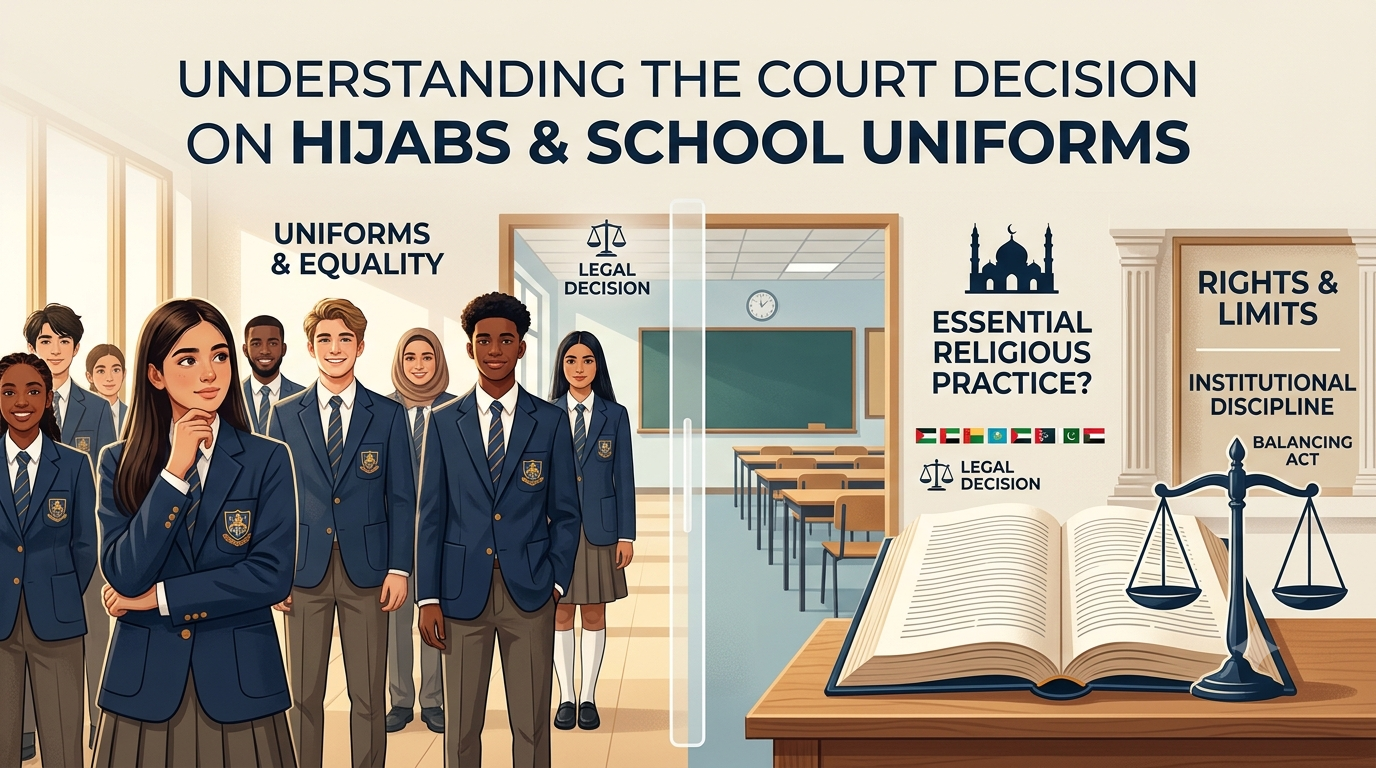
Recently, the Allahabad High Court made a significant ruling regarding what students are allowed to wear in educational institutions. The situation began when a student was not permitted to wear a hijab to school because it went against the institution’s strict uniform policy. The student took the matter to court, arguing that this rule violated her basic constitutional rights to personal expression and religious freedom.
However, the court ultimately sided with the school, deciding that institutional dress codes must be followed equally by everyone.
Why the Court Made This Choice
The judges based their decision on a few simple but powerful legal principles:
The Purpose of Uniforms: The court highlighted that uniforms exist to create a sense of equality and discipline. A shared dress code keeps the school environment neutral and focused purely on education rather than personal differences.
Core Religious Practices: In Indian law, courts use a specific test to determine if a tradition is an absolute, unavoidable requirement of a religion. The court concluded that, legally speaking, wearing a hijab did not meet the strict definition of an “essential religious practice.”
Rights Have Limits: The judges noted that while citizens have a right to practice their religion freely, these rights are not absolute. Schools are legally allowed to enforce fair, non-discriminatory rules that maintain order and institutional identity.
No Exceptions for Individuals: A student cannot independently decide to change or ignore a school’s official dress code.
A Familiar Legal Pattern
This is not the first time Indian courts have dealt with this complex topic:
In 2022, a court in Karnataka made an almost identical decision regarding school uniforms.
When the Karnataka case reached the Supreme Court, the judges were divided in their opinions. This means there is still no single, final rule for the entire country.
Other regional courts, like those in Kerala and Bombay, have also supported the right of schools to mandate specific uniforms.
The Larger Balancing Act
This ruling represents a much bigger conversation happening across the country. It highlights how difficult it is to perfectly balance a person’s right to express their individual religious identity with an institution’s need to maintain a shared, secular space for all students.
How do you think educational institutions should best balance a student’s desire for personal expression with the need for a unified environment?