




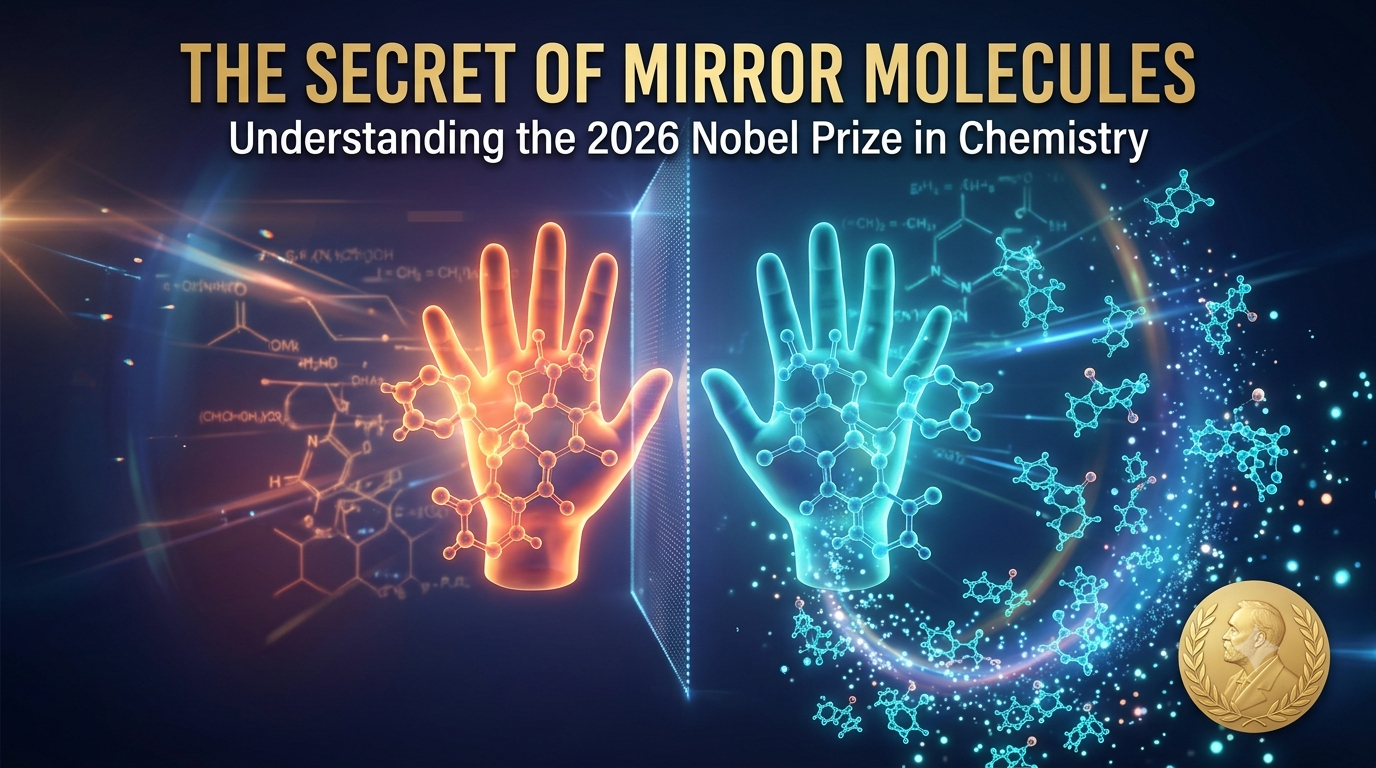
If you look at your hands, they seem identical. However, if you try to put a left-handed glove on your right hand, it just won’t fit. They are mirror images of each other.
In the world of science, the tiny building blocks of life—called molecules—work exactly the same way. This simple “left-hand, right-hand” concept is at the heart of the 2026 Nobel Prize in Chemistry, awarded to scientists Henri B. Kagan from France and Kenso Soai from Japan.
Here is a simple breakdown of what they discovered and why it is changing the world.
The Problem with Medicine
When scientists create medicines in a lab, the chemical process naturally produces a 50-50 mix of both “left-handed” and “right-handed” molecules.
The problem is that our human body is very picky. Our cells have “locks,” and medicine acts as the “key.” Usually, only one shape of the molecule fits the lock to heal us.
What happens to the other half of the medicine? Most of the time, the wrong molecule just wanders around doing nothing, which is a waste of money and resources. But sometimes, it can be very dangerous. In the 1960s, a medicine called Thalidomide was given to pregnant women. While one shape of the molecule helped with nausea, the mirror-image shape caused severe birth defects in babies.
For decades, separating the good molecules from the bad ones was extremely difficult, expensive, and wasteful.
The Nobel-Winning Solution
Henri B. Kagan and Kenso Soai won the Nobel Prize for figuring out how to force chemical reactions to make only the good molecules.
Henri B. Kagan found special methods to push the chemical reaction to favor one specific shape over the other.
Kenso Soai took it a step further by discovering an amazing trick. He found that if you put a little bit of the correct molecule into the mix, it acts like a tiny copy machine. It actually forces the chemicals to keep making perfect copies of itself.
Instead of getting a risky 50-50 mix, drug makers could now get nearly 100% of the exact, safe molecule they needed.
Why This is a Game-Changer
Their groundbreaking work is helping the world in three major ways:
Safer and Cheaper Medicines: Medicine factories (especially in countries like India, which makes a lot of the world’s drugs) can now make purer medicines. This means pills will have fewer side effects, cost less to make, and create less chemical waste.
Eco-Friendly Farming: The same science can be used to make farming chemicals and bug sprays. By using only the specific molecules that work, farmers can use way fewer chemicals, keeping our soil and water much cleaner.
Understanding How Life Began: For a long time, scientists were puzzled as to why humans, plants, and animals are all made entirely of just one shape of molecules. Kenso Soai’s “copy machine” discovery helps explain how early life on Earth might have accidentally chosen one molecule shape, which then copied itself to build all living things.
In short, by solving a tiny molecular puzzle, these two scientists have made our medicines safer, our environment cleaner, and helped answer one of the oldest mysteries of life itself.