

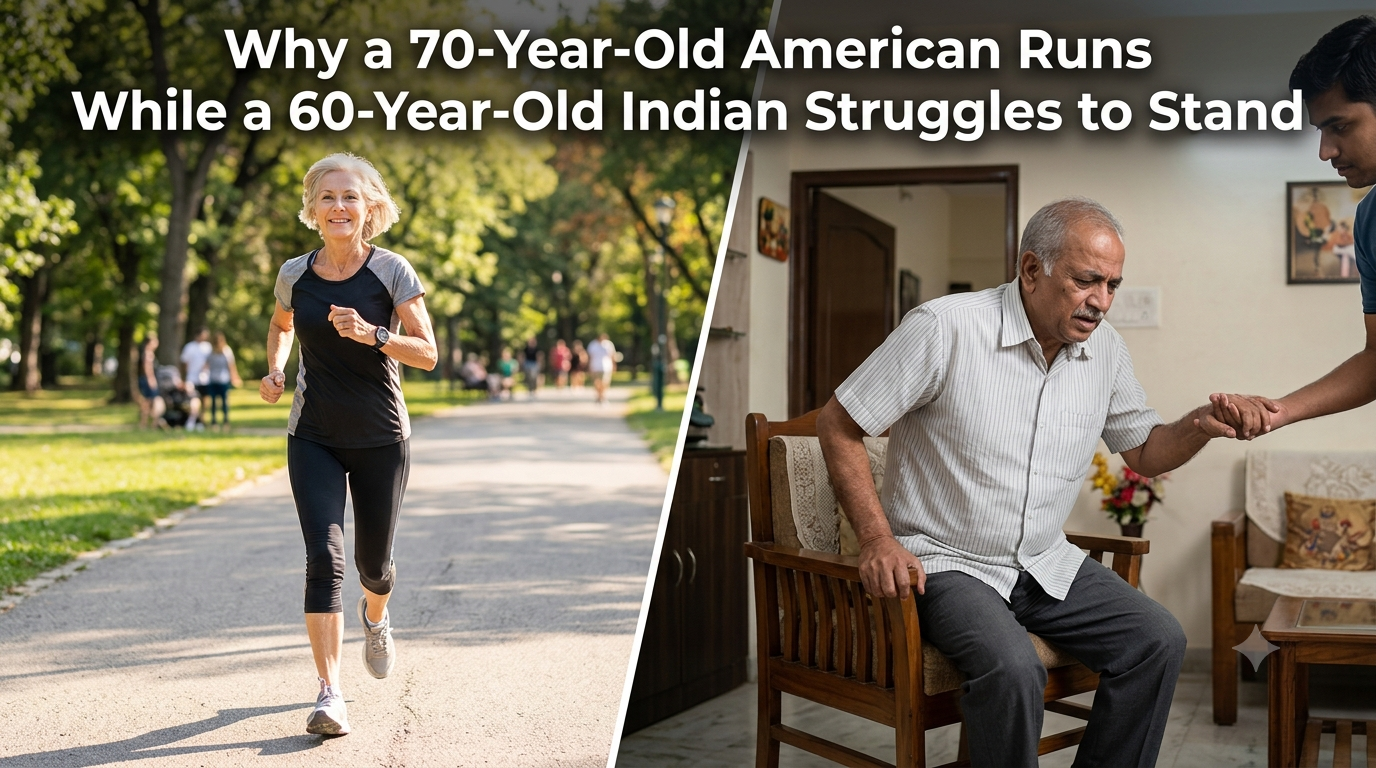
If you use social media, you have probably seen videos of 70-year-olds in Western countries running marathons or lifting heavy weights. But when we look around our own homes in India, the picture is often different. Many people start complaining about knee pain in their 60s, and by the time they are 70, they often need help just to stand up from a chair.
When we ask why this happens, we usually blame genetics or think foreigners just have “better genes.” At the same time, we believe our traditional diet full of milk and ghee is the healthiest in the world.
But is this really true? Let’s look at the facts.
Living Long vs. Living Well
The real test of health is not just how many years you live, but how many years you live without disease or needing help.
In countries like Japan and Singapore, people live on average into their early 80s, and they stay healthy and independent until they are about 73. In India, while the average lifespan is around 70, the average healthy, independent life stops at age 60. This means a lot of older Indians spend the last decade of their lives dealing with weakness and sickness.
The Truth About Our Strength
Health studies on older Indians show some worrying signs:
Overall Weakness: About 1 in 3 Indians over the age of 60 are medically considered physically weak or frail.
Weak Hands: A huge majority of older Indian men have very weak grip strength. Doctors worldwide use hand grip strength as a simple test to check how strong your whole body is.
Weak Bones: Bone density drops very fast in India, especially for women after they go through menopause.
Why Are We Becoming Weak?
If it isn’t our genetics, what is causing this? It comes down to our daily habits and four main reasons:
1. We ignore our bodies when we are young
The human body builds its maximum muscle and bone strength by the age of 30. Think of this as your body’s “savings account.” After 30, you slowly spend those savings. In India, people in their 20s are usually stressed about exams, getting jobs, and marriage. We don’t exercise to build our “savings,” so we enter old age with very little physical wealth.
2. We think “walking” is the only exercise
In our culture, a morning walk is considered the best form of fitness. Walking is fantastic for your heart, but it does not build muscle. To build muscle, you have to push or lift things (like lifting weights). When our elders try to lift something heavy, we immediately tell them to stop so they don’t get hurt. But science says older adults need to do strength training to keep their bones strong and prevent falls.
3. We eat farm-worker food but sit at desks
Milk, curd, and ghee are not bad foods. But we often forget that ghee provides pure energy (fat), not protein or calcium. Hundreds of years ago, our ancestors ate this diet because they worked in fields all day, walking for miles and doing hard physical labor. Today, we eat the exact same heavy food, but we spend our days sitting in chairs and cars. When you eat high energy food but don’t burn it, it just turns into body fat.
4. The “Love” that makes our elders weak
Culturally, we show respect to our elders by not letting them do any physical work. We tell them to sit back and relax while we do the chores. While this comes from a place of love, the human body works on a simple rule: “Use it or lose it.” By making our elders rest too much, we accidentally take away their strength. Add to this the fact that most Indians don’t eat enough protein or get enough sunlight (Vitamin D), and our muscles and bones have no building blocks to stay strong.
How to Change the Story
The good news is that muscles can be rebuilt at any age. Even an 80-year-old can get stronger with the right habits. Here is what we all need to do:
Lift and Push: Do not just walk. Add light weightlifting, use resistance bands, or practice sitting and standing from a chair to make your muscles work harder.
Eat More Protein: Ghee and wheat are not enough. Make sure every meal has good protein like dal, paneer, eggs, curd, or meat.
Get Checked: If you are over 50, especially if you are a woman, get your Vitamin D and bone strength checked by a doctor.
A country’s true health isn’t about people living to 100. It is about making sure people can spend their final 20 years standing strong on their own two feet. It is time to update our habits, eat for the lives we live today, and encourage our older generation to move more, not less