




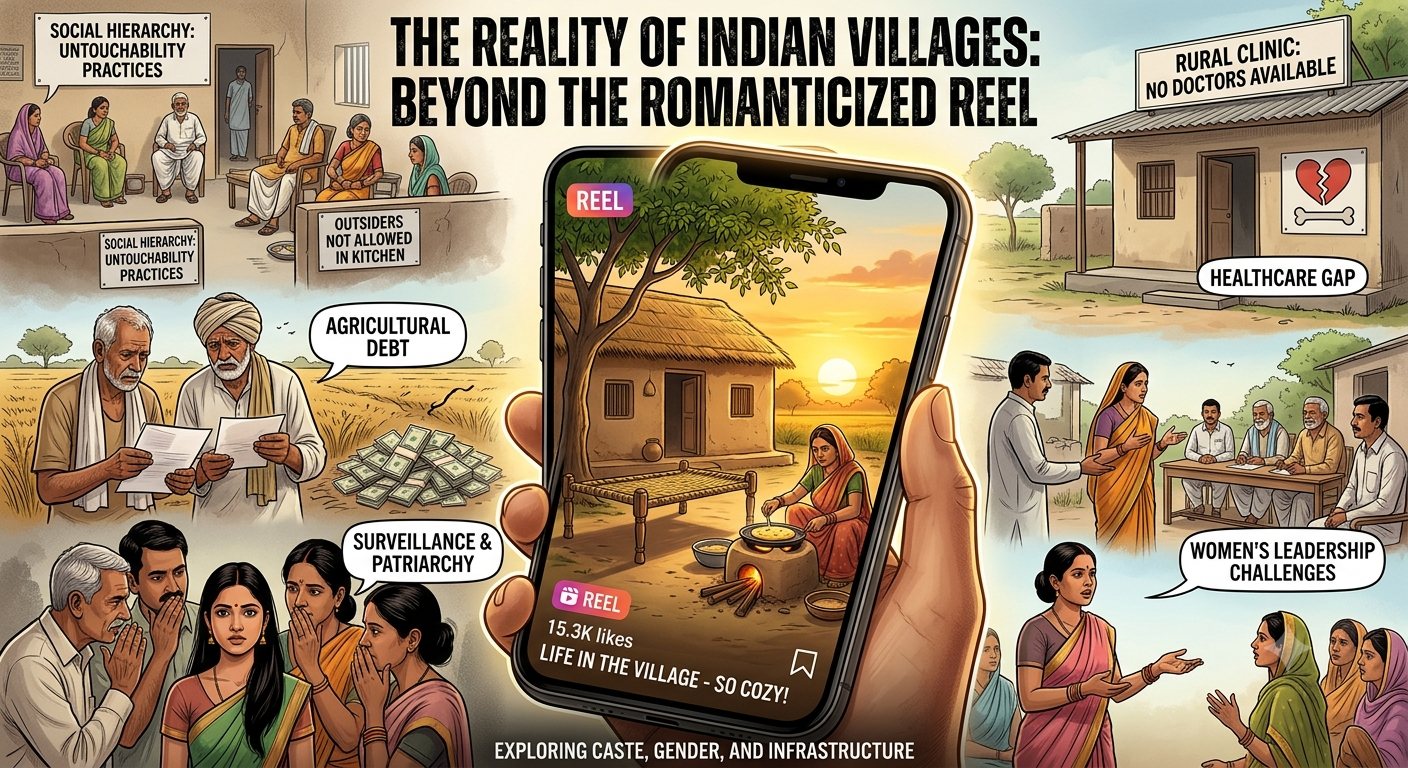
Imagine a tired office worker in a noisy, polluted city. After a long day of looking at screens, they check their phone and see a beautiful video of village life—a peaceful mud house, a big tree, home-cooked food, and a gorgeous sunset. The caption says, “This is the real life.”
Many of us watch these short videos and dream about moving to a village after retirement to live a quiet, simple life. But these videos hide a very uncomfortable question: If you lived in that village, which house would you belong to?
A village isn’t just a place with trees and fresh air. It is a strict social system. How much you enjoy village life depends entirely on your caste, your gender, and your social standing. Let’s look at the real facts that social media doesn’t show you.
The Truth About Caste and Equality
Many people think untouchability is a thing of the past, but data shows otherwise. A major survey found that 27% of homes in India still practice untouchability—meaning they don’t let people of certain lower castes enter their kitchens. In villages, this number is 30%.
The most surprising part is that this discrimination happens at every level. It is practiced by 52% of upper castes, but also by 33% of middle castes, and even 22% of lower castes against those they consider below them.
Education doesn’t fix this as much as we hope. About 29% of uneducated families practice it, compared to 23% of families with college degrees. A degree doesn’t erase the prejudice; it just makes people quieter about it. Years ago, Dr. B.R. Ambedkar rightly warned that villages can often be places of narrow-mindedness and deep inequality.
Life for Women: No Privacy and Unfair Rules
Village life can be especially hard for women. Surveys show that nearly one in three married women faces domestic violence.
The saddest part is how deeply accepted this is. When asked if a husband is allowed to beat his wife, 44% of men said yes. Shockingly, 45.4% of women also agreed. This shows that when you grow up in a strict, unfair system, you start believing its unfair rules.
On top of this, villages offer zero privacy. Everyone knows everyone. The constant fear of “What will people say?” acts like an invisible prison, especially for young girls whose every move is watched and judged by the community.
The Problem with Money and Hospitals
What about the dream of a cheap, peaceful retirement? The math doesn’t add up.
An average farming family makes only about ₹10,218 a month. In fact, many make more money doing random daily wage labor than from actual farming. Because of this, half of all farming families are trapped in debt.
Healthcare is another massive problem. Government data shows an 80% shortage of specialist doctors in rural areas. If you plan to retire to a village at age 60, you are moving to a place where heart doctors and bone specialists are almost impossible to find. If there is a medical emergency in the middle of the night, a good hospital might be hours away.
It’s Not All Bad: Villages Are Changing
To be fair, villages are not terrible places, and cities are not perfect either. (In fact, 20% of city homes still practice untouchability—they just hide it better). Millions of people live happily in villages, raising families and working hard.
Villages are also improving. Child marriage is going down. Today, 44% of elected village leaders are women. This is better than many rich countries! When women lead, villages see better roads, cleaner water, and better schools. Even though some husbands still try to control their elected wives’ work, real change is happening.
What to Do If You Still Want to Move
If you still want to move to a village, here are five simple pieces of advice:
Test the Waters: Don’t just visit during good weather. Try living there for three months during the hot summer or heavy rains. And find out exactly how far the nearest good hospital is.
Be Helpful: Don’t just go there to relax. Use your savings, your skills, and your education to help improve the village.
Start Equality at Home: Make sure you treat everyone equally in your own house. Don’t use separate cups or plates for workers.
Respect Female Leaders: If a woman is the head of your village, speak directly to her about local issues, not to her husband.
Look Past the Screen: Next time you see a beautiful village video online, remember that the sunset is real, but so are the struggles.
It is easy to love a village when you have a safe city job and a way to leave whenever you want. But for the people who are born there and cannot leave, the village is not a vacation spot—it is their real, everyday life.