




Think back to 13 years ago when the video game Grand Theft Auto V (GTA 5) first came out. Back then, most people in India didn’t have smartphones, and the internet was very expensive. Today, India has completely transformed. We have the cheapest internet and the highest number of internet users in the world.
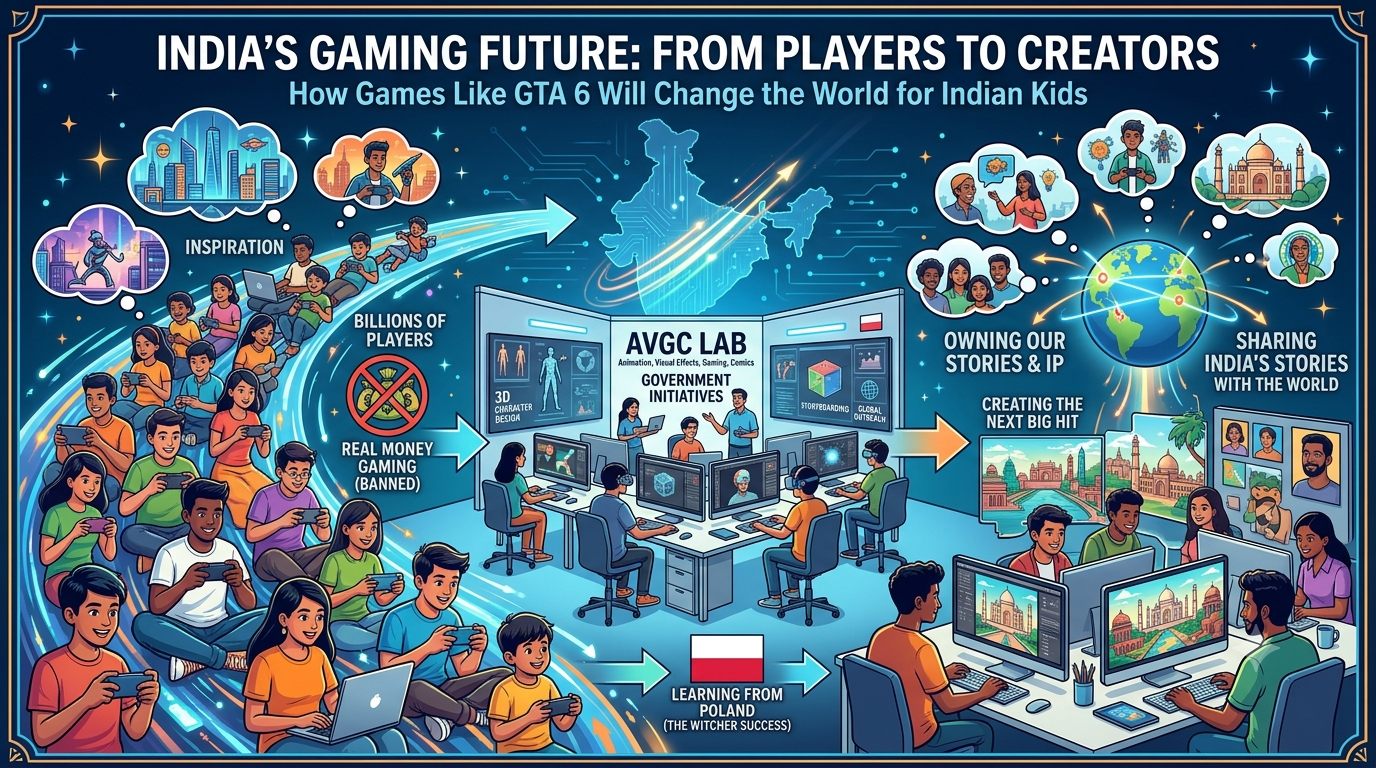
In that same time, GTA 5 became one of the most successful entertainment products in history, making billions of dollars. But even though Indians love playing games—making up a huge portion of the world’s gamers—our share of the money made from these games is almost zero. We are consumers, not creators.
With the highly anticipated GTA 6 coming in 2026, it’s time to ask: How will this change the future for Indian kids, and can India start making its own world-class games?
More Than Just a Game
When a game like GTA becomes popular, it doesn’t just make money; it spreads culture. In GTA 5, players spend hundreds of hours in a virtual city based on Los Angeles. Many young Indians know the streets, music, and culture of that digital American city better than they know other cities in their own country.
This is known as “soft power.” It is a way for a country to share its culture with the rest of the world. GTA 6 is expected to cost over $1 billion to make. That is more money than the entire economy of some small countries! It shows that gaming is no longer just a hobby for kids; it is a massive global industry.
Why is India Left Behind?
India has over 500 million gamers. Out of all the gamers in the world, about 18% are Indian. However, India only earns about 1% of the world’s gaming money. Why is there such a huge gap?
There are three main reasons:
We work for others: Indian tech workers are very talented. They help build art and designs for some of the biggest games in the world. But because they work for foreign companies, India doesn’t own the final product or the brand name, which is where the real money is.
We focus on mobile phones: Most Indians play games on their mobile phones. Mobile games usually don’t make as much money per player as big computer or console games do, so investors are scared to spend millions of dollars on a big Indian game.
The focus on betting apps: For a long time, the brightest minds in India’s gaming industry were not making adventure games. Instead, they were building apps for poker, rummy, and fantasy sports because that is where the easy money was.
A Big Change in 2025
Everything started to change when the Indian government passed a new law in 2025 that banned “real-money” betting and gambling games.
While this caused betting companies to lose a lot of money, it forced the industry to change directions. Now, instead of making gambling apps, talented Indian creators are finally focusing on making real video games. We are already seeing new, high-quality games being made that are based on Indian cities and stories.
Learning from Poland
If India wants to succeed, we can look at the small country of Poland. Poland has a much smaller population than India, but they created The Witcher, a game series loved all over the world.
Poland is so proud of their gaming industry that their Prime Minister even gave a copy of the game to the US President as an official gift. They also added a video game to their schools’ required reading lists. Poland used gaming to share its local stories with the world.
India has thousands of years of history, beautiful ancient cities, and diverse cultures. Yet, we have never seen a major global video game let players explore a detailed, virtual Indian city. We have a massive opportunity to share our culture with the world through games.
Looking to the Future
When GTA 6 comes out, it will be so advanced that it will raise the expectations of Indian kids. They will no longer settle for low-quality games.
While millions will simply play the game for fun, a few curious kids will stop and ask, “Who built this? Why can’t we build something like this in India?”
The good news is that the future is bright. The government is starting to fund special gaming and technology labs in schools and colleges across the country. The kids who get to use these computers today will be the game creators of tomorrow.
In the future, the goal isn’t just to see how many games Indian kids can play. The real success will be when kids all over the world are spending their time exploring beautiful, virtual cities created right here in India.