




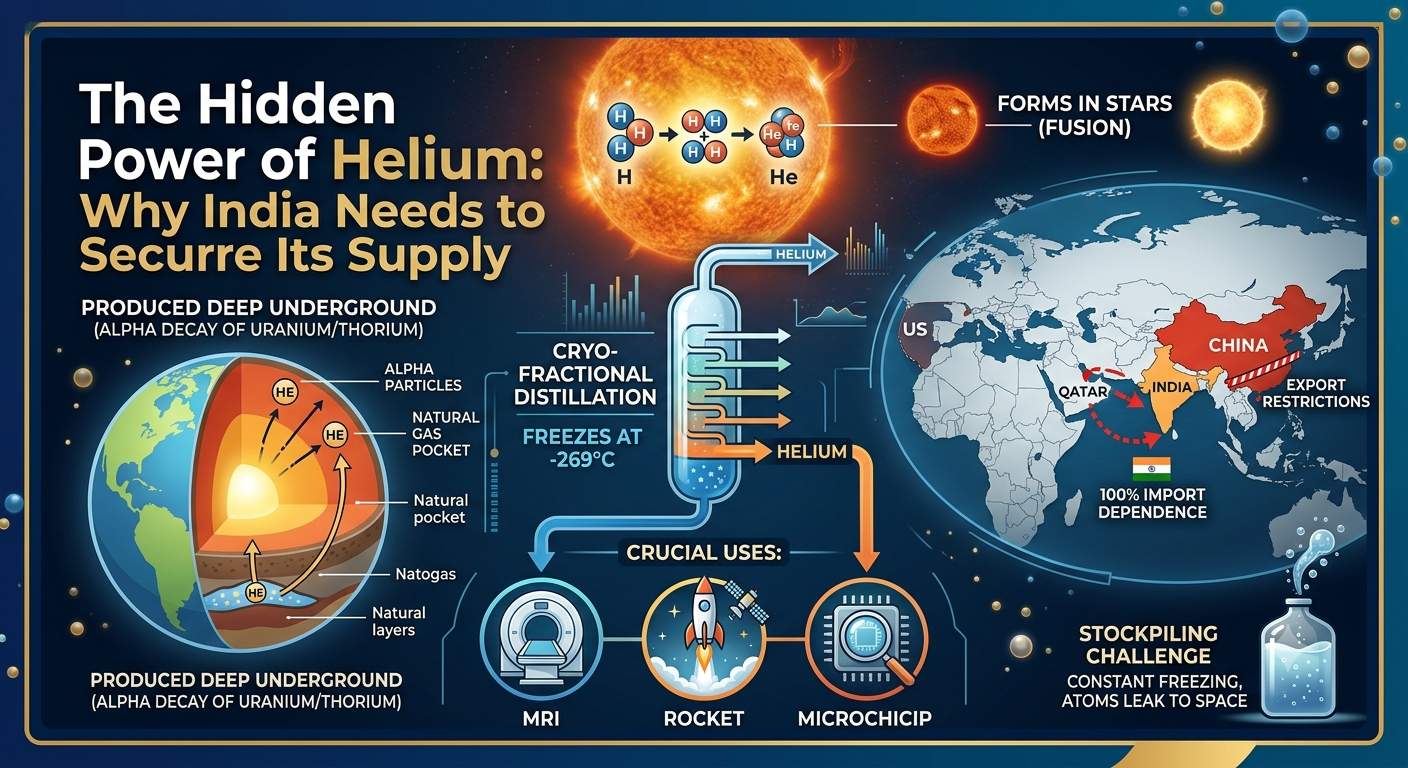
When we think of helium, we usually picture floating party balloons. However, in today’s high-tech world, this gas has become an incredibly valuable and irreplaceable resource.
What Makes Helium So Unique?
Helium belongs to a group called “noble gases,” meaning it is highly stable and does not easily react with other chemicals. It also has a few rare “superpowers”:
It stays colder than almost anything else: Helium has the lowest boiling point of any element (around -269°C), allowing it to stay liquid at unimaginably freezing temperatures.
It won’t explode: Because it is completely unreactive, it can be safely used around highly combustible materials.
It absorbs heat: It is excellent at soaking up and moving heat away from sensitive equipment.
It is incredibly tiny: Helium atoms are so small that they can slip through microscopic cracks, making the gas perfect for finding tiny leaks in industrial pipes.
Where Do We Use It?
Because of these unique traits, modern technology heavily relies on helium:
Space Missions: Space agencies like ISRO and NASA use it to keep highly explosive rocket fuels stable and pressurized.
Hospitals: The lifesaving MRI machines in hospitals use powerful magnets that only work when super-cooled by liquid helium.
Everyday Electronics: The tiny microchips inside your smartphone and computer require helium during the manufacturing process.
The Supply Problem
Even though helium is created in the stars, the helium we use on Earth comes from deep underground. It is slowly released by decaying radioactive rocks and gets trapped in natural gas pockets. Separating helium from natural gas is a highly expensive and complicated process that requires freezing the gas to extreme temperatures.
India’s Helium Crisis
Right now, India faces a major challenge: we import 100% of our helium, primarily from Qatar. While there are tiny traces of helium in places like Jharkhand and West Bengal, the amounts are too small to extract affordably.
You might wonder, why not just buy a lot and store it for emergencies? Unfortunately, hoarding helium is nearly impossible. Keeping it liquid requires massive amounts of money and energy to maintain the freezing temperatures. Plus, because the atoms are so small, helium easily leaks out of containers and floats straight into space—meaning you either use it immediately or lose it forever.
The Road Ahead
The global helium supply is tight. The United States and Qatar control most of the market, China has restricted its exports to protect its own tech industries, and tensions in the Middle East often delay shipments.
To protect its technological future, India must act quickly. The country needs to invest heavily in advanced technologies to affordably extract helium from its own natural gas reserves. As artificial intelligence and advanced electronics grow, the demand for helium will only skyrocket.
Do you think India should heavily subsidize local companies to develop deep-earth extraction technologies, even if it is incredibly expensive in the short term?