



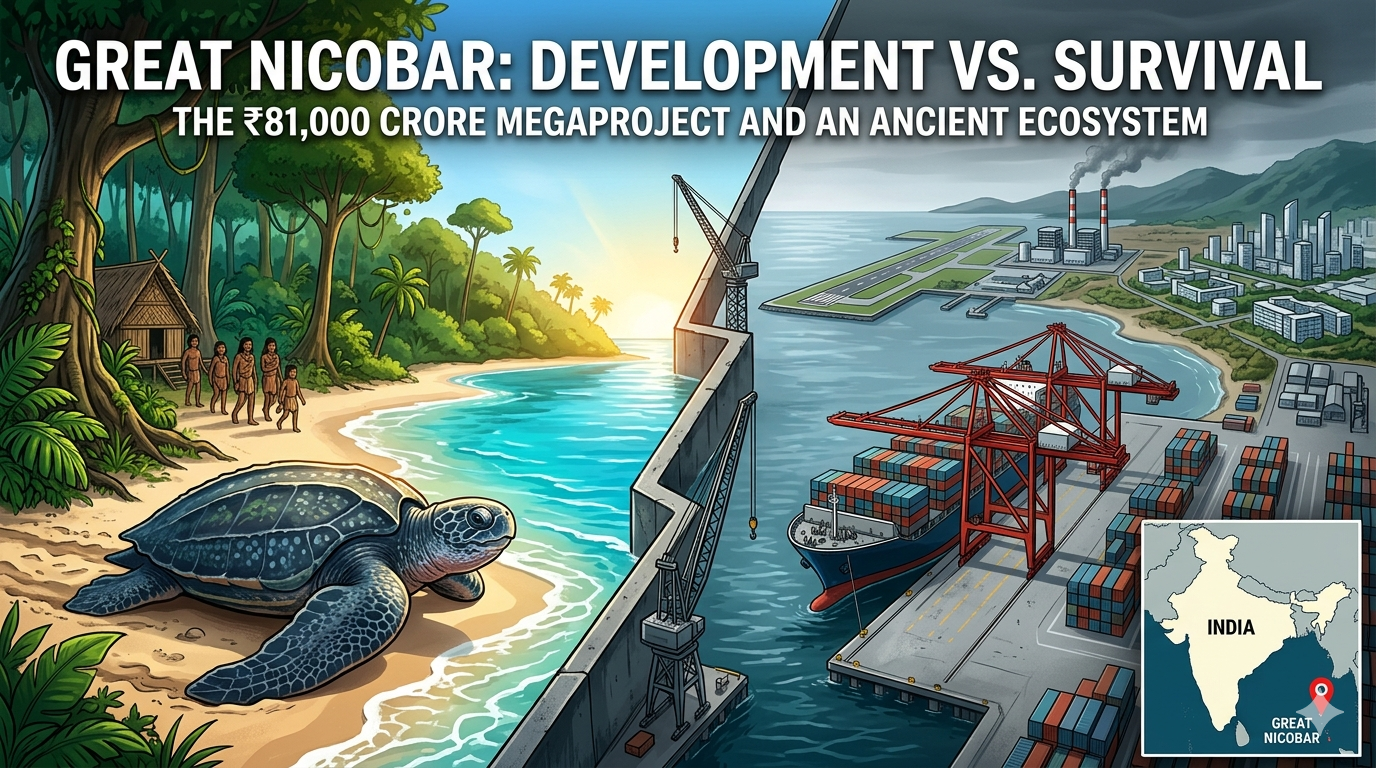
Situated at the southernmost tip of India, the Great Nicobar Island is celebrated as a UNESCO Biosphere Reserve, housing ancient rainforests, rare wildlife, and highly isolated indigenous groups. However, a massive ₹81,000 crore infrastructure proposal has sparked intense national and international debate. While championed by authorities as a vital national security measure, critics argue the development masks severe environmental degradation, procedural irregularities, and heavy commercialization.
Here is an overview of the proposed development and the primary concerns raised by environmentalists, scientists, and strategic analysts.
Scope of the ₹81,000 Crore Initiative
The ambitious blueprint aims to radically transform a significant portion of the island. Its four primary pillars include:
An international transshipment terminal for cargo.
A dual-purpose airport catering to both civilian and military needs.
A 450 MVA gas-based power plant.
A massive new urban township designed to accommodate between 350,000 and 650,000 new residents.
Authorities aim to have the initial phase of the project operational by 2028.
The Ecological and Demographic Cost
Spanning roughly 116 square kilometers, the project’s footprint overlaps with pristine, ecologically sensitive zones, prompting several major concerns:
Threats to Ancient Marine Life: The island’s Galathea Bay serves as one of the most critical global nesting sites for the Leatherback sea turtle. Development plans indicate that the bay’s natural opening will be drastically narrowed, potentially destroying up to 90% of the turtles’ nesting habitats.
Massive Deforestation: While official government estimates project the felling of around 7.11 lakh trees, independent environmental researchers warn the actual number could reach up to 10 million. The loss of these centuries-old tropical trees would severely disrupt local climate regulation and rainfall patterns.
Existential Risk to the Shompen Tribe: The island is home to the Shompen, a Particularly Vulnerable Tribal Group (PVTG) living in voluntary isolation. Global anthropologists and human rights experts warn that an influx of hundreds of thousands of outsiders will expose the tribe to novel pathogens, potentially leading to a demographic collapse.
Coral Reef Eradication: The construction threatens over 16,000 coral colonies. Though project planners have proposed transplanting these reefs, marine biologists widely dismiss coral relocation on this scale as an unproven and scientifically unfeasible strategy.
Evaluating the Strategic Justifications
To justify the immense environmental toll, the development is frequently marketed as a geopolitical necessity to counter regional rivals by monitoring or “choking” the Strait of Malacca. Analysts, however, point out several flaws in this narrative:
Geographic Disconnect: The actual narrow choke points of the Malacca Strait are situated near Malaysia and Singapore, hundreds of kilometers away from Great Nicobar, which sits in the expansive Andaman Sea.
Redundant Trade Routes: Even if the strait were somehow compromised, rival nations have spent decades securing alternative energy and trade routes, including the China-Pakistan Economic Corridor, overland routes through Central Asia, and direct pipelines via Myanmar.
Existing Military Infrastructure: The Indian Armed Forces already maintain a robust regional presence through the Andaman and Nicobar Command in Port Blair and the INS Baaz naval facility on Great Nicobar itself, making a commercial mega-port potentially redundant for basic surveillance.
Concerns Over Regulatory Processes
Critics and legal observers have highlighted multiple alleged irregularities in how the project received its environmental and administrative clearances:
Bypassing Indigenous Consent: Under Indian law, repurposing forest land requires the explicit consent of local tribal communities. Reports indicate that the local councils which approved the land diversion lacked any actual indigenous representation.
Rushed Environmental Assessments: Environmental Impact Assessments (EIAs), which typically require extensive, long-term field studies to gauge ecological consequences, were reportedly fast-tracked and completed in a matter of days, allegedly omitting critical negative forecasts.
Regulatory Rollbacks: To pave the way for construction, the Galathea Bay Wildlife Sanctuary was abruptly stripped of its protected status in 2021. Additionally, conservationists allege that official coastal maps were altered to hide the presence of coral reefs in the construction zones.
The Push for Tourism and Real Estate
With the geopolitical and security arguments facing scrutiny, many suspect the primary driver of the project is commercial gain. Project documents reveal that the vast majority of the diverted land is earmarked for a sprawling integrated township featuring luxury resorts, casinos, and entertainment hubs. Several major corporate entities and private port operators have already expressed interest in developing these lucrative facilities.
Summary
The Great Nicobar Project stands at the center of a fierce debate over India’s development priorities. While proponents see an opportunity for economic expansion and strategic posturing, opponents argue the country is trading irreplaceable biodiversity, ancient ecosystems, and the survival of vulnerable indigenous communities for questionable geopolitical leverage and private commercial real estate.