



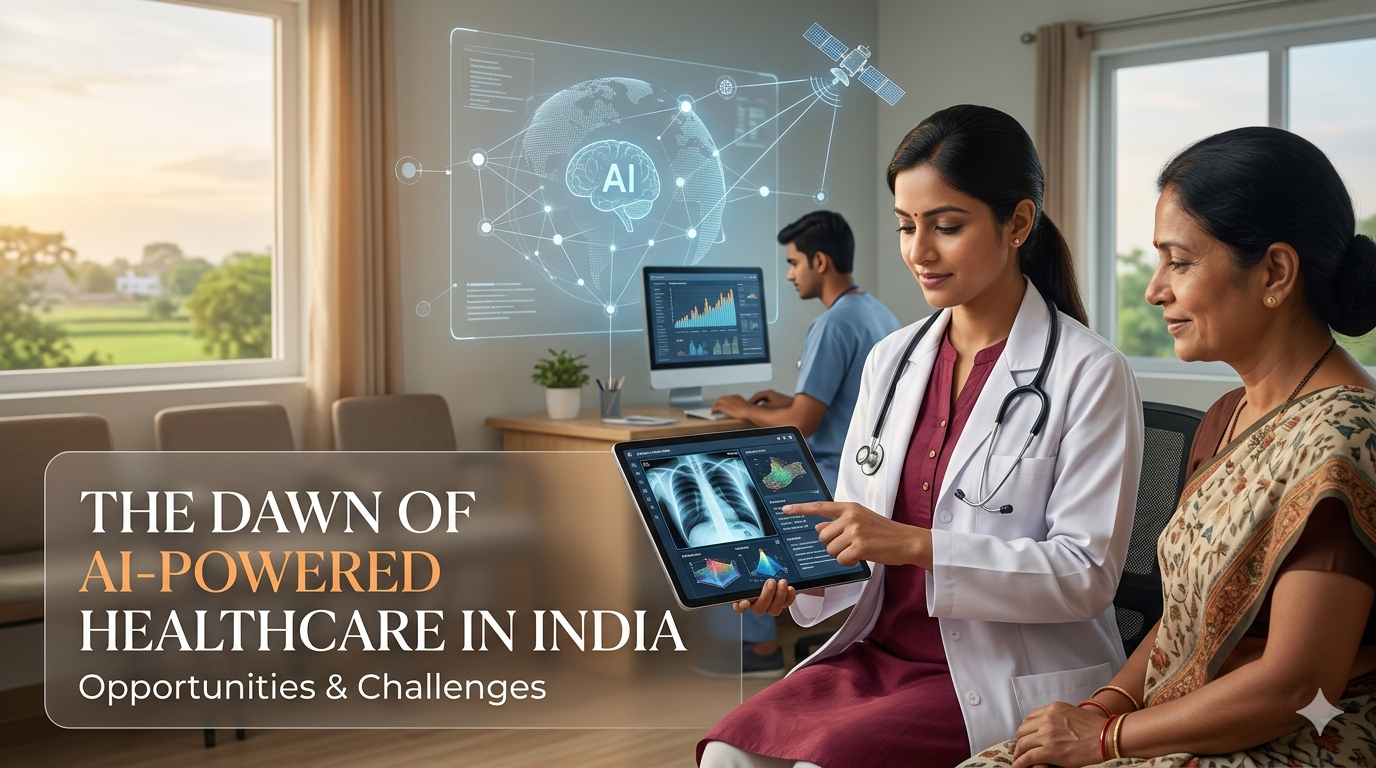
Artificial Intelligence is fundamentally shifting the global medical paradigm, moving the focus from treating existing illnesses to proactive prevention and early prediction. In India, this technological wave is proving to be a powerful equalizer, bringing advanced diagnostics and accessible care to remote and underserved populations.
Based on insights from global health experts and ongoing technological shifts, here is a look at how artificial intelligence is transforming the Indian medical ecosystem.
Setting a Strategic Foundation
When integrating a disruptive technology like AI, the immediate instinct is often to solve the most complicated medical mysteries. However, health policymakers and experts emphasize that AI’s greatest initial value lies in streamlining basic operational efficiencies. To guide this rollout, India has established specific strategic frameworks—often supported by global health bodies—to ensure AI is deployed responsibly and securely. The primary goal is to rely on gold-standard medical data, ensuring that the technology is implemented ethically across diverse state infrastructures before scaling up to complex diagnostic tasks.
Revolutionizing Remote Consultations
India’s massive push toward digital health and telemedicine platforms is already bridging the geographical divide. By reducing the need to travel long distances for medical consultations, telemedicine inadvertently acts as a climate-friendly intervention and greatly benefits demographics like rural women, who frequently neglect their own health due to logistical or domestic constraints.
When AI is layered onto these telemedicine platforms, it introduces powerful “triaging” capabilities. For instance, a frontline health worker in a remote village can upload a photo of a patient’s skin condition. An integrated AI system can analyze the image and instantly advise whether the condition can be treated locally with basic medication or if it requires urgent escalation to a specialized medical center.
The Risks of DIY Diagnoses
With the accessibility of consumer-facing AI chatbots, a concerning trend has emerged: individuals uploading their personal X-rays, lab results, and MRI scans for self-diagnosis. Health experts strongly advise against this practice for two critical reasons:
High Margin of Error: General-purpose AI models are prone to hallucinations and inaccuracies. In medicine, a minor misinterpretation can lead to severe health consequences.
Compromised Privacy: Feeding sensitive medical documents into public AI tools strips away patient confidentiality and exposes personal health data to third-party databases.
AI is designed to be a regulated co-pilot for trained medical professionals, not an autonomous digital doctor.
Navigating Data Privacy and Digital Fragmentation
AI’s lifeblood is high-quality data. To protect individuals, India utilizes a federated data architecture, meaning medical records are stored locally at the point of collection (such as a specific hospital) and ultimately belong to the patient. Stringent digital protection laws ensure that personal identifiers are scrubbed before any data is utilized for broader research.
Despite these protections, a significant operational hurdle remains: digital fragmentation. Currently, vast amounts of health data are trapped in isolated systems that cannot interact with one another. To build highly accurate, population-representative AI models, India needs to unify these siloed systems into a standardized, interoperable public digital infrastructure.
The Power of Grassroots Innovation
Much of the practical momentum in India’s health-tech space is being driven by its vibrant startup ecosystem. Innovative, often women-led tech companies are pioneering low-cost AI screening tools for conditions like cervical and breast cancer. Once proven effective in localized population studies—such as pilot programs in specific rural districts—these scalable solutions are being adopted by other state governments, proving that homegrown innovation can have a massive public health impact.
Adapting the Medical Workforce
A common fear is that AI will replace human medical staff, but the reality is one of augmentation. Just as the medical community adapted to the transition from paper charts to electronic health records, modern healthcare workers must develop digital competencies. Integrating foundational AI training into standard medical and nursing curricula will be essential, empowering practitioners to use these advanced tools safely and effectively.
The Future: Accessible and Affordable Screening
Perhaps the most exciting frontier for AI in healthcare is its potential to democratize disease screening. Historically, detecting conditions like breast cancer in rural areas required relying on basic physical examinations or traveling to access expensive, scarce mammography machines. Today, responsibly developed AI tools offer the promise of highly accurate, low-cost, and non-invasive screening alternatives.
Ultimately, the true success of AI in healthcare will not be measured by the sophistication of the code, but by its ability to make quality medical care fairer, safer, and universally accessible.