




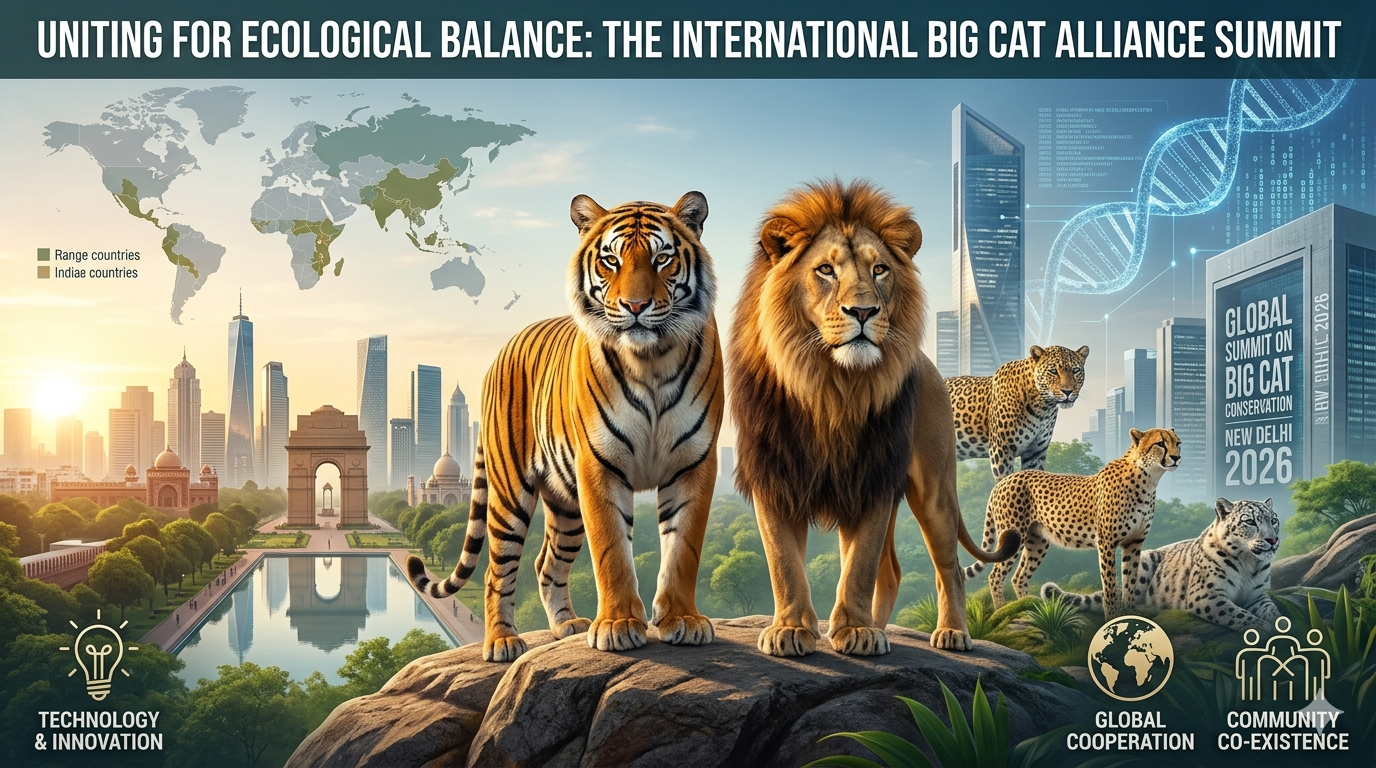
In a major step forward for global environmental cooperation, New Delhi is set to host the International Big Cat Alliance (IBCA) Summit on June 1 and 2, 2026. This gathering of global leaders, conservationists, and scientists represents a shift in how the world views wildlife preservation, moving from the simple protection of animals to the survival of entire ecosystems. The guiding philosophy of the summit is clear: protecting apex predators is essential to protecting humanity.
At a time when the planet faces severe climate shifts, habitat loss, and declining biodiversity, saving large wildlife is closely linked to securing forests, water resources, and a stable climate for future generations.
The Ecological Importance of Large Felines
The world’s seven major big cats—tigers, lions, leopards, snow leopards, cheetahs, jaguars, and pumas—are recognized as keystone species. Because they sit at the top of the food chain, their presence indicates a healthy, thriving environment.
Efforts to save these animals naturally require the preservation of vast natural landscapes. By protecting millions of square kilometers of habitat to support these felines, nations inadvertently protect the very forests and ecosystems that absorb carbon and help mitigate global warming.
The Host Nation’s Conservation Blueprint
India’s selection as the host for the 2026 summit highlights its distinct and highly successful approach to wildlife management. Despite having a dense human population and rapid economic development, the country has managed to foster a thriving environment for large predators.
Currently, India is home to approximately 70% of the world’s wild tigers and is the only nation where five of the seven big cats can be found in the wild—including the last remaining population of Asiatic lions.
This success is heavily rooted in a cultural ethos of co-existence rather than separation. For centuries, local and indigenous populations have lived alongside these animals. It is this active community involvement that has turned conservation from a mere government policy into a successful, grassroots reality.
Goals of the International Big Cat Alliance
First conceptualized by the Indian government, the IBCA seeks to unite 95 countries that naturally host these large felines. By creating a collaborative network, the alliance aims to achieve several key objectives:
Knowledge and Skill Sharing: Transferring decades of successful wildlife revival strategies and habitat management techniques to nations that may lack the resources or experience.
Technological Integration: Utilizing modern advancements such as artificial intelligence, drone surveillance, camera traps, and genetic mapping to monitor animal populations and prevent poaching.
Borderless Conservation: Wildlife naturally roams across political borders. The summit emphasizes transboundary cooperation to ensure safe migration corridors between neighboring countries.
Strengthening Legal Frameworks: Helping member nations develop and enforce robust environmental protection laws and judicial systems to defend wildlife.
A New Era of Environmental Diplomacy
The IBCA Summit represents more than just a meeting about wildlife; it is emerging as a powerful tool for environmental diplomacy. Supported by major global organizations, the alliance aims to become as influential as the international COP summits on climate change. By uniting nations under the common goal of protecting natural heritage, the IBCA proves that shared scientific knowledge and international cooperation are our best tools for securing a balanced and resilient planet.