




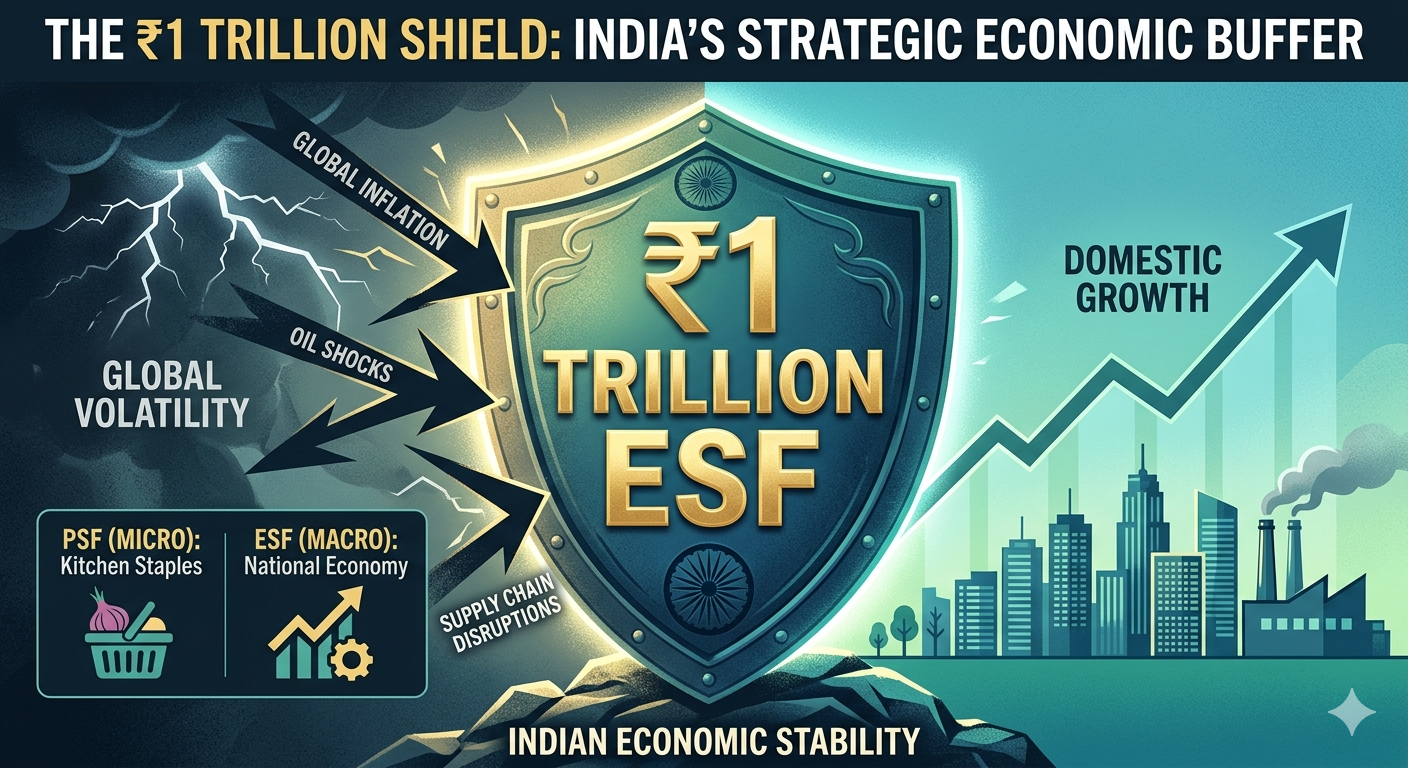
In a move to insulate the domestic economy from global turbulence, the Government of India has institutionalized a ₹1 Lakh Crore Economic Stabilisation Fund (ESF). Managed by the Department of Economic Affairs (DEA), this fund is not merely a budgetary allocation but a sophisticated “rainy-day” fiscal mechanism designed to provide the government with immediate liquidity during external crises without derailing fiscal deficit targets.
1. The Strategic “Why”: Navigating Global Headwinds
The ESF serves as a protective barrier against “imported” volatility. In 2026, several geopolitical and economic factors have made this buffer a necessity:
Energy Volatility: With crude oil prices periodically testing the $100 per barrel mark, the fund provides a cushion to absorb price shocks, preventing them from trickling down to transportation and manufacturing costs.
Supply Chain Resilience: In an era of regional conflicts (particularly in West Asia), global logistics are frequently disrupted. The ESF provides the capital necessary for emergency imports or the rapid development of alternative supply routes.
Remittance and Currency Stability: The fund helps manage the fallout from fluctuations in the $50 billion+ annual remittance inflow from the Middle East, ensuring the Indian Rupee remains resilient against a strengthening US Dollar.
2. Evolution of Policy: Micro vs. Macro Stability
India has historically managed price volatility at a micro-level, but the ESF represents a shift toward systemic, macro-level management.
Micro-Level Management (The Price Stabilisation Fund – PSF):
The existing PSF is a targeted tool used primarily by the Department of Consumer Affairs. It focuses on specific agricultural commodities—such as pulses, onions, and potatoes—using buffer stocks and interest-free loans to keep kitchen staples affordable for the average household.
Macro-Level Management (The Economic Stabilisation Fund – ESF):
The new ESF operates on a national scale. It is designed to safeguard the entire macroeconomic framework. Rather than managing the price of a single crop, it addresses systemic risks like global recessions, massive energy shortages, and “black swan” events. It uses high-impact fiscal tools, such as Capital Expenditure (CAPEX) stimulus and bank recapitalization, to keep the national growth engine running.
3. Operational Scenarios: How the Fund is Deployed
The government utilizes this ₹1 Trillion corpus through three specific “Counter-Cyclical” strategies:
Fiscal Headroom for Subsidies: When global fertilizer or fuel prices spike, the government can draw from the ESF to “subsidize the shock.” This prevents a massive surge in farming costs and protects food security without needing to immediately slash other vital department budgets.
Counter-Cyclical CAPEX: If a global slowdown causes private investment to retract, the government can deploy ESF capital into infrastructure projects. This creates jobs and maintains domestic demand, ensuring the economy doesn’t slip into a recessionary spiral.
Systemic Backstop: In cases of extreme financial stress where global liquidity dries up, the fund acts as an ultimate backstop. It can be used to recapitalize financial institutions (Banks and NBFCs), ensuring that the flow of credit to small and medium enterprises remains uninterrupted.
4. The Fiscal Tightrope: Discipline vs. Protection
A critical feature of the ESF is its Deficit Neutrality. For the 2025–26 fiscal year, India has set a fiscal deficit target of 4.4% of GDP. The government intends to fund the ESF through:
Supplementary Demands for Grants: A constitutional mechanism (Article 115) to seek additional funds for unforeseen expenses.
Increased Revenue Receipts: Leveraging higher-than-expected tax collections (estimated at an additional ₹80,000 crore) driven by robust economic growth.
By utilizing these “extra” receipts to fill the ESF, the government provides a massive economic stimulus while staying firmly on the path of fiscal consolidation.
Conclusion: A New Era of Economic Sovereignty
The establishment of the ESF signals a transition in India’s economic identity. By joining nations like Chile, Norway, and Russia in maintaining a stabilization reserve, India is moving from a “reactive” state—responding to crises as they happen—to a “preemptive” state, where the tools for recovery are built long before the crisis arrives.