




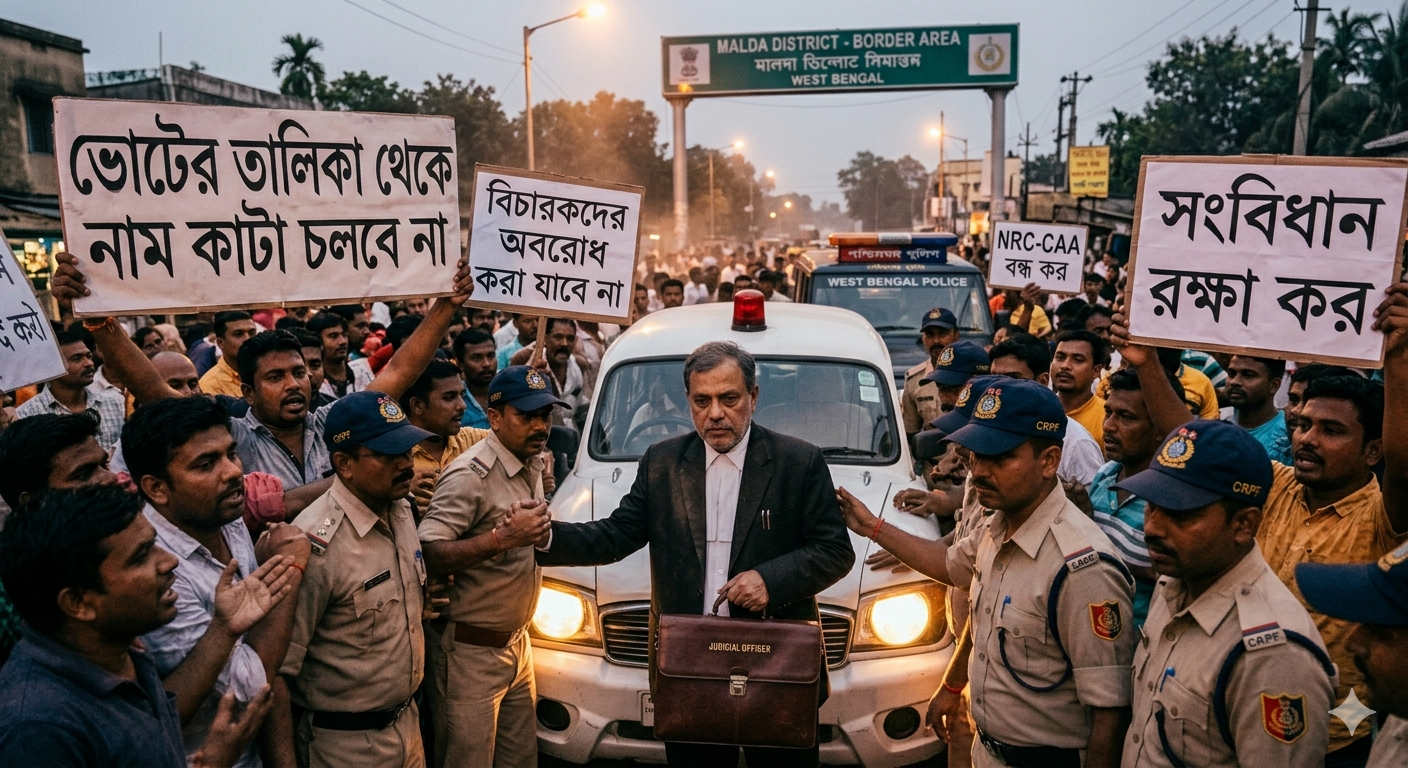
A robust law and order system is the bedrock of any functioning democracy. However, recent events in West Bengal have raised serious constitutional alarms. The Supreme Court of India recently directed sharp criticism at the Mamata Banerjee-led administration, pointing to a “complete breakdown of law and order” following a shocking incident involving the intimidation and confinement of judicial officers.
Here is a detailed breakdown of the controversy, the constitutional crisis it has sparked, and what it means for the state’s governance.
The Trigger: Electoral Roll Revisions in Malda
The roots of the current crisis lie in the Election Commission of India’s Special Intensive Revision (SIR) program. The primary goal of SIR is to ensure the accuracy of electoral rolls by removing the names of deceased individuals or non-citizens.
While the process was rolled out in multiple regions, it met with severe friction in West Bengal’s Malda district—a region that shares a significant border with Bangladesh. When reports surfaced that over 1.6 million names were marked for scrutiny and potential deletion, seven judicial officers were dispatched by the center to Malda to oversee the process, verify claims, and hear public objections.
Mob Intimidation and Delayed Police Action
What was meant to be a standard administrative and judicial process quickly spiraled into a socio-political nightmare. Upon arriving in Malda, the judicial officers were met by a massive, aggressive crowd protesting the voter list deletions.
The situation rapidly deteriorated as the mob surrounded the officers, preventing them from leaving. Reports indicate that these public servants were virtually held hostage for eight to nine hours. What was most alarming, however, was the delayed response from the state police. Law and order is fundamentally a state subject, yet local police failed to intervene promptly. It wasn’t until late at night that the officers were finally rescued with the assistance of the Central Armed Police Forces (CAPF).
The Political Narrative: A “Backdoor NRC”?
The administrative friction was heavily fueled by ongoing political tensions. The ruling state government had already been publicly criticizing the SIR process, alleging that it was a covert attempt to implement the National Register of Citizens (NRC) through the back door. They claimed the exercise was designed to specifically target and exclude a particular community.
This rhetoric fostered deep suspicion and fear among the local populace. The opposition, on the other hand, argued that the state’s politically charged narrative was the direct catalyst for the mob violence, claiming that clear communication could have prevented the chaos.
The Supreme Court Steps In
Taking suo motu cognizance of the harrowing episode, the Supreme Court of India intervened with forceful remarks. The Apex Court categorized the situation as a glaring failure of the state machinery.
While holding off on immediate disciplinary action, the Court issued formal notices to the state’s Chief Secretary, the Director General of Police (DGP), and local district authorities. The Court questioned how judicial officers—who are extensions of the judiciary itself—were left unprotected in a volatile environment.
The Supreme Court highlighted several constitutional violations:
Threat to the Rule of Law: Allowing a mob to dictate terms is a slide toward “mobocracy,” completely undermining the rule of law.
Article 21 Violations: The state failed its positive obligation to protect the fundamental right to life and personal liberty of the officers.
Compromising Free and Fair Elections: The integrity of electoral rolls is a part of the Constitution’s basic structure. Disrupting this process threatens the very foundation of democratic elections.
Is President’s Rule on the Horizon?
The Supreme Court’s strong language regarding the failure of law and order has inevitably sparked debates about Article 356—the imposition of President’s Rule.
However, constitutional experts note that invoking Article 356 is a complex process. A single breakdown of law and order, while severe, does not automatically trigger the dismissal of a state government. President’s Rule typically requires a sustained failure of constitutional machinery—such as a state repeatedly refusing to comply with Supreme Court orders—backed by a formal report from the State Governor to the Central Government.
Conclusion
The Malda incident serves as a massive red flag for India’s institutional integrity. When administrative procedures are hijacked by political conspiracies and mob violence is allowed to overpower judicial officers, democratic institutions inevitably weaken. Moving forward, the focus will be on how the West Bengal administration answers the Supreme Court’s notices and what steps are taken to ensure that the sanctity of the electoral process—and the safety of those who uphold it—is maintained.