


In a move that has sent ripples through India’s non-profit sector, the proposed Foreign Contribution Regulation Act (FCRA) Amendment Bill of 2026 represents a fundamental pivot in how the state interacts with civil society. While previous regulations focused on the flow of money, the new bill introduces mechanisms for total institutional and asset control, sparking an intense debate over the balance between national security and democratic autonomy.
From Regulation to Institutional Control
Historically, the FCRA (first enacted in 1976) was designed to prevent foreign “interest” from influencing Indian politics. The 2010 and 2020 amendments progressively tightened these screws by banning the sub-granting of funds and mandating centralized bank accounts in New Delhi.
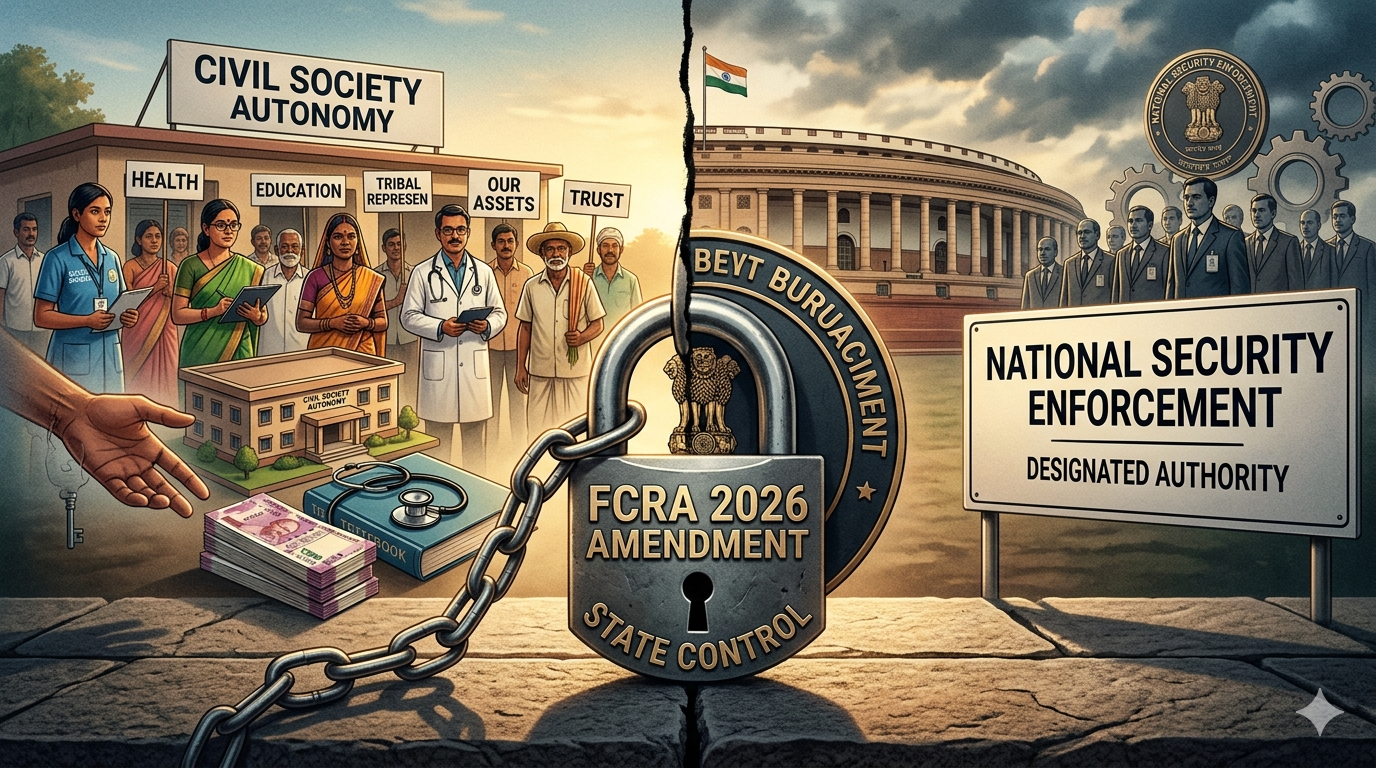
However, the 2026 Bill moves beyond financial oversight. It introduces a “Designated Authority”—a bureaucratic body with the power to manage, seize, and even transfer the assets of organizations deemed “inactive” or in violation of the law. This marks a shift from a compliance-based model to an enforcement-based model.
The Mechanics of the New Bill
The 2026 legislation introduces several “trigger conditions” that allow the state to intervene in an NGO’s operations:
The Inactivity Trigger: If an NGO fails to renew its license, surrenders it, or has its renewal rejected, its registration is deemed “inactive.”
Asset Takeover: Once inactive, the government-appointed authority can take control of the organization’s physical and financial assets, including land, buildings, and bank deposits.
Discretionary Disposal: Perhaps the most controversial clause is the power of the state to transfer seized assets to other entities or the public treasury. Crucially, the bill offers no absolute guarantee that assets will be returned, even if a court later clears the organization of wrongdoing.
Universal Application: The bill explicitly includes religious charities and institutions. While the state promises to respect the “religious nature” of these properties, the prospect of government management of religious assets has created significant political friction.
The Constitutional Tug-of-War
Legal scholars and civil rights activists have raised concerns that the Bill may conflict with several pillars of the Indian Constitution:
Freedom of Association (Article 19): Critics argue that by making the survival of an NGO dependent on broad bureaucratic discretion, the state is effectively eroding the fundamental right to form associations.
Due Process (Article 21): The power to seize property through administrative orders—rather than a judicial trial—is seen by many as a bypass of the established legal process.
Federalism: As the Union government centralizes all regulatory power, states argue they are being sidelined in the management of civil society within their own borders.
The State’s Rationale: Security in a Volatile World
The government justifies these stringent measures by citing a shifting global landscape. The primary arguments for the 2026 Amendment include:
Mitigating Strategic Risks: Authorities point to instances of foreign-funded movements causing internal instability in various nations as a reason to treat foreign funding as a potential security threat.
Financial Integrity: Ensuring that funds are not diverted toward money laundering, religious conversion agendas, or “anti-national” activism.
Global Precedents: India argues that its tightening of foreign-funding rules aligns with a growing international trend of nations protecting their domestic policy space from external interference.
The Economic and Social Fallout
With over 20,000 NGOs currently operating under FCRA licenses, the stakes are high. These organizations often fill critical gaps in healthcare, education, and disaster relief, particularly in remote tribal areas.
Opponents of the bill fear that the increased compliance burden and the threat of asset seizure will deter foreign donors and force smaller, grassroots NGOs to shut down. This could lead to a significant “service vacuum” in areas where the state’s reach is limited.
Conclusion
The 2026 FCRA Amendment Bill stands at the crossroads of two competing visions: one that views NGOs as vital partners in development requiring autonomy, and another that views them as potential conduits for foreign influence requiring strict state guardianship. As the Bill moves through the legislative process, the challenge for India will be to protect its national interests without stifling the vibrant, independent civil society that is a hallmark of any robust democracy.