




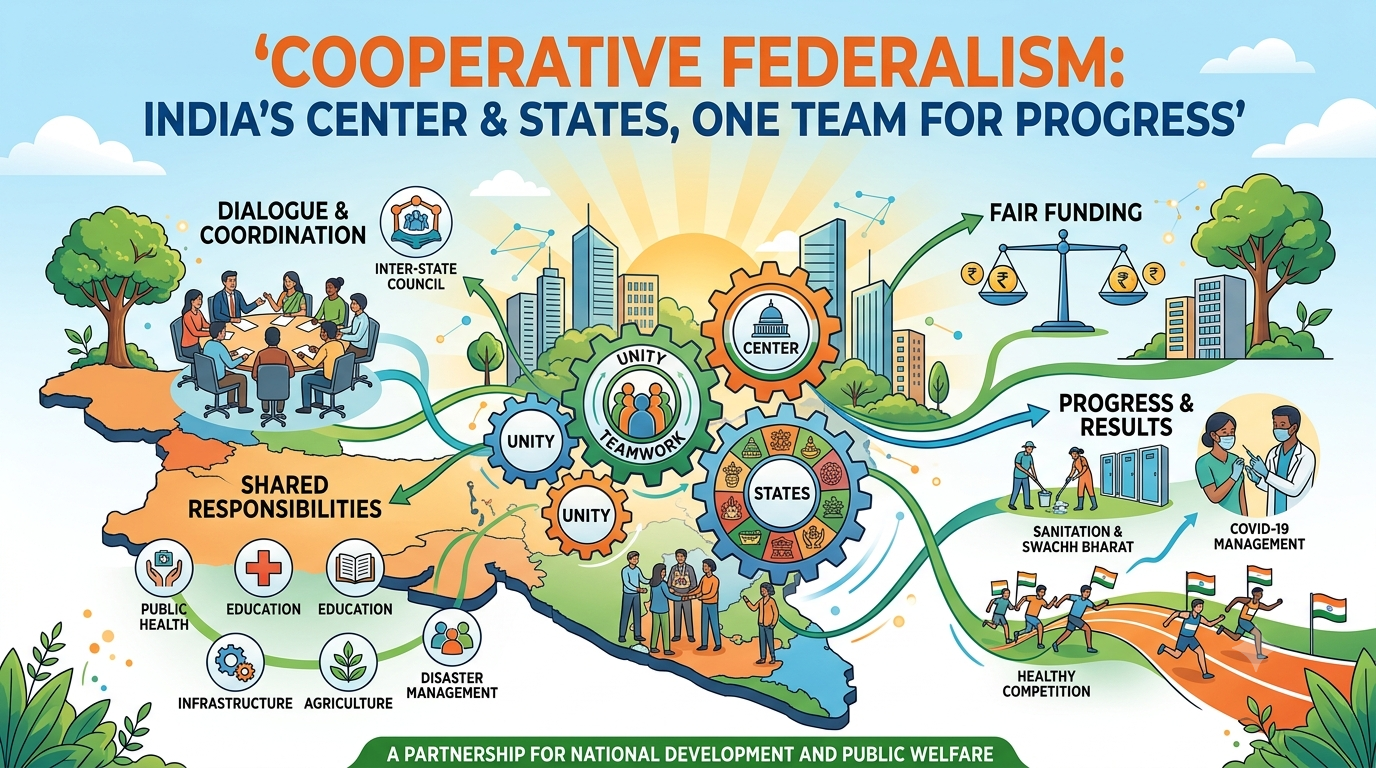
India is a massive country with diverse cultures, languages, and local needs. Because of this, a single central government in New Delhi cannot manage everything on its own. To run the country effectively, India uses a system called cooperative federalism. Simply put, this means the central (Union) government and the state governments work together as a team rather than fighting for power.
The Rulebook for Teamwork
The Indian Constitution acts as the ultimate rulebook to make sure this partnership works smoothly:
Sharing Responsibilities: The Constitution has clear lists that divide tasks. Some tasks belong to the center (like defense), some to the states (like local police), and some are shared (like education and forests), forcing both to work together.
Fair Money Sharing: The Constitution sets up a Finance Commission to ensure tax money is divided fairly between the central government and the states so everyone has enough funds to function.
A Space to Talk: It creates an Inter-State Council, which acts as a meeting room where central and state leaders can resolve disputes and plan policies together.
Changing the Rules: If a new law changes how power is shared, the central government cannot just force it through; a majority of the states must also agree to it.
Even the Supreme Court of India has stepped in during major legal cases to protect this system, ruling that this balanced partnership is a permanent part of India’s foundation that no government can erase.
Modern Tools for Collaboration
To bring this teamwork to life, India has set up a few key organizations:
The GST Council: This is the best modern example of government teamwork. Leaders from the center and every state sit down together to agree on the country’s tax rates. It ensures states still have a say in how money is collected.
NITI Aayog: This is a national planning group that replaced older, rigid systems. Instead of forcing one single plan on the whole country, it asks individual states what they need and helps them design tailored solutions.
Zonal Councils: These groups allow neighboring states to team up and solve shared regional problems, like border disputes or connecting transport routes.
Real-World Examples
When the center and states work together, massive national challenges become manageable:
Fighting COVID-19: During the pandemic, the central government secured vaccines and provided financial aid, while state governments took charge of local lockdowns, hospital management, and grassroots public health campaigns.
Education: Under the National Education Policy, the center provides the big-picture goals and funding, but states are given the freedom to teach children in local languages and adapt the curriculum to their own cultures.
Cleaning the Country: For the Swachh Bharat (Clean India) Mission, the central government provided the vision and the money. The states then took over, designing local campaigns and building sanitation facilities that fit their specific rural or urban needs.
Protecting the Environment: For massive projects like cleaning the Ganga River, the center sets the guidelines and pays the bills, while the states actually carry out the cleanup work on the ground.
Healthy Competition
While cooperation is vital, a little rivalry is also good. This is known as competitive federalism. State governments compete with one another to build the best roads, offer the fastest services, and create the easiest rules for starting a business.
This healthy competition encourages states to improve faster. When states try to outdo each other in attracting investors and creating jobs, the citizens win, and the entire country moves forward. Ultimately, balancing this friendly competition with deep cooperation is the secret to India’s growth.