




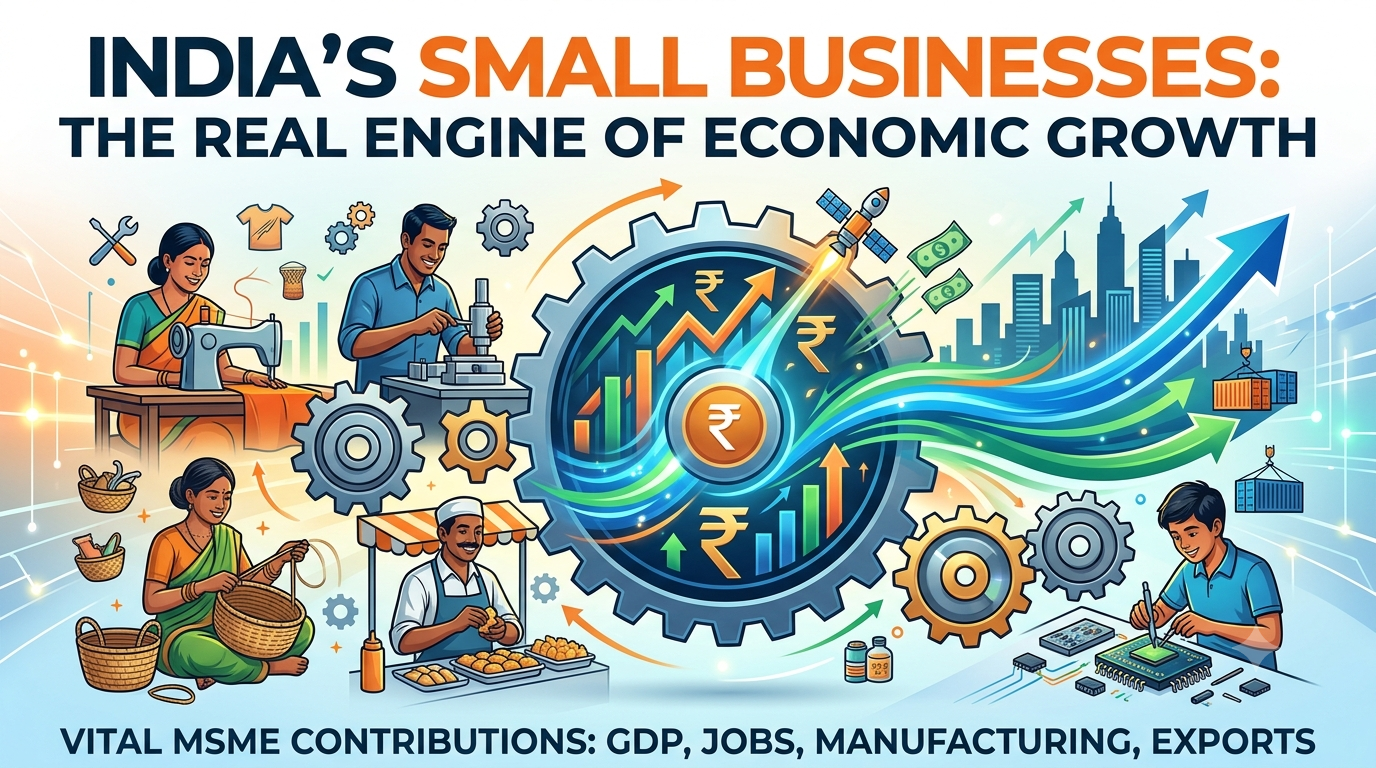
Small and medium businesses, known as MSMEs, are the true heroes of India’s economy. Recently, a parliamentary committee looked closely at this sector. They found that while giant corporations usually get the spotlight, it is the small workshops, local shops, and rural artisans that actually keep the country running and growing.
The Big Impact of Small Businesses
Heavy industries might seem powerful, but tiny local businesses carry the weight of the Indian economy. The committee highlighted several impressive facts:
Massive Job Creation: After farming, small businesses are the biggest employers in India, giving jobs to around 45 crore people.
National Wealth: They generate 31.1% of India’s GDP (national wealth) and create 35% of all manufactured goods in the country.
Global Reach: Small businesses produce over half (50% to 60%) of India’s total exports. They even manufactured vital parts for India’s successful Chandrayaan-3 moon mission.
High Numbers: Out of the 9.29 crore businesses registered on the government portal, almost all of them (9.23 crore) are very small “micro” industries.
The Need for a “Nano” Category
Right now, the government calls a business “micro” even if it has an investment of up to ₹2.5 crore. The committee pointed out a major flaw here. An ordinary village artisan, a local tailor, or a street-side food vendor usually only needs a loan of ₹2 lakh to ₹5 lakh. Putting them in the same group as someone with a ₹2.5 crore factory is unfair.
To fix this, the committee advised the government to create a special “Nano” category for tiny businesses that invest up to ₹10 lakh. The state of Kerala is already doing this successfully. This change would guarantee that financial help reaches the poorest people, like uneducated youth and rural women, who want to start their own small setups.
The Struggle to Get Bank Loans
The government has clear rules stating that poor, first-time business owners do not need to provide collateral (like land or property as a guarantee) for loans up to ₹10 lakh under certain schemes.
However, the committee found that banks are not following these rules. Bank officials regularly demand collateral from poor applicants who live in basic huts and have nothing to pledge. On top of that, getting a simple loan approved can take up to six months, causing endless frustration. The committee strongly urged banks to treat poor applicants with respect, guide them through the paperwork, and stop rejecting forms over minor mistakes.
Respect and Dignity for Workers
The committee also focused on the language used in government programs, like the PM Vishwakarma scheme. They noted that old, outdated terms for certain professions carry a social stigma. They recommended replacing these older terms with modern, dignified titles—for example, using “hairdresser” or “shoemaker” instead of the traditional caste-based or outdated labels. This simple change gives workers the respect and social dignity they deserve.
The Push for a Bigger Budget
Finally, the committee noted that the current MSME budget of ₹38,000 crore is simply not enough. More people are learning about government loan schemes and applying for them. As a result, even when loans are approved on paper, the actual money gets delayed because the government subsidies run dry.
For India to become economically stronger and tackle the problem of unemployment, the committee concluded that the government must increase funding for small businesses and force banks to actually deliver the money to the people who need it most.