




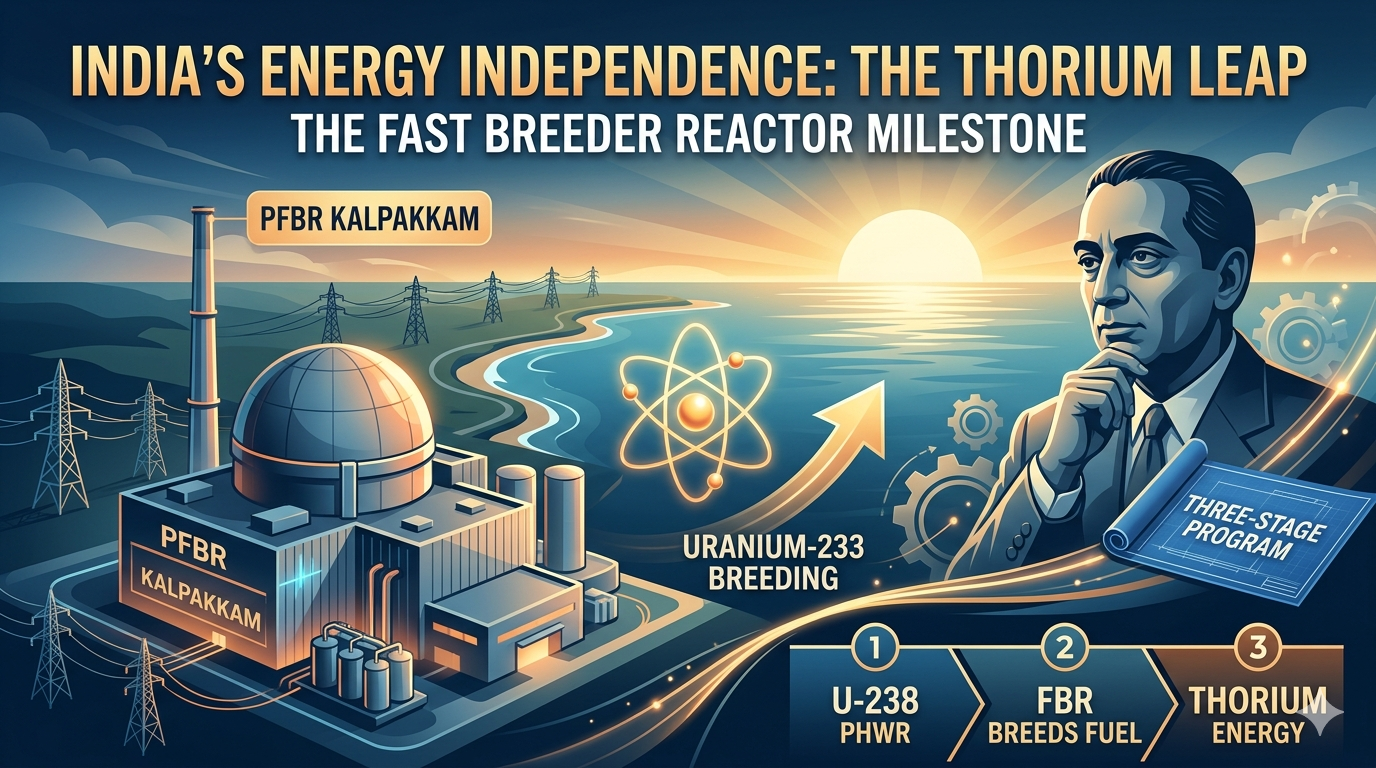
In a groundbreaking development for global power generation, a nuclear facility in India has achieved what sounds like a scientific paradox: generating more fuel than it actually burns. The 500-megawatt Prototype Fast Breeder Reactor located in Kalpakkam, Tamil Nadu, has successfully initiated a self-sustaining chain reaction, marking a massive leap in energy technology. With this achievement, India joins Russia as one of the only nations to successfully bring a fast breeder reactor to an operational stage.
The Resource Dilemma: Overcoming Uranium Scarcity
The driving force behind this decades-long innovation stems from a stark geographical reality. Historically, India’s pursuit of energy independence has been hindered by limited domestic supplies of conventional uranium. Relying purely on international imports leaves any nation vulnerable to supply chain disruptions and geopolitical shifts.
However, nature provided a powerful alternative. The country boasts some of the most abundant thorium deposits on the planet, estimated to be around 8.5 lakh tonnes. The scientific hurdle is that thorium cannot naturally sustain a nuclear reaction on its own; it requires a specific catalyst—namely, Uranium-233—to become a viable power source.
The Visionary Three-Tier Strategy
To solve this elemental puzzle, early scientific pioneers, led by Dr. Homi J. Bhabha in the 1940s, conceptualized a brilliant three-tier strategy to slowly transition the nation toward its domestic thorium wealth.
Phase 1: Establishing the Foundation
The journey begins with standard Pressurized Heavy Water Reactors. These facilities utilize naturally occurring Uranium-238 to generate basic electricity. Crucially, the byproduct of this conventional reaction is Plutonium-239.
Phase 2: The Breeder Breakthrough
The recent milestone in Kalpakkam represents the critical second phase of this master plan. The fast breeder reactor takes the plutonium generated in Phase 1 and utilizes it to produce power. Because of the unique physics of a “breeder” reactor, the operational process simultaneously converts surrounding materials into Uranium-233. It effectively breeds a surplus of entirely new nuclear fuel while keeping the lights on.
Phase 3: The Thorium Era
This brings us to the ultimate goal. The Uranium-233 “bred” during the second phase is exactly the catalyst needed to unlock thorium’s potential. In the final stage, this newly created uranium will be combined with the nation’s vast thorium reserves.
A Century-Defining Reality
By successfully executing the highly complex second phase of this blueprint, the path to a completely self-sufficient energy grid is clearer than ever. Decades after the initial framework was drafted by early visionaries, this operational milestone proves that a thorium-powered future is no longer just a theoretical concept—it is a rapidly approaching reality.