




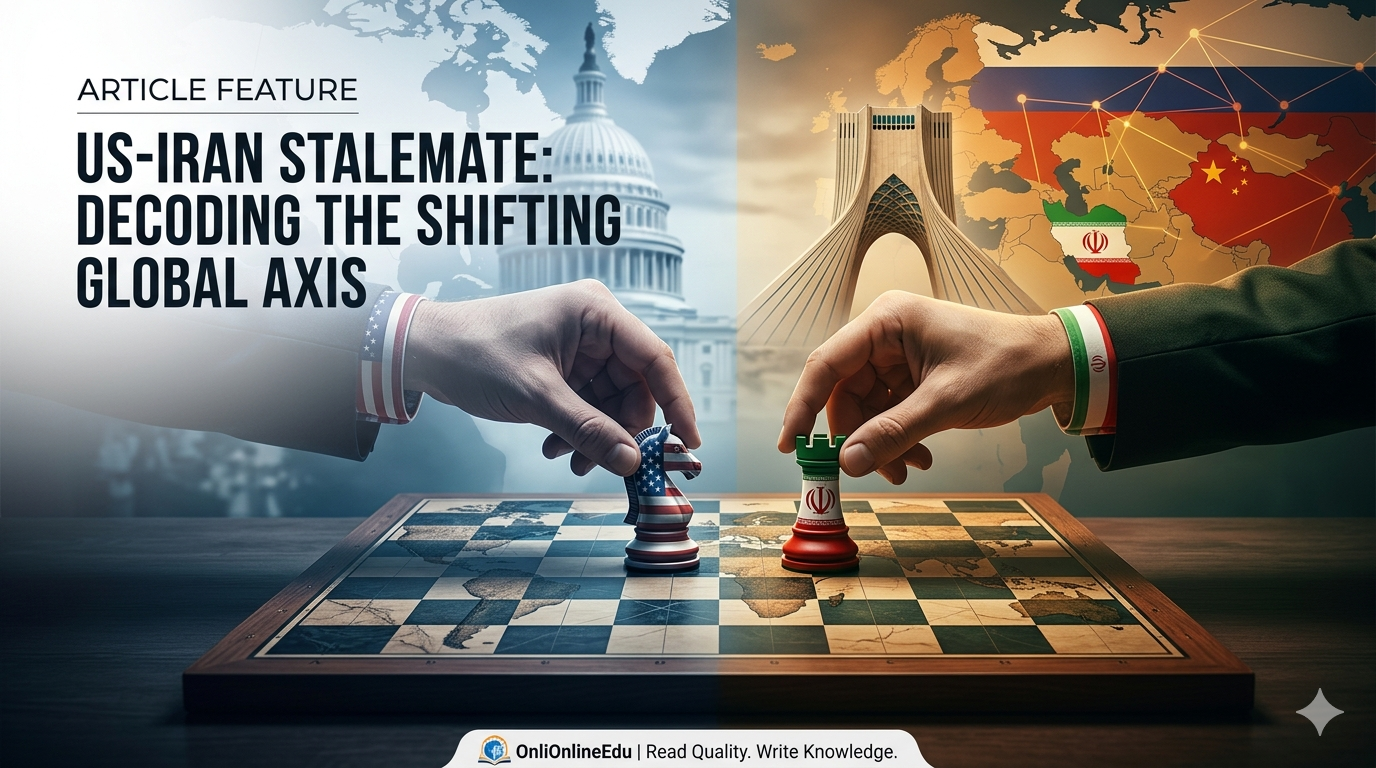
The military confrontation between the United States and Iran has reached the three-month mark, resulting in a complex geopolitical stalemate rather than a decisive victory. What began as a massive projection of military strength has transitioned into a diplomatic quagmire. For students analyzing International Relations and global geopolitics for competitive examinations, this evolving crisis serves as a masterclass in the limitations of unilateral hard power and the shifting balance of global alliances.
Here is an original breakdown of the current negotiations, the realities of the battlefield, and the broader implications for the global order.
The Temporary Truce: A 60-Day Working Framework
Diplomatic channels are currently focused not on a permanent peace treaty, but on a temporary 60-day Memorandum of Understanding (MoU) designed to stabilize volatile global markets.
Core Components of the Proposed Draft:
Maritime Navigation: Efforts to unblock the highly strategic Strait of Hormuz, with Tehran proposing a “management fee” rather than conceding to unconditional free passage.
Economic Concessions: The lifting of naval blockades and a phased release of frozen Iranian capital, starting with a demanded $12 billion tranche.
Financial Re-engagement: A pivot from traditional war reparations to a proposed $300 billion foreign investment package directed at Iran’s infrastructure.
Regional De-escalation: A mutual agreement to pause active hostilities and proxy engagements in surrounding regions like Lebanon.
Crucial Omissions:
The draft notably excludes Washington’s primary pre-war demands. There are no stipulations enforcing the dismantlement of Tehran’s ballistic missile infrastructure, no framework for neutralizing its regional proxy networks, and no permanent, binding nuclear treaties.
Strategic Ambitions vs. Ground Realities
A critical analysis of the initial military objectives set by the United States reveals a significant gap between strategic intent and actual outcomes 90 days into the conflict:
Political Overhaul: The objective to trigger a collapse of the current regime did not materialize. Following the loss of senior leadership in early strikes, the domestic political structure consolidated, resulting in a seamless transition of power to a new Supreme Leader and a fortified Islamic Revolutionary Guard Corps.
Military Neutralization: Attempts to obliterate Tehran’s defense capabilities fell short. Intelligence suggests a vast majority of the missile arsenal remains intact within fortified networks, and maritime forces successfully disrupted global shipping routes for extended periods.
Nuclear Confiscation: The demand to seize and export 400kg of enriched uranium was outright rejected. Instead, current negotiations mirror the parameters of the 2015 nuclear accord, suggesting a voluntary dilution of nuclear material back to the 3.67% threshold.
Control of the Strait: The ambition to unilaterally secure the Strait of Hormuz has been heavily contested. A new regional cooperative model has emerged, with Oman and Iran establishing joint administrative oversight of the waterway.
The Rise of a Multipolar Axis
The most profound outcome of this crisis is the visible acceleration of a multipolar world order. The ability of a heavily sanctioned state to withstand direct military pressure has galvanized a formidable trilateral alignment between Russia, China, and Iran.
This is no longer just a diplomatic partnership; it is a functional, operational axis. The integration of Russian and Chinese satellite networks to assist Iranian defensive and offensive tracking during the conflict demonstrates a highly coordinated counter-weight to Western dominance. For Beijing, the outcome of this Middle Eastern theater serves as a crucial data point for future geopolitical maneuvers, particularly regarding territorial disputes in the Indo-Pacific.
Domestic Repercussions for India
For developing nations, the ripple effects of this prolonged stand-off are immediate and tangible. The instability in energy-rich regions directly fuels domestic inflation. Aspiring civil servants and policymakers must note how disruptions in global oil supply chains lead to the depreciation of the Rupee and sudden spikes in domestic fuel costs, necessitating a highly agile and self-reliant foreign policy approach.