




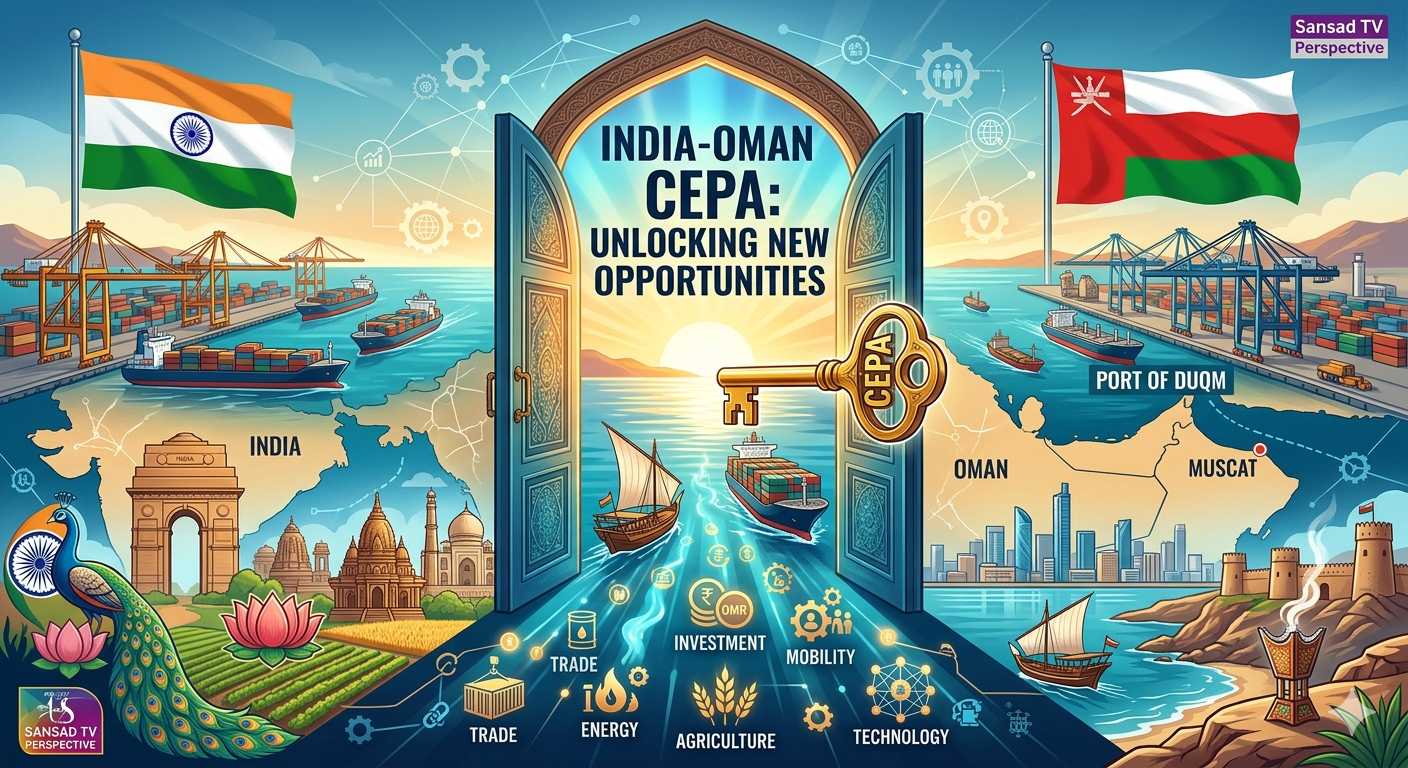
On June 1, 2026, a pivotal Comprehensive Economic Partnership Agreement (CEPA) between India and Oman officially went into effect. Originally signed late last year in Muscat by Prime Minister Narendra Modi and the Sultan of Oman, this historic deal builds upon centuries of maritime trade and cultural exchange, setting the stage for a highly integrated future.
Here is a look at the core components of this agreement and how it stands to reshape bilateral trade, energy security, and regional geopolitics.
Empowering Exporters and Small Businesses
The CEPA is a wide-ranging treaty that covers goods, services, investments, and intellectual property. For India’s manufacturing landscape, the benefits are substantial:
Tariff Eliminations: Oman has granted duty-free access to roughly 98% of its tariff lines, which translates to favorable conditions for over 99% of India’s total exports to the country.
Industry Boost: Small and medium-sized enterprises (MSMEs) stand to gain immensely. Vital sectors such as agriculture, pharmaceuticals, textiles, automotive, engineering goods, and jewelry will see a massive competitive advantage.
Workforce Mobility: Oman is already home to an Indian diaspora of over 600,000 people. The new treaty enhances mobility frameworks, creating smoother pathways for Indian professionals, including doctors, educators, and engineers, to work and thrive in the Gulf nation.
Strategic Geopolitics and Securing Energy
In a global climate marked by supply chain instability, the economic pact carries heavy strategic weight, especially concerning the Middle East.
Alternative Maritime Routes: With recent regional tensions threatening the Strait of Hormuz—a crucial global energy bottleneck—Oman’s unique geography just outside this zone makes it an indispensable partner for secure trade.
The Port of Duqm: Through specialized agreements, India has gained access to Oman’s strategically located Port of Duqm. This serves as a secure logistical hub and an alternative gateway for reaching markets in West Asia and East Africa.
Energy Supply Chain: Oman continues to be a cornerstone of India’s energy and agricultural stability, providing consistent supplies of crude oil, liquefied natural gas (LNG), and fertilizers. The agreement also revitalizes talks of an underwater energy pipeline, which would further cement India’s energy security.
Innovation and Defense Collaboration
The pact is designed with future economies in mind, pushing boundaries beyond traditional trade:
Advanced Technologies: The agreement fosters horizontal collaboration across emerging sectors like artificial intelligence, space exploration, and cybersecurity.
Defense Manufacturing: By establishing formal institutional dialogues and joint committees, both nations aim to co-develop technologies, support startup ecosystems, and strengthen defense supply chains.
A Gateway to the Broader Gulf
Significantly, India is only the second nation—following the United States—to finalize a trade agreement of this magnitude with Oman. Regional experts view the India-Oman CEPA, alongside the recent pact with the UAE, as a foundational blueprint. It is widely anticipated that these successful bilateral deals will accelerate ongoing negotiations for a much larger, comprehensive free trade agreement with the entire Gulf Cooperation Council (GCC).
By blending mutual economic ambitions with strategic foresight, the operationalization of this agreement marks a highly beneficial alignment that aims to secure growth and stability for both nations over the coming decades.