




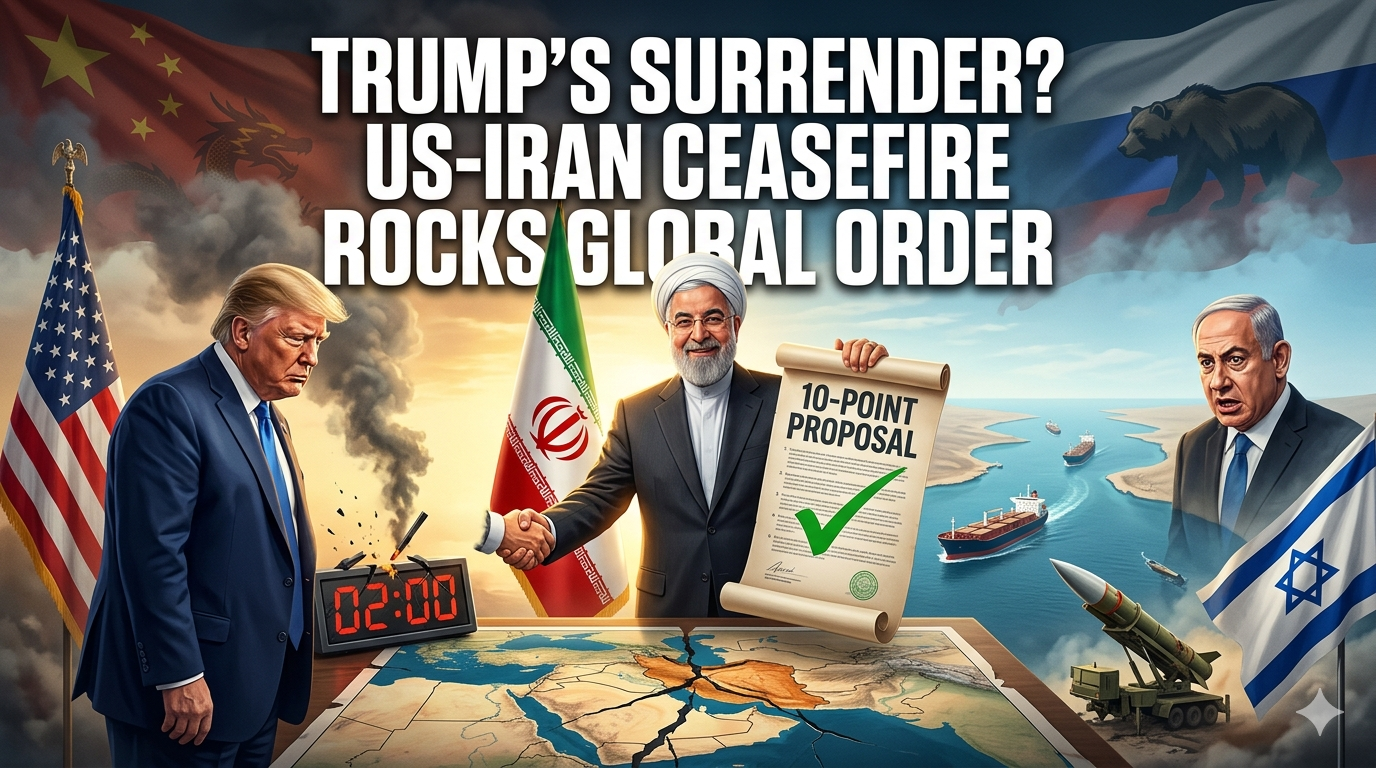
Just hours before a widely anticipated military escalation that threatened to send global markets into a tailspin, Washington and Tehran shocked the world by announcing a sudden two-week truce. Prior to this, fiery rhetoric from the US administration had pushed oil prices past $100 a barrel, sparking fears of a full-scale regional conflict. Instead, the resulting agreement has prompted analysts to evaluate a dramatic realignment in global power dynamics.
Tehran’s Negotiating Triumph
While initially framed by the US administration as a total victory, the finalized agreement heavily mirrors Iran’s own 10-point proposal. Crucially, the deal bypasses major US demands, leaving Iran’s nuclear enrichment and ballistic missile programs completely unaddressed.
The most significant concessions granted to Iran include:
Sanctions Relief: A commitment to lift the extensive sanctions that have historically crippled the Iranian economy.
Regional Immunity: A non-aggression pact that protects not only Iran but also its regional proxy groups, explicitly restricting strikes on forces like Hezbollah in Lebanon.
Control over Trade Routes: Iran retains authority over the Strait of Hormuz. Under the new terms, Tehran is permitted to collect a substantial transit toll from commercial vessels, splitting the revenue with Oman. This could inject billions of dollars into the Iranian economy for rebuilding efforts.
The Financial and Strategic Toll on Washington
The US shift toward diplomacy appears heavily influenced by the unsustainable costs of the brief conflict. In a matter of weeks, the US expended tens of billions of dollars, suffered military casualties, and witnessed domestic fuel prices skyrocket. Furthermore, reports of a compromised secret operation highlighted the severe logistical nightmare and potential human cost of attempting a ground invasion, pushing American leadership to seek an immediate off-ramp.
The Strategic Winners: Beijing and Moscow
Beyond the Middle East, the truce represents a significant strategic victory for America’s primary geopolitical rivals:
China’s Quiet Dominance: By vetoing UN resolutions aimed at forcing Iran’s hand in the Strait of Hormuz, Beijing protected its access to discounted oil. Furthermore, China is largely credited with orchestrating the diplomacy behind the scenes, accelerating regional efforts to trade oil in non-dollar currencies and challenging the US petrodollar system.
Russia’s Geopolitical Retaliation: Moscow capitalized on the US distraction to double its own oil exports and reportedly provided critical intelligence to Tehran, effectively turning the conflict into a proxy retaliation for US involvement in Ukraine.
Jerusalem’s Outrage and the Lebanon Flashpoint
The most volatile reaction to the truce has come from Israel. Kept entirely out of the negotiation loop until the final moments, the Israeli leadership has expressed profound betrayal. The Israeli government had operated under the assumption that the US would dismantle Iran’s nuclear capabilities.
The truce now faces an immediate threat of collapse: while Israel nominally acknowledged the ceasefire, Prime Minister Netanyahu firmly stated that military operations against Hezbollah in Lebanon will not cease. Because the US-Iran agreement explicitly prohibits attacks on Lebanon, Israel’s defiance places Washington in an incredibly precarious position regarding its closest regional ally.
South Asian Ripple Effects: Islamabad and New Delhi
The diplomatic fallout has also created waves in South Asia. Pakistan emerged as the surprising public intermediary between the US and Iran. Although widely believed to be acting as a diplomatic front for Beijing, the move successfully elevated Islamabad’s international standing from a state grappling with economic crises to a relevant geopolitical mediator.
Conversely, India maintained a strictly neutral, trade-focused approach, quietly securing the safe passage of its own commercial assets. However, the optics of Pakistan’s elevated role clearly struck a nerve in New Delhi, with India’s External Affairs Minister sharply dismissing Islamabad’s diplomatic efforts and reiterating that India does not act as a “broker state.”
Looking Ahead
As the two-week clock ticks, the Middle East remains highly unstable. With the nuclear question unresolved and Israel openly refusing to abide by the Lebanon parameters of the agreement, the international community watches to see if this truce will establish a new, permanent world order or simply serve as a brief pause before a much larger regional eruption.