




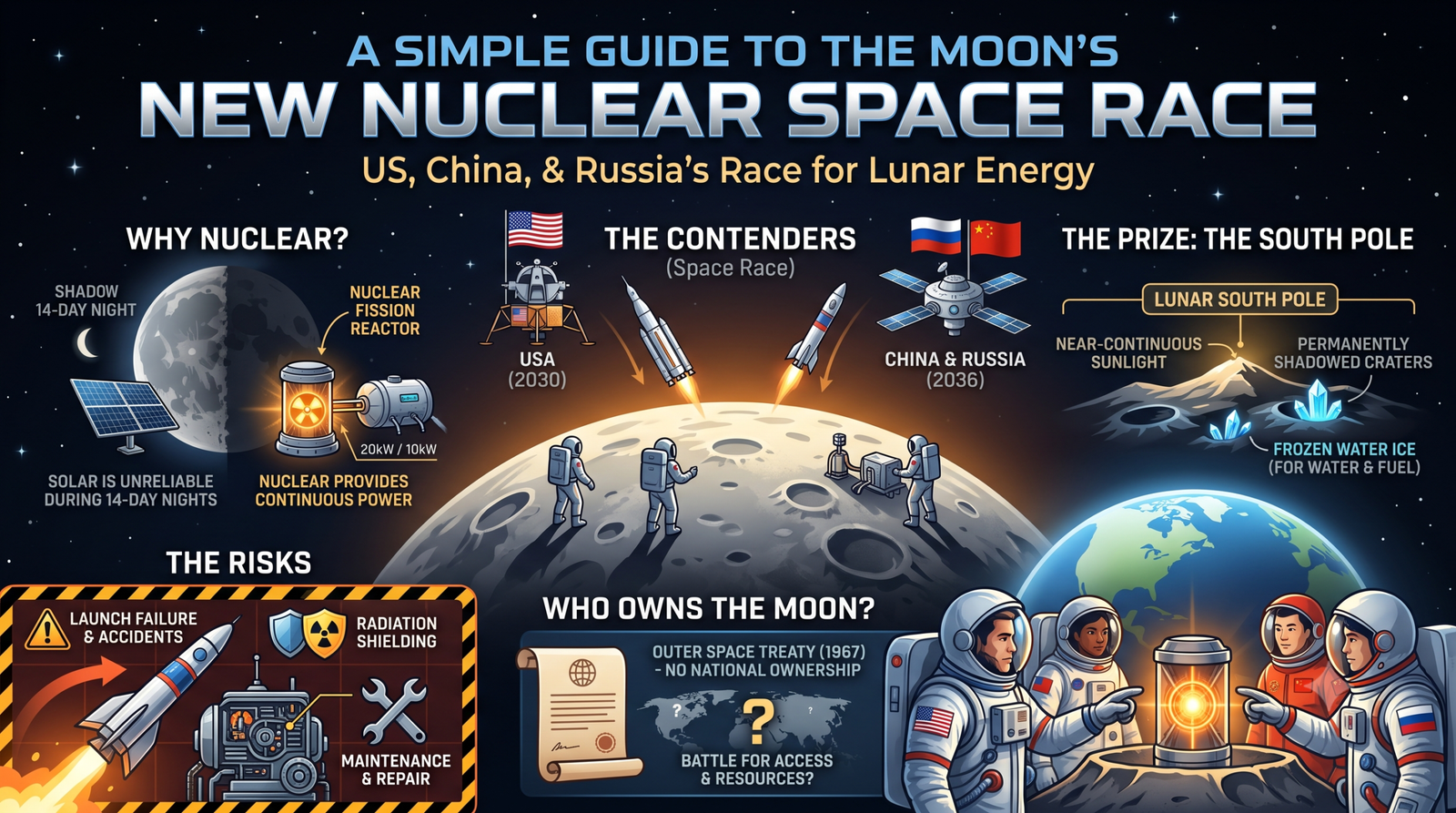
The competition between global superpowers is no longer just happening on Earth. Countries are now looking at the moon to build the next big thing in energy: nuclear power plants in space.
Here is an easy-to-understand breakdown of why countries are trying to put nuclear reactors on the moon and what it means for the future of space exploration.
Who is Going to the Moon, and Why?
Right now, three major countries are leading the charge to build nuclear power on the lunar surface:
The United States hopes to have a working nuclear reactor on the moon by the year 2030.
China and Russia have teamed up and plan to build their own lunar nuclear facility by 2036.
It is important to know that this power is not being sent back to Earth. The electricity generated by these reactors will be used exclusively to power future moon bases, scientific rovers, and human habitats.
Why Use Nuclear Power Instead of Solar?
You might wonder why we cannot just use solar panels, since space has plenty of sunshine. The problem is how days and nights work on the moon.
A single “day” on the moon lasts about a month on Earth. This means that when it gets dark on the moon, the night lasts for about 14 and a half Earth days. Solar panels cannot collect energy during two straight weeks of total darkness. To make sure astronauts have heat, light, and working equipment during the long lunar night, small nuclear reactors are the most reliable solution.
The Importance of the Moon’s South Pole
All of these countries want to land at the exact same spot: the moon’s South Pole. This area is highly valuable for a few key reasons:
Hidden Ice: The deep, dark craters at the South Pole never see sunlight, meaning they hold frozen water. Astronauts can use this ice for drinking water, breathing oxygen, and even making rocket fuel.
Constant Sunshine: While the craters are dark, the high mountain peaks at the South Pole get almost constant sunlight, which is great for backup solar power.
What Are the Risks?
Putting nuclear material in space is incredibly dangerous. There are a few major worries:
Rocket Crashes: Space travel is risky. If a rocket carrying nuclear fuel explodes during launch, it could be an environmental disaster.
Radiation: Nuclear reactors create dangerous radiation. Astronauts will need heavy, complex structures to protect them from getting sick.
Fixing Breakdowns: If a nuclear reactor breaks down on Earth, it is hard enough to fix. If it breaks down hundreds of thousands of miles away on the moon, repairing it will be a massive challenge.
Who Actually Owns the Moon?
If everyone wants to build at the South Pole, who gets to decide who gets the best spots?
According to an old international agreement called the Outer Space Treaty of 1967, no single country is allowed to “own” the moon or any other planet. Space belongs to everyone. However, the rules are very blurry when it comes to digging up resources like ice or minerals.
Because the rules are not entirely clear, there is a real fear that countries will start arguing over the best locations on the moon. As nations try to set up permanent bases, the fight for control and resources in space is just beginning.