




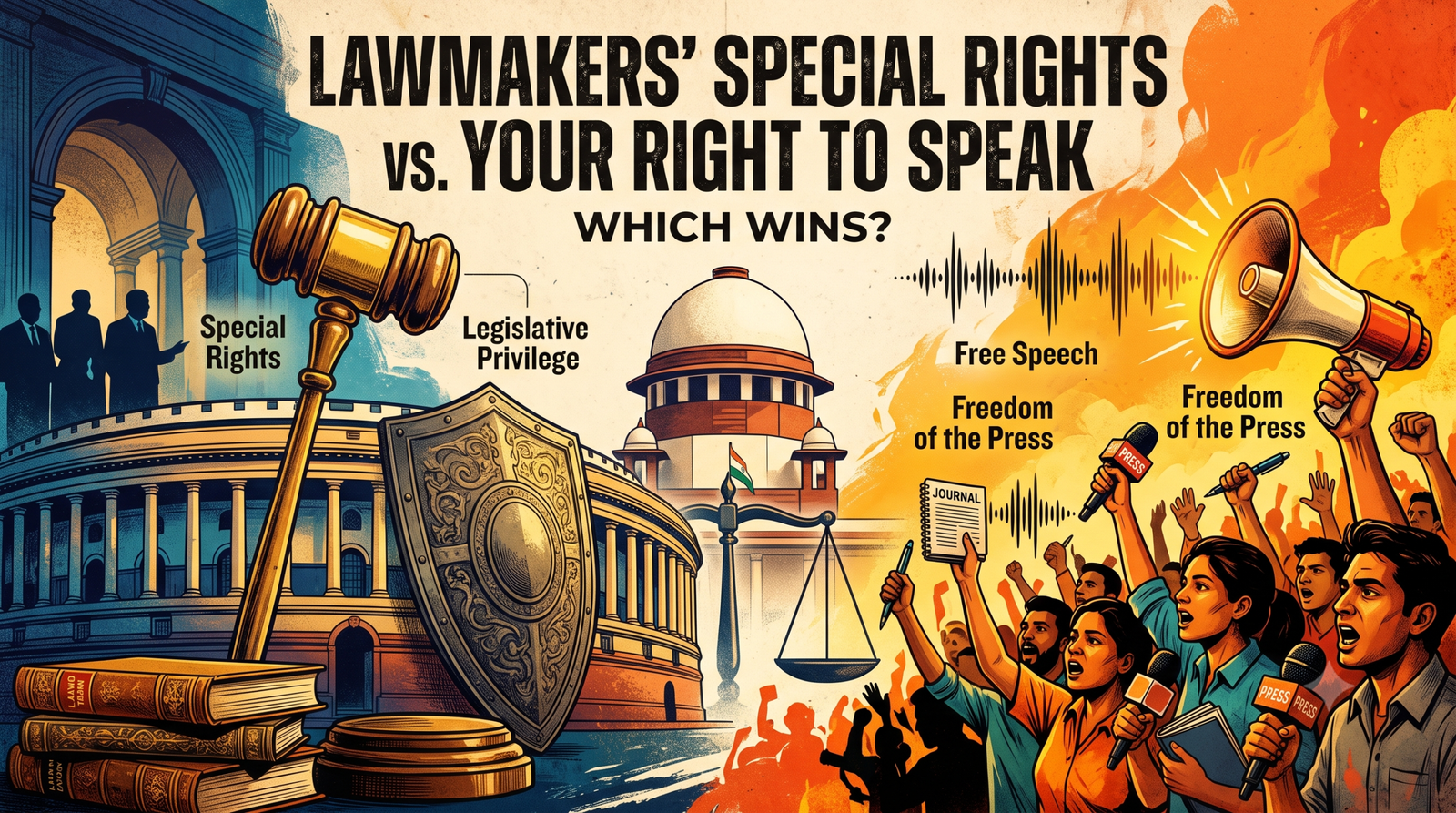
Imagine writing a newspaper article or a social media post criticizing the way politicians are acting in a government assembly. Instead of taking you to court, the politicians themselves decide you have insulted them and send you straight to jail. Can they actually do that?
This is a major question currently being reviewed by seven judges in India’s Supreme Court. It is a classic tug-of-war between two important democratic ideas: a citizen’s freedom to speak the truth versus the special powers given to lawmakers.
The Rules of the Game
This conflict involves two main parts of the Indian Constitution:
Your Freedom (Article 19): This guarantees that every citizen and journalist has the right to speak, write, and express their opinions freely.
Lawmakers’ Power (Articles 105 and 194): These rules give special protections—often called “privileges”—to Members of Parliament (MPs) and State Assemblies (MLAs).
Why Do Politicians Need Special Powers?
These powers aren’t there just to protect a politician’s ego. They exist so leaders can do their jobs without being scared. For example, if a lawmaker exposes a major scam during a session inside the parliament, they cannot be sued in a regular court for what they said. This allows them to debate freely.
The assembly as a whole also has powers. They can hold private meetings, ask outsiders to leave, and punish people who purposely disrupt their daily work.
The Main Problem: Unwritten Rules
The biggest issue today is that there is no official, written rulebook that clearly defines what these “special powers” are. Because Indian lawmakers never wrote a specific law for this, they still rely on old traditions inherited from the British parliament.
Historically, the British parliament had the power to act like a court and lock people up for disrespecting them. Indian assemblies still use this old logic. Many experts believe lawmakers avoid writing these rules down on purpose. If the rules were officially written into a law, regular courts could review them and limit their power. Right now, when a politician feels insulted, the assembly gets to act as the victim, the police, and the judge all at the same time.
Mixed Signals from the Courts
In the past, India’s courts have given confusing answers about who has the upper hand:
The 1959 Searchlight Case: A newspaper printed parts of a political debate that the assembly had ordered to be erased. The Supreme Court sided with the politicians, saying their special assembly rights were stronger than the newspaper’s right to publish.
The 1964 Keshav Singh Case: A state assembly sent a man to jail for handing out pamphlets. When High Court judges tried to grant the man bail, the angry politicians tried to summon the judges! The Supreme Court had to step in and firmly state that courts do have the power to check if politicians are jailing people illegally.
How Do We Fix This?
For a democracy to stay healthy, lawmakers need to feel safe doing their jobs, but citizens and journalists also need to feel safe criticizing the government. To fix this broken system, a few things need to change:
Write down the rules: The government needs to create a clear, written law so citizens know exactly what crosses the line.
Ensure fair trials: If someone is accused of disrespecting the assembly, they should have the right to a lawyer and a fair chance to defend themselves.
Stop using jail as a weapon: Politicians sending citizens to prison should be extremely rare, and any jail sentence should be strictly reviewed by real judges.
At the end of the day, a lawmaker’s special power is meant to be a shield to protect their important work for the country, not a sword to silence the people who question them.