




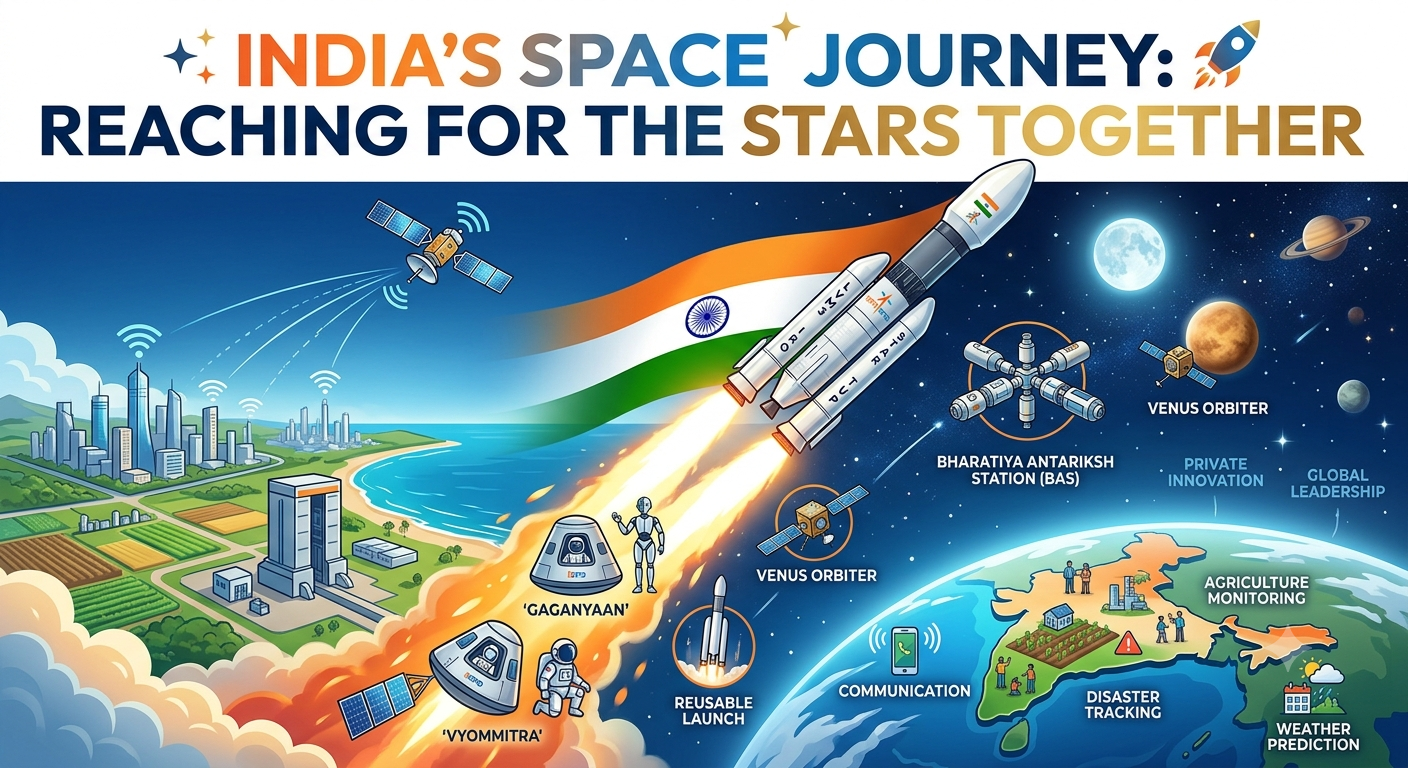
India’s space program has come a long way. What started as a government effort to build basic satellites has grown into a world-class space industry. Today, India is not just launching rockets on its own—it has opened its doors to private companies, changing the way the country explores space.
The Boom of Space Startups
For a long time, the Indian Space Research Organisation (ISRO) did almost all the space work in India. But things have changed. In 2014, India had only one space startup. By the year 2026, that number has jumped to around 440.
Because of these new companies, private investments have grown massively. India’s space economy is now worth about $9 billion. Experts believe that with this fast growth, it could reach up to $45 billion in the next ten years.
Rules That Help Businesses Grow
To make this growth possible, the Indian government changed its rules. In 2023, a new space policy was created to invite private businesses to build rockets, make satellites, and launch them.
The government also made it easier for foreign countries to invest money in India’s space market. On top of that, special funds and grants have been set up by the government to give early-stage startups the money they need to test their new ideas.
Better Rockets and Cheaper Launches
Right now, India uses four reliable rockets to send satellites into space for both itself and other countries. But scientists are already building the next generation of space technology.
To make space travel cheaper, scientists are designing rockets that can be used more than once. They are testing rockets that can take off, do their job, and then land safely back on Earth so they can be reused. They are also building new, super-powerful engines to carry heavier loads into space.
Big Plans for the Future
India has set some huge goals for the coming years:
Sending Humans to Space (Gaganyaan): India is preparing to send three astronauts into space for a three-day trip. A test flight using a robot named Vyommitra will happen first in late 2026, and the human crew is planned to fly in 2027.
An Indian Space Station: By 2035, India plans to build and run its very own space station where astronauts can live and do research.
A Trip to Venus: In 2028, India will send a spacecraft to Venus to study the planet’s atmosphere and surface.
Connecting in Space: Scientists are testing ways for two different spaceships to safely link up (or dock) with each other while floating in space.
Why It Matters
India’s space missions aren’t just about exploring the unknown. The satellites in space help people right here on Earth. They help farmers know when it will rain, provide internet connections, track bad weather, and help cities plan better.
By welcoming young startups, creating friendly rules, and dreaming big, India is proving to the world that it is a smart, reliable, and powerful leader in space exploration.