




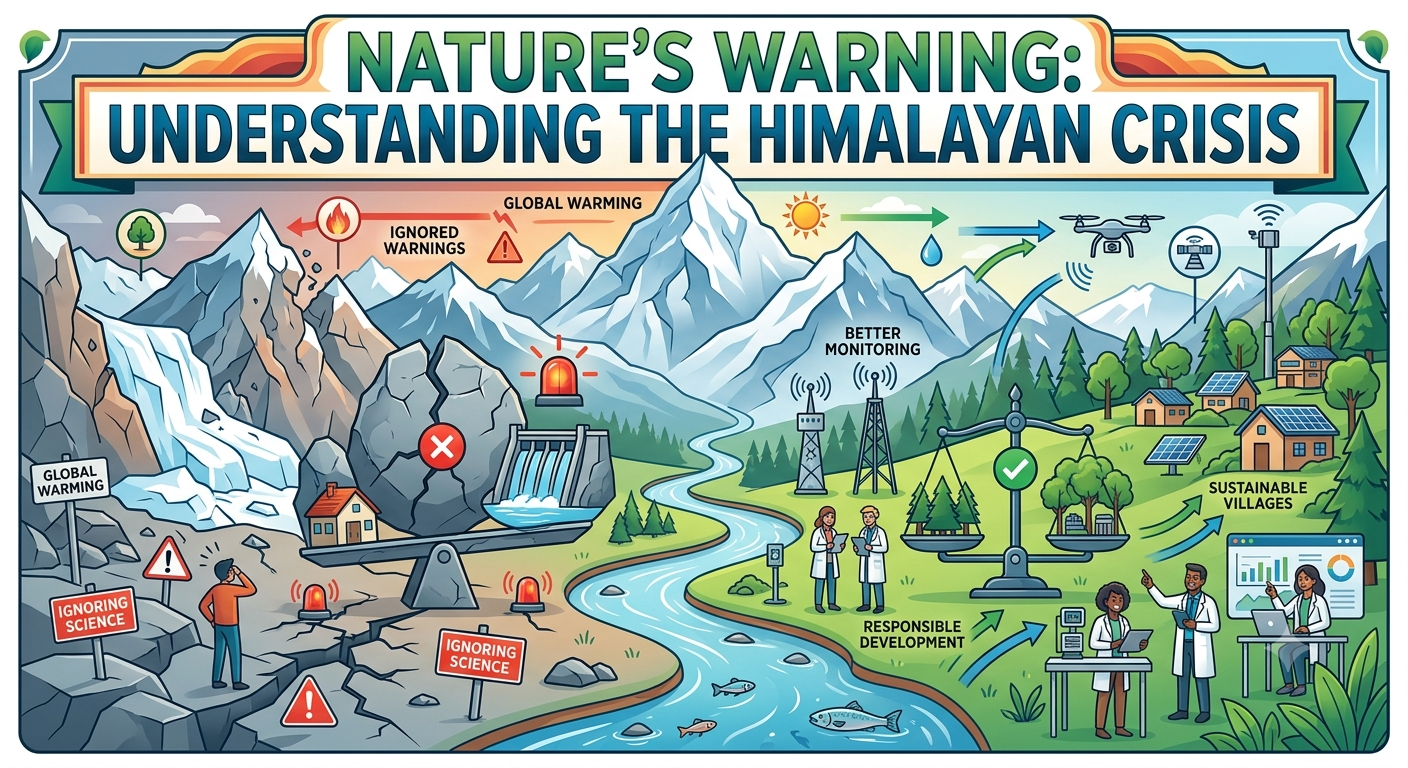
The Himalayas are the youngest mountains on Earth. For thousands of years, they have acted as a giant shield for India and provided water to major rivers. But today, these beautiful mountains are incredibly fragile, and they are sending us a serious warning.
A Massive Wake-Up Call
Recently, a huge disaster struck near the border of Nepal and Tibet. A massive chunk of a mountain and a glacier broke apart and crashed down. The impact was so powerful that it released energy equal to a medium-sized earthquake.
The results were heartbreaking:
Hundreds of people lost their lives, and over a thousand went missing.
The rushing flood of mud, rocks, and ice destroyed roads, buildings, and power plants.
The effects didn’t stay in the mountains. The debris flowed down rivers, posing huge risks to flat lands miles away, like Bihar and Uttar Pradesh.
Why Is This Happening?
This disaster highlights two major problems working together:
Climate Change: The Earth is getting warmer, causing mountain snow and ice to melt much faster than before. On top of that, rainfall has become heavy and unpredictable, which easily triggers dangerous flash floods.
Human Activity: We are pushing the mountains to their breaking point. People are building heavy concrete roads, massive buildings, and large dams high up in delicate areas. When we change the natural shape of the mountains, nature reacts aggressively.
Ignoring the Science
Geologists (scientists who study the Earth) explain that the Himalayas are still shifting. They are full of natural fault lines, which are essentially weak spots in the Earth’s crust.
Experts constantly warn builders to avoid these highly sensitive zones. Unfortunately, these warnings are often ignored. Massive construction projects, like multiple dams, are frequently built right over these risky areas, putting both nature and human lives in danger.
How Can We Protect Ourselves?
We cannot stop natural mountain shifts or completely halt development, but we can be much smarter about safety:
Better Warning Systems: Right now, danger alarms are mostly placed near dams. But by the time a flood reaches a dam, people might only have 30 minutes to run. We need to place sensors much higher up the mountains, right next to the glaciers.
Using New Technology: Builders and governments need to use modern tools, like drones and special radars, to constantly monitor the mountains for early signs of danger.
Finding the Right Balance
The Himalayas are not just rocks; they are a living, changing environment. The people living there absolutely need safe roads, electricity, and development. However, we have to build in a way that respects the mountains’ limits. If we continue to force heavy construction into fragile areas, the mountains will keep pushing back.