

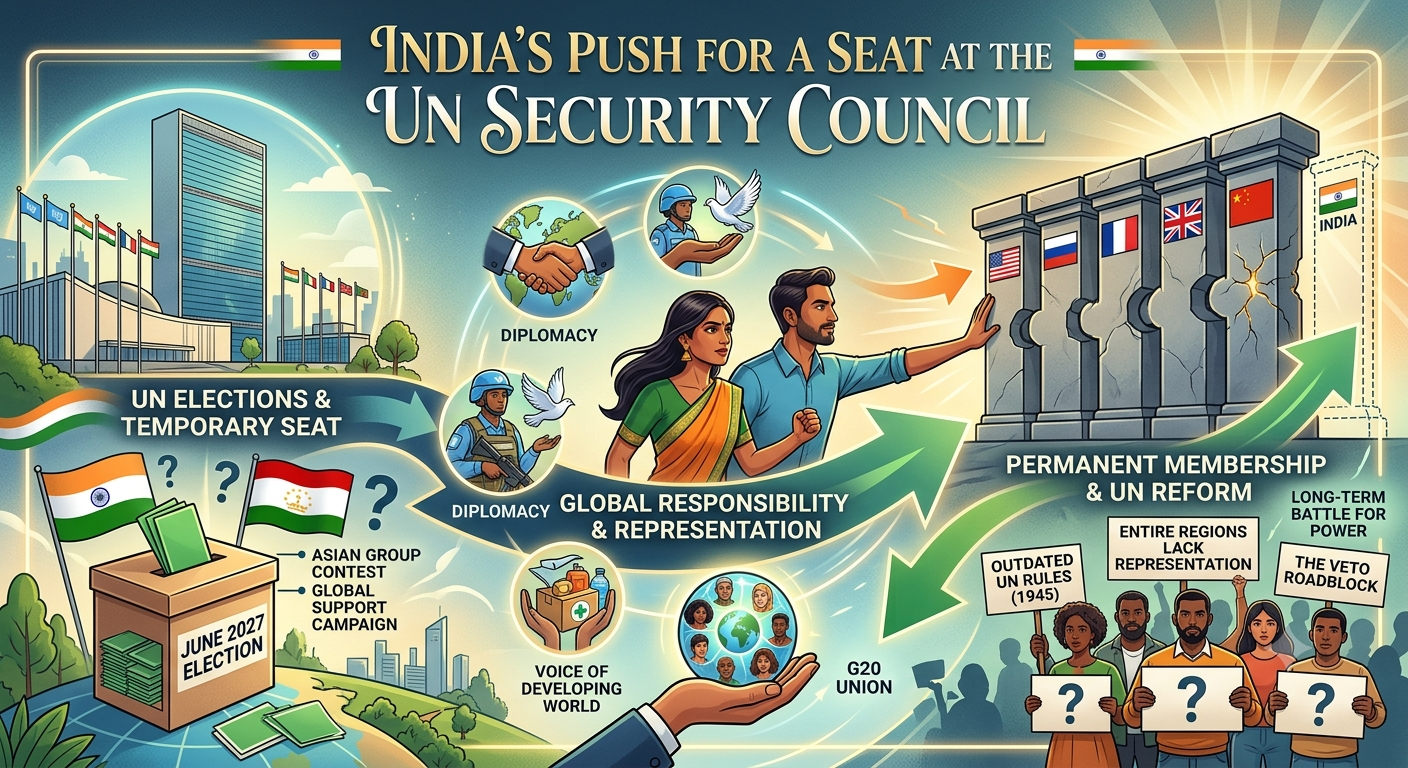
India is actively campaigning to secure a temporary (non-permanent) seat on the United Nations Security Council (UNSC) for the years 2028 and 2029. With the election coming up in June 2027, the Indian government is reaching out to countries around the world to gather support.
Here is a simple breakdown of what this campaign means, how the elections work, and why India is pushing for bigger changes at the UN.
How the UN Elections Work
The United Nations divides the world into five regional groups. To ensure fairness, the ten temporary seats on the Security Council are split among these regions.
The Asian Group: This group gets two temporary seats.
The Current Contest: For the upcoming election, both India and Tajikistan are competing for a seat in the Asian group.
The Goal: India is working hard through diplomatic visits and meetings to win enough votes from other countries before the 2027 election.
Looking Beyond a Temporary Seat
India has already held a temporary seat on the UNSC eight times. However, this current campaign is also about a much bigger goal: becoming a permanent member.
To prove it deserves a permanent spot, a country must show it is responsible and represents a significant portion of the world. India has proven this in several ways:
Global Responsibility: India frequently helps the world by sending peacekeepers to conflict zones, providing disaster relief during earthquakes and tsunamis, and supplying vaccines during the COVID-19 pandemic.
Representing the Developing World: India acts as a strong voice for the “Global South” (developing nations). Recently, India successfully pushed to make the African Union a permanent member of the G20.
Why the UN Needs to Change
The main argument India is making is that the United Nations is outdated.
Old Rules: The UN was created in 1945 after World War II. The five victorious countries (the USA, Russia, France, the UK, and China) gave themselves permanent seats and a special “veto” power, meaning they can block any major decision.
A Changed World: The world looks completely different today. Many countries have gained independence, yet entire regions like Africa and Latin America still do not have a single permanent seat on the council.
The Roadblock: While many countries agree that the UN needs to be updated, the five permanent members are hesitant to share their power. For India, China remains a major roadblock to gaining permanent entry.
The Bottom Line
Because the current permanent members often disagree on major global conflicts, the UN can sometimes struggle to take action. India believes that updating the Security Council is long overdue. While the fight for a permanent seat and veto power will be a long and difficult political battle, winning this temporary seat is India’s next step to proving it belongs at the world’s top decision-making table.