




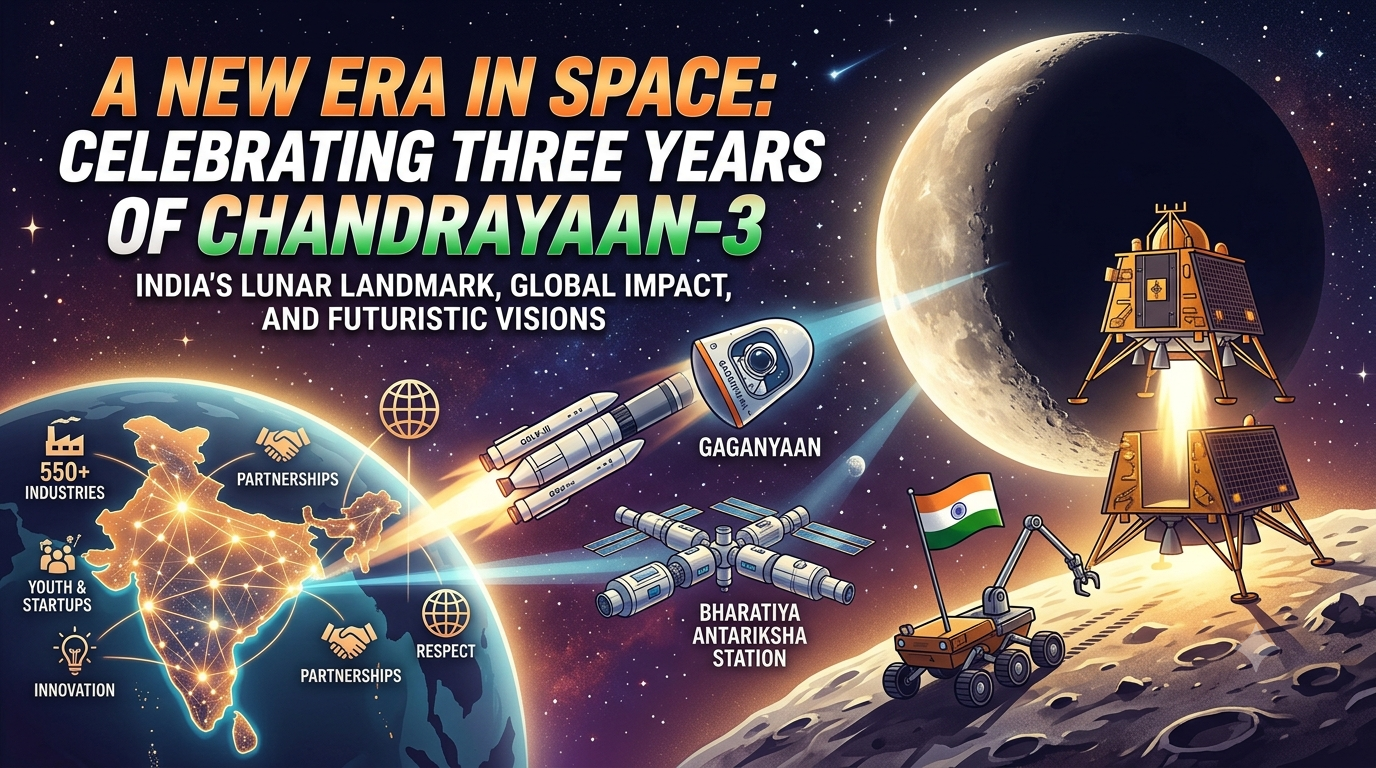
Three years ago, India did something no other country had ever done: it successfully landed a spacecraft near the moon’s south pole. This historic mission, Chandrayaan-3, proved to the world that India is a true leader in space exploration.
Recently, space experts looked back on this amazing achievement. They discussed how the mission changed India’s space program, how the world views India today, and the exciting challenges waiting in the future.
Bouncing Back from Failure
The success of Chandrayaan-3 was built on hard lessons. After the setback of the Chandrayaan-2 mission, scientists worked tirelessly to improve the spacecraft’s technology and software. When Chandrayaan-3 finally landed, it was a moment of massive pride for the 1.4 billion Indians watching.
More importantly, it broke a mental barrier. It proved that India does not just try—it succeeds in doing highly advanced, world-class space missions completely on its own.
Inspiring Students and Startups
Chandrayaan-3 changed the way space exploration works in India. In the past, space missions were strictly the government’s job. Today, the doors are open to private businesses. There are now over 550 companies and new startups building rocket parts, satellites, and new technologies.
The moon landing also sparked a fire in the younger generation. Instead of only choosing traditional computer or electronics jobs, many young students are now dreaming of aerospace engineering and rocketry.
Earning Global Respect
For a long time, the world mostly praised India for doing space missions very cheaply. Now, that view has changed. The world respects India for its advanced technical skills.
Because of this new respect, international partnerships are booming. Indian space startups are teaming up with companies in Europe, Australia, and New Zealand. The Indian Space Research Organisation (ISRO) is also working closely with foreign space agencies, such as partnering with Japan for future moon missions.
Big Dreams for the Future
With confidence at an all-time high, India is aiming for the stars. Some of the upcoming goals include:
Sending Humans to Space: The Gaganyaan mission aims to put Indian astronauts into space by 2028.
An Indian Space Station: Since the International Space Station will retire soon, India plans to build its own space station between 2035 and 2040.
Exploring Further: Scientists are planning missions to orbit Venus and a special mission to bring rocks from the moon back to Earth.
Hurdles to Cross
Even with all these successes, experts warn that India still has some big challenges to solve if it wants to stay at the top:
More Launches, Bigger Rockets: India needs to launch rockets much more often to meet demand. Also, India’s current rockets cannot carry extremely heavy satellites. For those, India still has to rely on foreign companies.
Reusable Rockets: To save money and compete with countries like China and companies like SpaceX, India needs to perfect rockets that can fly to space, land safely back on Earth, and be used again.
Helping New Businesses: The many young space companies in India still need a lot of guidance, funding, and support from experts to survive and grow.
Looking Ahead
Chandrayaan-3 was a major turning point. It showed that India’s space program has truly grown up. With new businesses joining the effort, students eager to learn, and bold missions on the horizon, the next decade promises to be a thrilling adventure for India in space.