




In India, entering the judicial system as a young graduate is a massive responsibility. Deciding on people’s freedom, property, and family disputes requires great maturity and practical knowledge. For years, a major debate has surrounded this career path: should a fresh law graduate be allowed to become a judge without ever practicing law in a real courtroom?
To solve this, the Supreme Court of India recently updated the eligibility rules for entering the lower courts as a Civil Judge. Here is a simple breakdown of the changing rules and the new path forward.
How the Rules Have Changed Over Time
The requirements for entry-level judges have shifted repeatedly as the legal system tried to find the perfect balance between experience and youth:
1993: The Supreme Court mandated that candidates needed three years of experience working as a lawyer before they could apply to be a judge.
2002: The three-year rule was dropped to attract young, bright talent immediately after graduation. Instead of prior practice, new judges were given extensive training after passing their exams.
2025: The court brought back the strict three-year practice rule, noting that fresh graduates often lacked the practical knowledge to manage a courtroom and handle lawyers.
2026: Recognizing that forcing young lawyers to practice for three years with minimal income was unfair and delayed hiring, the Supreme Court introduced a new middle-ground approach.
The New Hybrid Path for Future Judges
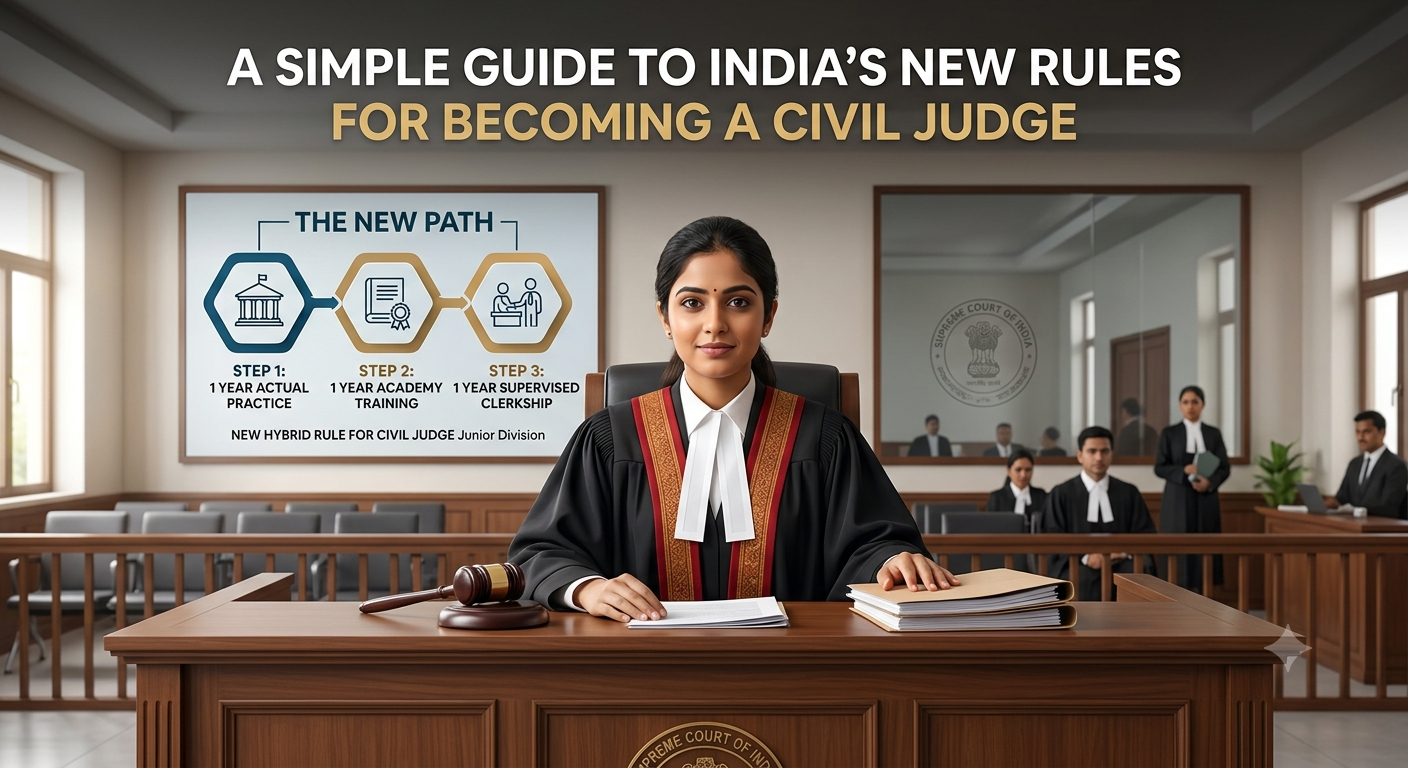
To balance the need for real courtroom experience with the need to hire young talent efficiently, the Supreme Court created a new system. For any judicial exams announced after April 1, 2027, aspiring judges will follow this specific path:
Step 1: Complete exactly 1 year of actual legal practice in a court before taking the judicial exam.
Step 2: Pass the exam and complete 1 year of official academy training.
Step 3: Complete 1 year of supervised clerkship before taking full charge of a courtroom.
The Bigger Picture
India’s district and lower courts are the first stop for most citizens seeking justice, yet they struggle with thousands of empty judge seats. This new hybrid rule attempts to solve two problems at once: filling those vacancies faster while ensuring that new judges have enough real-world exposure to understand the human impact of their decisions.