


Local self-governance is the bedrock of the world’s largest democracy. Ever since the historic 73rd Constitutional Amendment formally decentralized power, India’s focus has increasingly shifted toward village-level administration. Today, as the nation works toward the goal of becoming a fully developed country by 2047, empowering Panchayati Raj Institutions (PRIs) is recognized as the most critical step in transforming rural landscapes.
The True Center of Democracy
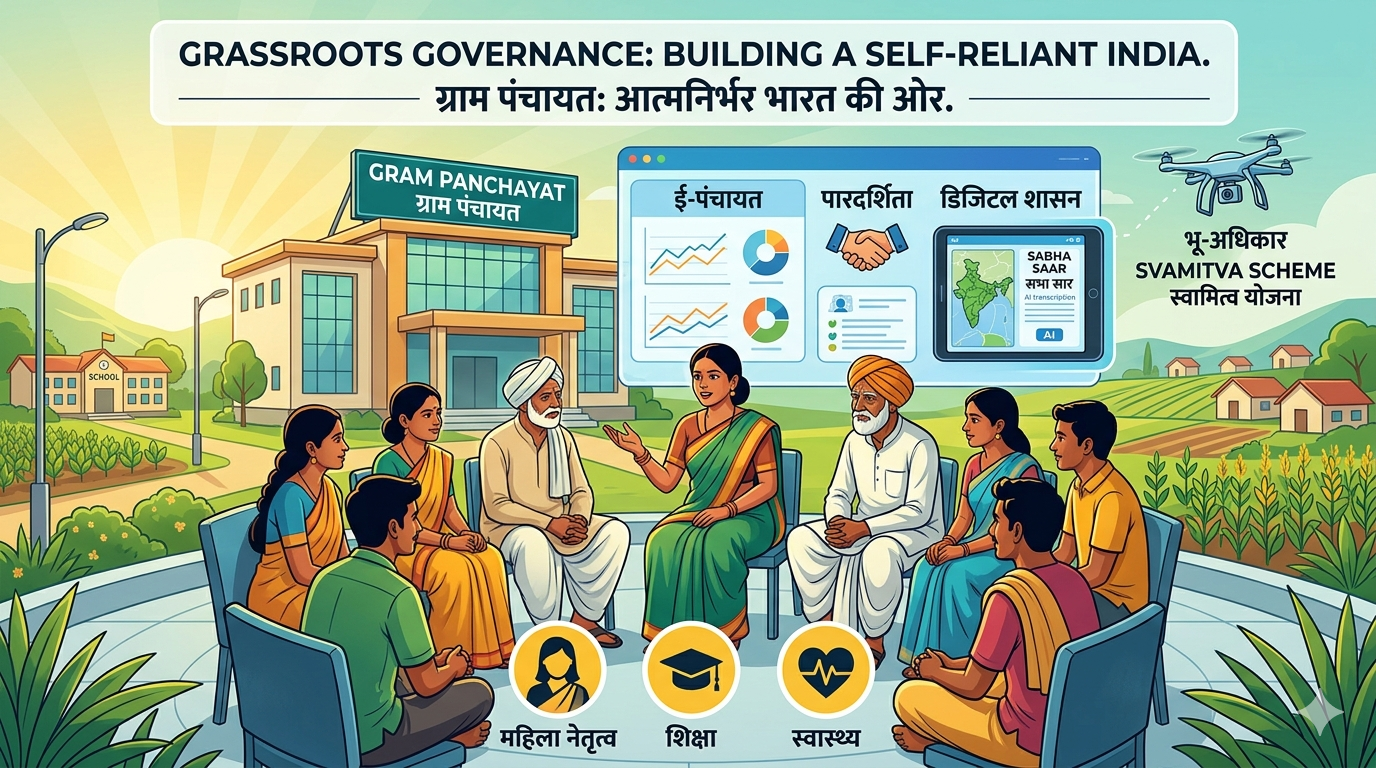
The most authentic form of direct democracy in India can be found in the Gram Sabha. Unlike higher levels of government, the Gram Sabha allows everyday citizens to participate directly in decision-making, from approving housing beneficiaries to monitoring the use of public resources. This bottom-up approach ensures that development is tailored to the actual needs of the community, turning ordinary villagers into active stakeholders in their own progress.
Moving from Grants to Financial Independence
A major hurdle for many rural councils is an over-reliance on state and central government grants. While some states in North India still depend heavily on external funding, several southern and western states—such as Kerala, Karnataka, Maharashtra, and Andhra Pradesh—have successfully leveraged local taxation. For example, local property taxes in Andhra Pradesh and Karnataka have generated thousands of crores, allowing villages to fund their own development.
To encourage this self-reliance nationwide, the 16th Finance Commission has introduced “performance grants,” setting aside a massive ₹87,000 crore to reward panchayats that consistently increase their internal revenue. True decentralization, however, still requires state governments to fully hand over the “three Fs”—functions, functionaries, and finances—to local bodies.
Embracing the Digital and AI Revolution
Technology is rapidly erasing the rural-urban divide in administration. Today, over 2.5 lakh panchayats operate on unified digital platforms that handle everything from project planning and budgeting to final audits.
This digital leap has brought unprecedented transparency to rural governance. Applications like the Meri Panchayat app allow residents to track local spending, view account balances, and monitor project progress, virtually eliminating the opacity that once bred corruption. Furthermore, rural administration is stepping into the future with Artificial Intelligence. Tools like Sabha Saar, an AI-driven speech-to-text program, are now being used to instantly transcribe Gram Sabha meetings, reducing days of administrative paperwork to mere minutes.
The Transformative Power of Women Leaders
With women holding roughly half of all panchayat seats across the country, rural governance has seen a massive shift in priorities. Female leadership at the village level has been closely linked to remarkable improvements in human development indicators.
Villages led by women consistently report lower school dropout rates, better infant mortality statistics, and highly maintained sanitation facilities. Furthermore, women leaders have shown exceptional resourcefulness, frequently successfully securing Corporate Social Responsibility (CSR) funds from private companies to build school toilets and improve local infrastructure when government funding falls short.
Securing Land Rights Through Technology
Historically, a lack of documentation for residential rural land has led to property disputes and economic stagnation. The PM SVAMITVA scheme was launched to tackle this exact issue. By utilizing drone technology to map rural residential areas, the government has successfully issued over 3 crore property cards. This mapping initiative has not only resolved long-standing land conflicts but has also allowed villagers to finally use their homes as collateral to secure bank loans, unlocking vast economic potential.
Looking Forward
While the progress over the last three decades is undeniable, the journey is far from over. Tens of thousands of panchayats still lack dedicated office buildings, computers, and adequate administrative staff. However, as local councils continue to transition from basic administrative units to fully equipped citizen service centers, the dream of a self-reliant, developed India is steadily taking root exactly where it needs to—in its villages.