




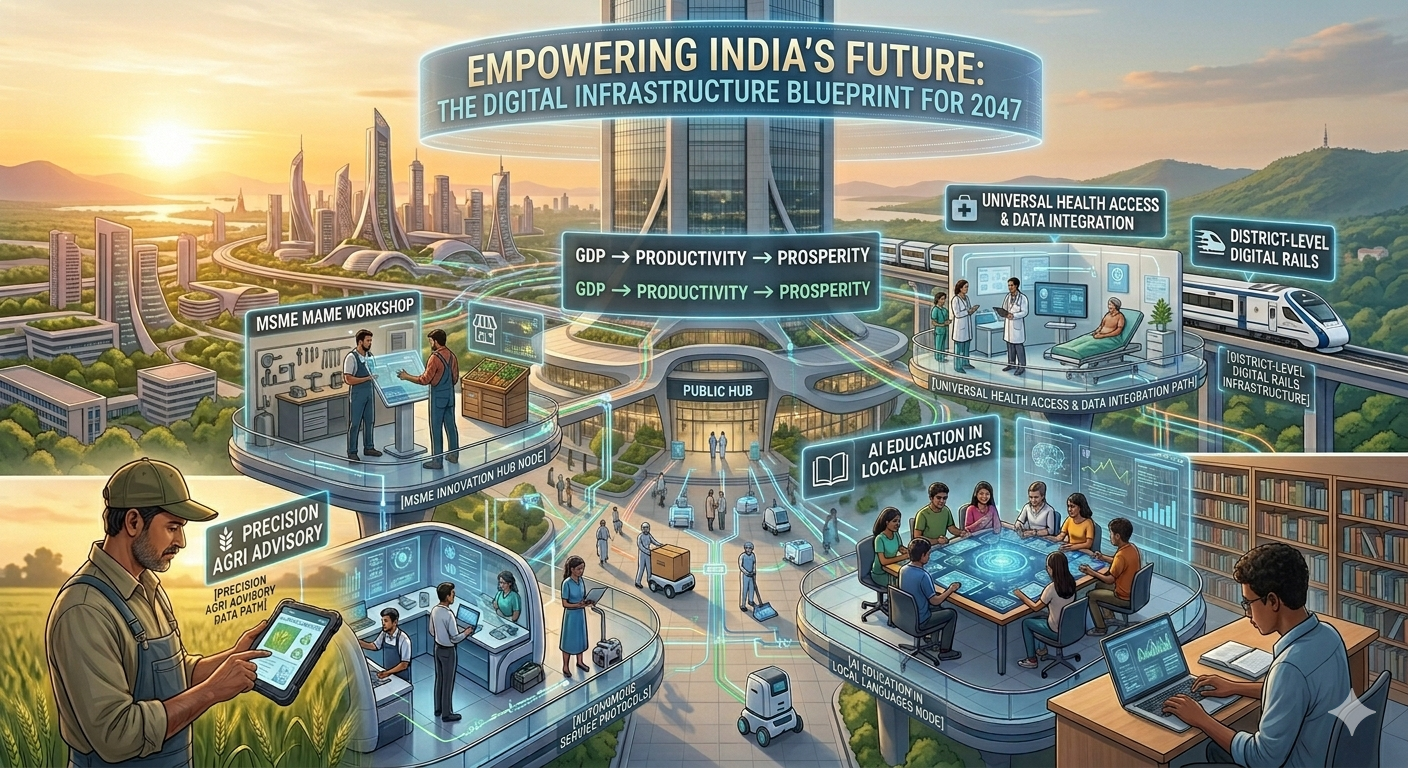
As India aims for a monumental milestone—a $30 trillion economy with significantly higher per capita income by 2047—a transformative technological strategy has been introduced to guide the way. A newly developed framework outlines how the fusion of Artificial Intelligence (AI) and Digital Public Infrastructure (DPI) can accelerate the nation toward sustainable, productivity-driven growth.
The Evolution: From Access to Empowerment
India’s early digital initiatives successfully laid a massive groundwork. Systems that enabled digital identities and fast digital payments brought millions into the formal economy, effectively solving the initial challenge of financial inclusion.
However, moving forward requires a fundamental shift in strategy. The new blueprint emphasizes transitioning from simply providing digital welfare to actively fostering wealth creation. The goal is to move beyond foundational access and create an ecosystem where citizens and businesses can actively generate prosperity.
The Next Decade: Driving Livelihoods at Scale
Over the next ten years, the focus will shift to a phase centered on livelihood generation. This stage aims to eliminate the everyday frictions that hold back economic potential, targeting key sectors:
Small and Medium Enterprises (SMEs): The infrastructure will streamline how small businesses find buyers, verify their credentials to secure low-cost business loans, and connect with local talent.
Agriculture: Farmers will gain access to highly localized, digital advisory services to improve crop yields. Enhanced digital rails will also seamlessly connect them to better supply chains and global markets.
Education and Healthcare: A major focus is placed on human capital. By combining AI with digital infrastructure, educational content can be personalized and delivered in diverse local languages. Similarly, an expanded digital health network aims to make universal healthcare systems easily discoverable, protecting vulnerable families from financial ruin due to medical emergencies.
A Grassroots Implementation Strategy
Because of India’s vast size and diversity, central mandates alone cannot achieve these ambitious goals. The blueprint highlights a decentralized approach:
District-Level Focus: Recognizing that some Indian districts have populations larger than small countries, interventions will be tailored at the district level to solve highly localized, specific problems.
State Leadership: The central government will act primarily as a catalyst and enabler. Certain “champion states” are expected to pilot innovative digital solutions, which other regions can later adopt and customize to fit their unique socio-economic landscapes.
A Collaborative Ecosystem
Building this future cannot be the sole responsibility of the government. The success of this vision relies heavily on an ecosystem approach that bridges government policy, private sector innovation, academic research, and civil society. Together, these groups will build the technology, create the necessary guardrails for data privacy, and drive grassroots adoption.
The Ultimate Vision for 2047
The final phase of this long-term strategy envisions an era of unbounded prosperity. By 2047, the goal is to have an infrastructure so robust and intuitive that equitable opportunities automatically find the individual—whether they are a student in a remote village or an entrepreneur in a major metropolis. Ultimately, this framework not only charts a path for domestic growth but also aims to establish a digital development model that the rest of the world can emulate.