




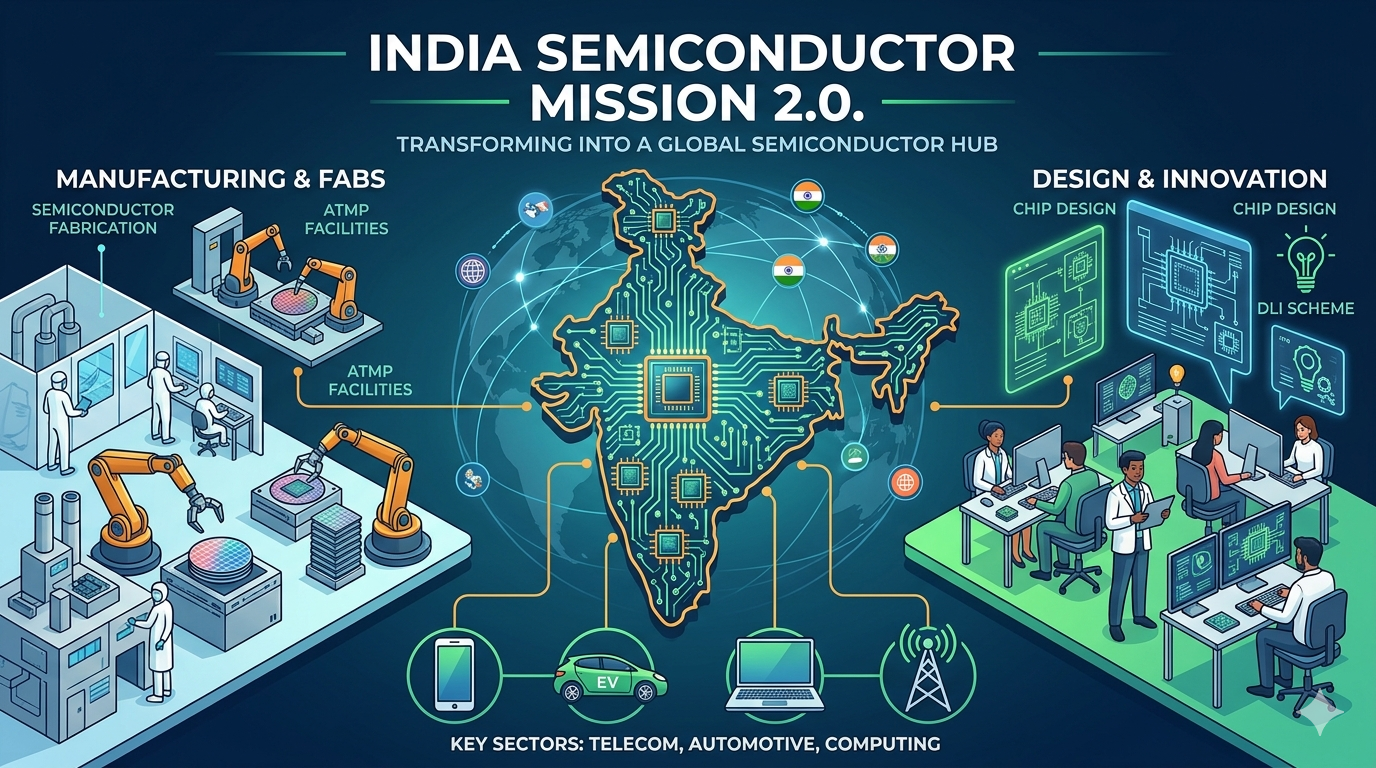
Transitioning from laying initial groundwork to building a robust, globally integrated network, the second iteration of the India Semiconductor Mission (ISM 2.0) is officially underway. This upgraded policy framework is designed to elevate the nation from a heavy consumer of electronics to a dominant, self-reliant force in global chip design and manufacturing.
Financial Commitment and Strategic Drive
Driven by the urgent need to secure digital supply chains and reduce reliance on imports, the Union Budget for 2026-27 dedicated ₹8,000 crore specifically to accelerate this ecosystem. Currently, advanced microchip technology is heavily concentrated among a few global players. ISM 2.0 acts as India’s strategic countermeasure, offering deep financial backing to attract global heavyweights and foster local talent, ensuring the nation remains competitive in a rapidly evolving technological landscape.
The Four Pillars of Support
Operating as an autonomous division to streamline approvals and strategies, the mission provides capital through four primary incentive channels:
Silicon Fabrication: Offers a massive 50% capital subsidy to enterprises building silicon wafer fabrication plants on Indian soil.
Display Manufacturing: Extends the same 50% fiscal support for the creation of domestic TFT and LCD display fabrication units.
Compound Semiconductors and Packaging: Targets the broader supply chain, providing incentives for assembly, testing, marking, and packaging (ATMP) facilities, alongside sensor and silicon photonics fabs.
Design-Linked Incentives (DLI): Focuses on the intellectual property side of the industry, offering monetary and infrastructure support to startups and established firms designing integrated circuits, chipsets, and IP cores.
Landmark Industry Investments
The government’s proactive incentives have successfully unlocked massive private capital across the country. Several cornerstone projects have already been greenlit, establishing a comprehensive microelectronics footprint:
Tata Electronics: Spearheading multiple massive ventures, including a ₹91,526 crore fabrication plant in Gujarat (partnering with Taiwan’s PSMC) and a ₹27,120 crore indigenous packaging facility in Assam.
Micron Technology: Injecting ₹22,516 crore into Gujarat for an advanced assembly and test manufacturing plant capable of processing 14 million units weekly.
HCL and Foxconn: A joint venture deploying ₹3,700 crore in Uttar Pradesh to manufacture display driver chips—essential components for smartphones, vehicles, and laptops.
CG Power: Building a ₹7,584 crore manufacturing hub, also located in Gujarat.
Other emerging facilities backed by major investments include projects from Kaynes Technology, 3D Glass Solutions, VMS Investments, and Continental Device India.
Employment and Ecosystem Growth
Beyond hardware, ISM 2.0 is an aggressive job-creation engine. The recently approved facilities alone are projected to introduce 20,000 direct, high-skill technology jobs and spark an additional 60,000 indirect employment opportunities. The positive ripple effects will be felt across allied sectors like automotive manufacturing, healthcare technology, telecommunications, and national defense.
Furthermore, the mission is actively cultivating grassroots innovation. Currently, over 270 academic institutions and 70 distinct startups are engaged in developing next-generation chip designs, proving that India is actively nurturing the human capital required to sustain this massive industrial shift.
Looking Forward
By offering substantial financial safety nets, prioritizing intellectual property creation, and forging partnerships with global technology leaders, ISM 2.0 provides a clear blueprint for success. It ensures that over the coming decade, India will not just participate in the global semiconductor trade, but actively shape its future.