




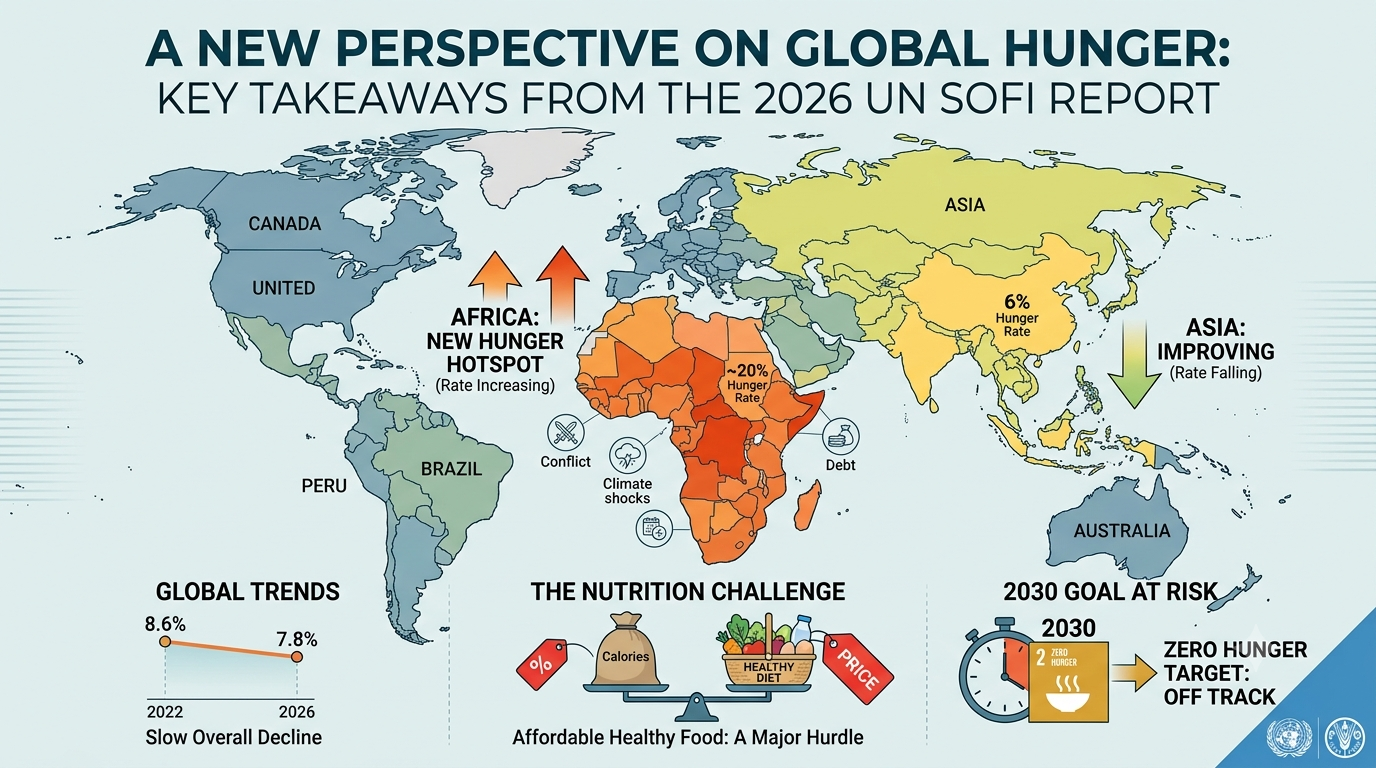
The Food and Agriculture Organization (FAO), in collaboration with its UN partners, recently published the 2026 State of Food Security and Nutrition in the World (SOFI) report. The findings reveal a complex reality: while the total number of people facing hunger is slowly shrinking, severe regional disparities and a global crisis in nutritional quality remain massive hurdles.
The Global Hunger Rate is Slowly Dropping
After years of grim statistics, the international fight against hunger is showing signs of slow but steady progress.
The Current Data: In 2025, an estimated 7.8% of the global population—roughly 645 million individuals—experienced hunger.
The Downward Trend: This represents a continuous decline from 8.6% in 2022 and 8.1% in 2024.
The Reality Check: While we can celebrate that 14 million fewer people are going hungry today compared to recent years, the overall numbers are still roughly 61 million higher than they were prior to the 2019 pandemic.
A Major Shift: Africa is Now the Epicenter of Hunger
For the first time in modern tracking, Africa has surpassed Asia to become the world’s most heavily impacted region for food insecurity.
Asia has successfully brought its hunger rate down to 6% of its population (292 million people). In stark contrast, Africa has experienced an 81% surge in hunger since 2010. Today, approximately 20% of the African population—or 309 million people—are facing hunger. This alarming regional spike is largely fueled by a combination of climate emergencies, localized conflicts, mounting national debts, and a heavy reliance on imported goods.
The 2030 “Zero Hunger” Goal is in Jeopardy
The international community is currently off-track to meet the UN’s second Sustainable Development Goal (SDG 2), which aims to eradicate hunger completely by 2030.
Current forecasts suggest that over half a billion people will remain undernourished by the end of the decade. The primary roadblocks to achieving this goal are global instability and systemic shocks. Factors such as extreme weather patterns (like El Niño), fluctuating energy and fertilizer costs, shrinking foreign aid, and ongoing conflicts in regions like Eastern Europe and the Middle East are heavily disrupting global food security.
The Nutrition Crisis: Calories vs. Quality
A central theme of the 2026 report is the urgent need to distinguish between simply providing enough food and providing the right kind of food.
Currently, one in four people globally (2.1 billion) endure some level of food insecurity, and a staggering one in three individuals cannot afford a nutritious diet. Nutrient-dense whole foods—such as dairy, meat, and eggs—remain financially out of reach for the world’s poorest communities due to supply chain bottlenecks and market monopolies. The report warns that simply solving caloric deficits without addressing basic nutritional needs will result in a global workforce that is fundamentally unhealthy.
India’s Paradox: Massive Progress Alongside Domestic Struggles
India’s recent policies have been a massive catalyst for global improvement, particularly in driving down the affordability deficit in lower-middle-income countries.
Major Wins:
India successfully reduced its undernourished population from 21.1% to 9.8%, lifting over 100 million citizens out of food deprivation.
The percentage of the population unable to afford healthy meals dropped drastically from nearly 60% in 2017 to 35.5% in 2025.
Ongoing Struggles:
Despite these massive statistical wins, India still battles severe domestic challenges. Rampant inflation in transportation and storage has driven the daily cost of a healthy diet up by nearly 48%, currently sitting at about $4.11 per person. Furthermore, the country is facing a severe public health crisis regarding child nutrition. India experiences some of the highest global rates of child wasting (18.7%) and child stunting (32.9%), while simultaneously dealing with an emerging “dual burden” as early childhood obesity rates rise from 2.1% to 3.7%.
Summary
The 2026 SOFI data proves that large-scale interventions can successfully reduce starvation, as seen in India’s recent statistical triumphs. However, to truly solve the global food crisis, international efforts must now shift focus toward stabilizing vulnerable regions and making high-quality, nutrient-rich diets affordable for everyone.