




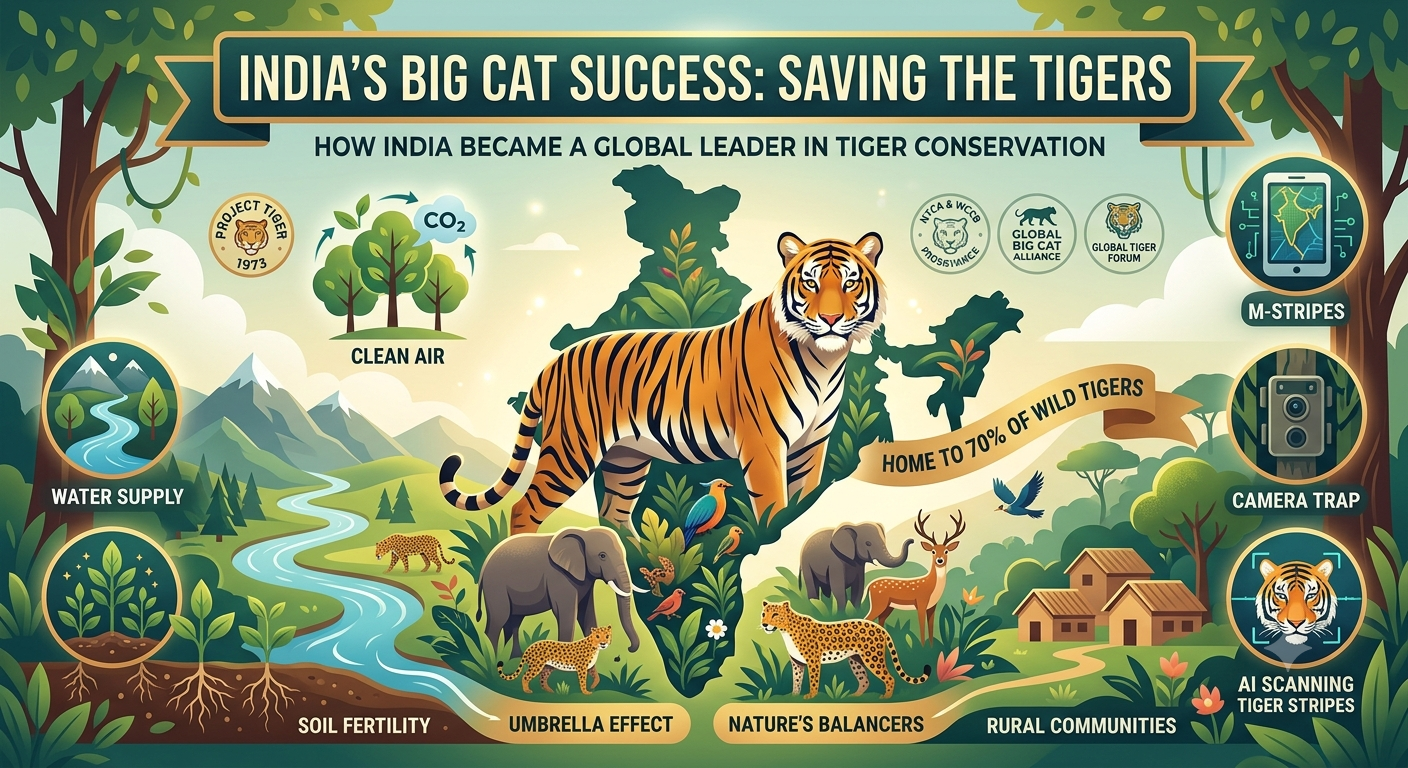
Every year on July 29, the world marks International Tiger Day. For India, this is a proud moment. India is now home to about 70% of all wild tigers in the world, proving that its wildlife protection plans are working incredibly well.
The Numbers Tell the Story
Back in 2006, tiger numbers were dangerously low. However, a major survey in 2022 showed that India had 3,682 tigers out of a global total of around 5,711. This means India has successfully more than doubled its tiger population in just a few decades.
Why Do Tigers Matter So Much?
Saving tigers is about much more than just protecting a beautiful animal. It is about keeping nature in balance.
Nature’s Balancers: Tigers are top hunters. They eat animals like deer and wild boars. If tigers disappeared, these plant-eating animals would multiply out of control, eat all the plants, and destroy the forests.
The “Umbrella” Effect: Tigers need massive, healthy forests to survive. When we protect these large areas for tigers, we automatically save everything else living there—from elephants and leopards to insects and thousands of plant types.
How Protecting Tigers Helps the Planet
When we save tiger habitats, we get amazing benefits for the environment:
Better Water Supply: Many rivers start in tiger forests. Healthy trees soak up rainwater like a sponge, keeping the groundwater full and ensuring rivers flow year-round.
Rich Soil: Tree roots hold the ground together, stopping good, nutrient-rich dirt from washing away in the rain.
Climate Control: Dense forests breathe in carbon dioxide (a gas that heats the earth) and breathe out fresh oxygen. This keeps the local weather cooler and more stable.
Helping People: Many rural villages rely on healthy, thriving forests to earn a living.
How India Achieved This
India’s success came from making strong rules and sticking to them:
Early Steps: In 1972, India passed a major wildlife protection law. A year later, they launched “Project Tiger” to fund and manage tiger safety.
Learning from Mistakes: In 2005, illegal hunters wiped out tigers in a famous reserve. This woke the country up. In 2006, the government made the laws much stricter.
New Teams: They created special groups—one dedicated entirely to managing tiger conservation (NTCA) and another to fight wildlife crime and stop illegal hunting (WCCB). Today, India has 58 protected Tiger Reserves.
Using Smart Technology
Forest guards no longer just rely on notebooks and guesswork. They use advanced tech to keep tigers safe:
Digital Tracking: Guards use a GPS-based app called M-STrIPES (think of it like Google Maps for forests) to track their patrol routes and log data digitally.
Hidden Cameras: Motion-sensor cameras are tied to trees. When an animal walks by, it snaps a picture.
Stripe Matching: Just like humans have unique fingerprints, every tiger has a unique stripe pattern. Advanced computer programs (Artificial Intelligence) scan these photos to identify and count each individual tiger.
Leading the World
India doesn’t just protect its own wildlife; it is a global leader. India hosts the headquarters for major international groups, like the International Big Cat Alliance and the Global Tiger Forum. Furthermore, nearly two dozen Indian tiger reserves have received special international awards for being managed exceptionally well.
By bringing the tiger back from the brink, India is doing far more than saving a national symbol. It is securing the health of its forests, its rivers, and its ecological future.