


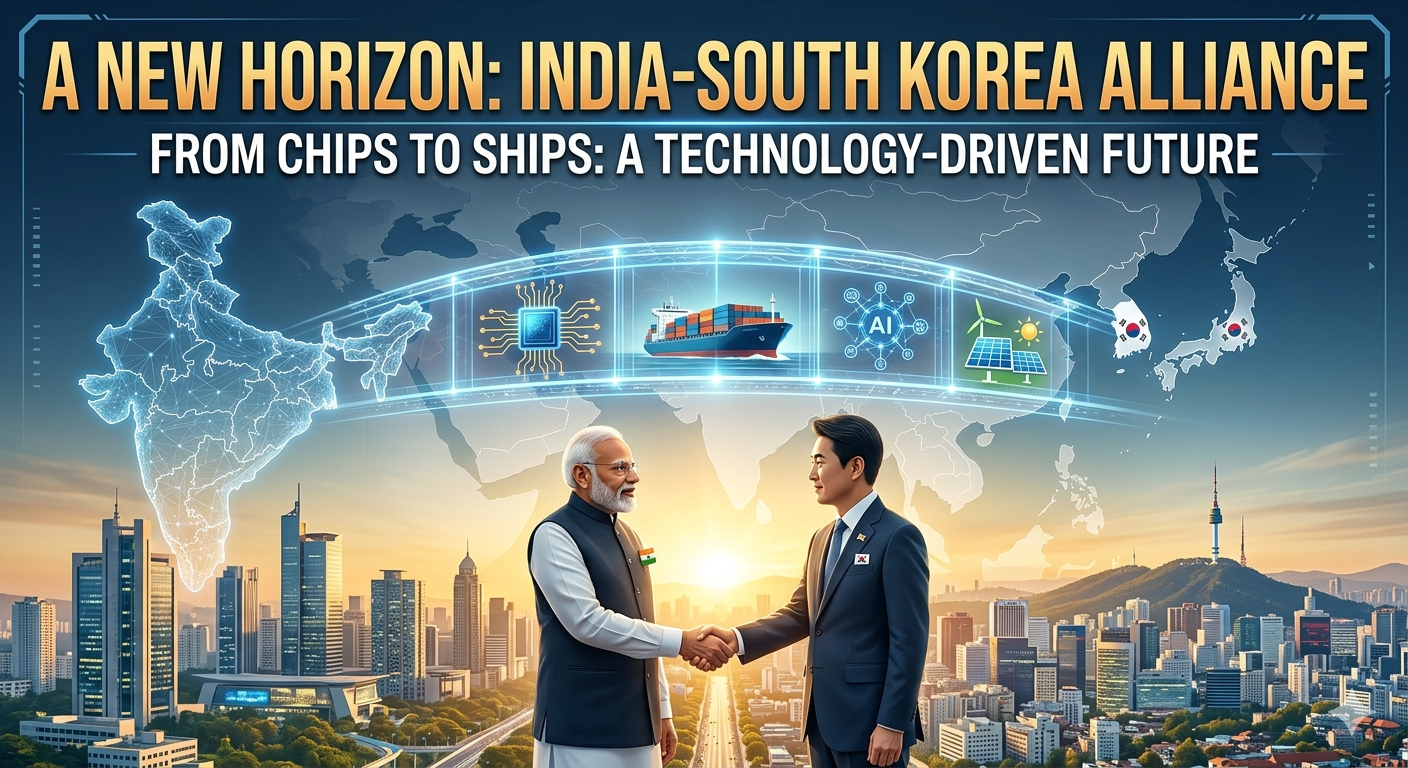
The diplomatic ties between India and the Republic of Korea are taking a monumental leap forward. Following a landmark three-day summit in India in April 2026, the bilateral relationship has officially transitioned from a reliable friendship into an ambitious, forward-looking alliance. Driven by shared geopolitical interests, a push for technological innovation, and a mutual vision for the Indo-Pacific, the two nations are setting the stage for a highly integrated future.
Strategic Agreements and Core Sectors
During the South Korean President’s visit, leadership from both nations, alongside top corporate executives, outlined a strategic roadmap. This resulted in the signing of 15 key agreements designed to deepen cooperation across several critical industries:
Next-Generation Technology: The launch of a new digital initiative will focus heavily on artificial intelligence, information technology, and semiconductor manufacturing, intertwining the tech ecosystems of both nations.
Maritime Collaboration: By merging South Korea’s world-class shipbuilding expertise with India’s manufacturing capacity and land resources, the two countries aim to revolutionize maritime logistics.
Sustainability and Climate: Emphasizing energy security, South Korea has aligned itself with major Indian-led global efforts, including the International Solar Alliance and the Indo-Pacific Oceans Initiative, to combat climate change.
To celebrate this deepening bond, 2028-2029 has been officially designated as a bilateral year of friendship.
Charting a $50 Billion Economic Course
A major highlight of the renewed partnership is a highly ambitious trade goal. Currently, bilateral trade hovers around $27 billion, but both governments are determined to nearly double that figure to $50 billion by the year 2030. To achieve this, officials are resuming talks to modernize their existing Comprehensive Economic Partnership Agreement (CEPA).
However, experts point out that the current trade environment heavily favors South Korea, with India importing over $21 billion while exporting under $6 billion. To correct this imbalance, discussions have strongly encouraged South Korean conglomerates to expand their manufacturing footprint within India. This strategy perfectly complements India’s drive for domestic production and its long-term economic vision for 2047.
Geopolitics and Energy Security
The push for a stronger alliance is heavily influenced by the current global landscape. With instability in the Middle East threatening crucial maritime choke points and global energy supplies, Asian economies are increasingly prioritizing regional resilience.
Both India and South Korea share a vital interest in keeping the Indo-Pacific peaceful and ensuring a steady flow of energy. By launching new dialogues on economic security and exploring alternative energy solutions like green hydrogen, the two countries are actively shielding their economies from global supply chain shocks.
The Demographic Advantage
Perhaps the most complementary aspect of this partnership lies in human capital. South Korea is currently navigating the economic challenges of a declining and aging population, while India boasts one of the world’s largest pools of young, skilled talent.
Indian professionals, particularly scientists and engineers, are already vital to the research and development centers of major Korean tech and auto giants. Moving forward, the goal is to increase workforce mobility across all sectors, from advanced IT to healthcare. To bridge the cultural and linguistic gap, there will be a renewed push to expand Korean language education and cultural studies across Indian academic institutions.
Looking Forward
The roadmap for India and South Korea is defined by a comprehensive synergy—ranging from microchips to massive ships, and from human talent to advanced technology. While the governments have successfully laid down the policy frameworks and strategic visions, the ultimate success of this upgraded alliance will rely heavily on private sector execution and cross-border corporate investments in the years to come.