




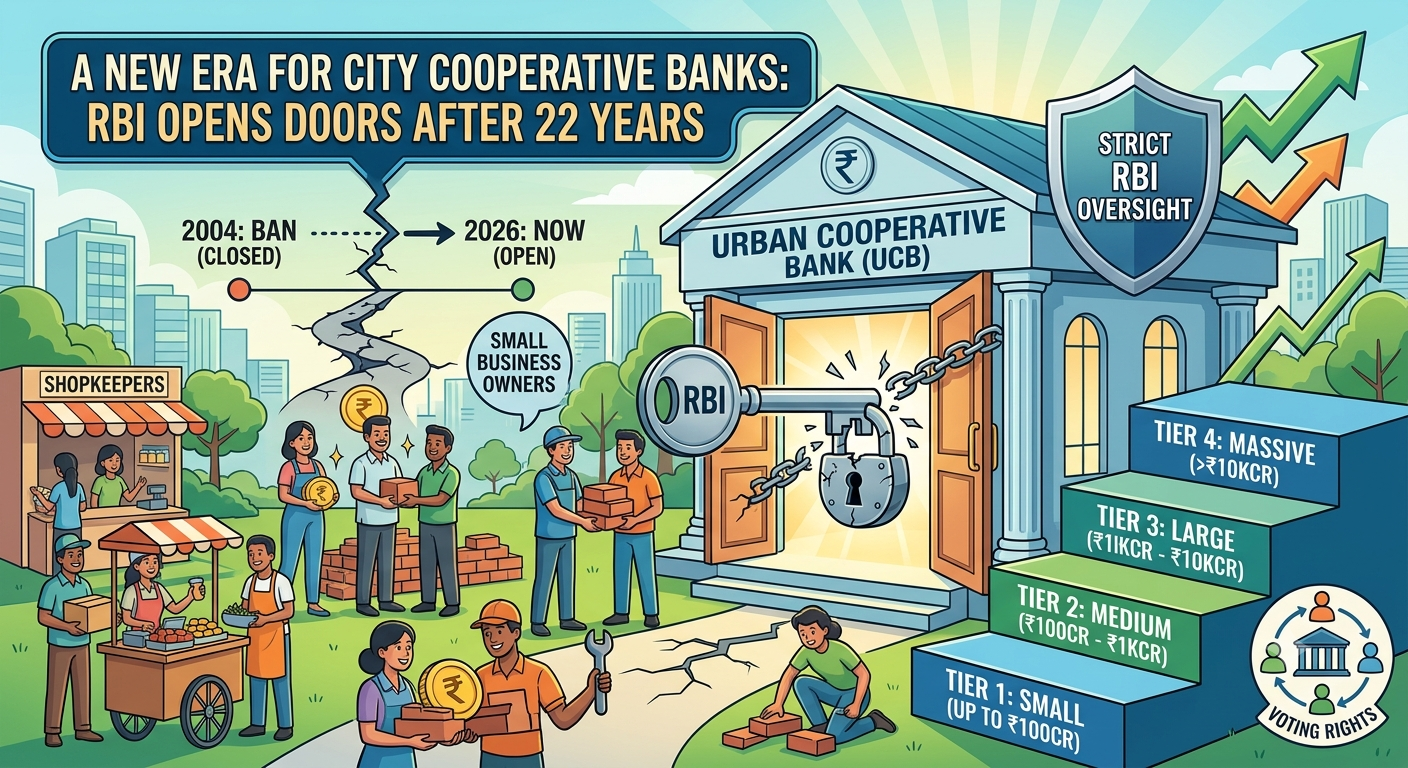
For the first time in over two decades, the Reserve Bank of India (RBI) is ready to allow new Urban Cooperative Banks (UCBs) to open. Back in 2004, the government stopped giving out new licenses because many of these banks were failing due to unpaid loans. Now, with stricter rules to keep money safe, the RBI is lifting that ban.
What Exactly is a Cooperative Bank?
Unlike regular commercial banks that focus heavily on making profits for their owners, cooperative banks are actually owned by their customers.
You Are an Owner: If you open an account and deposit money, you automatically become a member.
Voting Rights: Every member gets a vote to help choose the people who run the bank.
Better Perks: They often give you slightly more interest on your savings.
Helping the Little Guy: These banks are famous for giving loans to everyday people who might be ignored by big banks, such as street food vendors, local shopkeepers, and small businesses.
How City Cooperative Banks Work
Urban Cooperative Banks (UCBs) are specifically designed to serve people in cities and towns. They follow the Banking Regulation Act of 1949, as well as specific cooperative laws.
If a UCB operates inside just one state, it is registered under that state’s laws. If it has branches in multiple states, it is registered under the central government’s laws.
Tighter Rules for Better Safety
In the past, these banks had a confusing “dual control” system where the RBI managed banking tasks, but local boards handled the administration. This led to mismanagement.
To fix this, the government gave the RBI much more power in 2020 and 2021. Today, the RBI can directly fire bad managers or dissolve a failing board of directors. They also allowed these banks to raise extra money by selling shares, as long as the RBI approves.
The New 4-Step Sytem
To make regulating them easier, an expert panel called the N.S. Vishwanathan Committee suggested dividing these banks into four simple categories based on how much money they hold:
Tier 1: Small banks with up to ₹100 crore in deposits.
Tier 2: Medium banks with ₹100 crore to ₹1,000 crore.
Tier 3: Large banks with ₹1,000 crore to ₹10,000 crore.
Tier 4: Massive banks holding more than ₹10,000 crore.
Why This is Great News
Bringing back these local banks means smaller urban businesses will finally have an easier time getting the money they need to grow. With the RBI keeping a much closer eye on them, customers can feel confident that their hard-earned savings are secure.
Do you think having more local cooperative banks will make it easier for small businesses in your community to thrive?
Comment below your answer…