




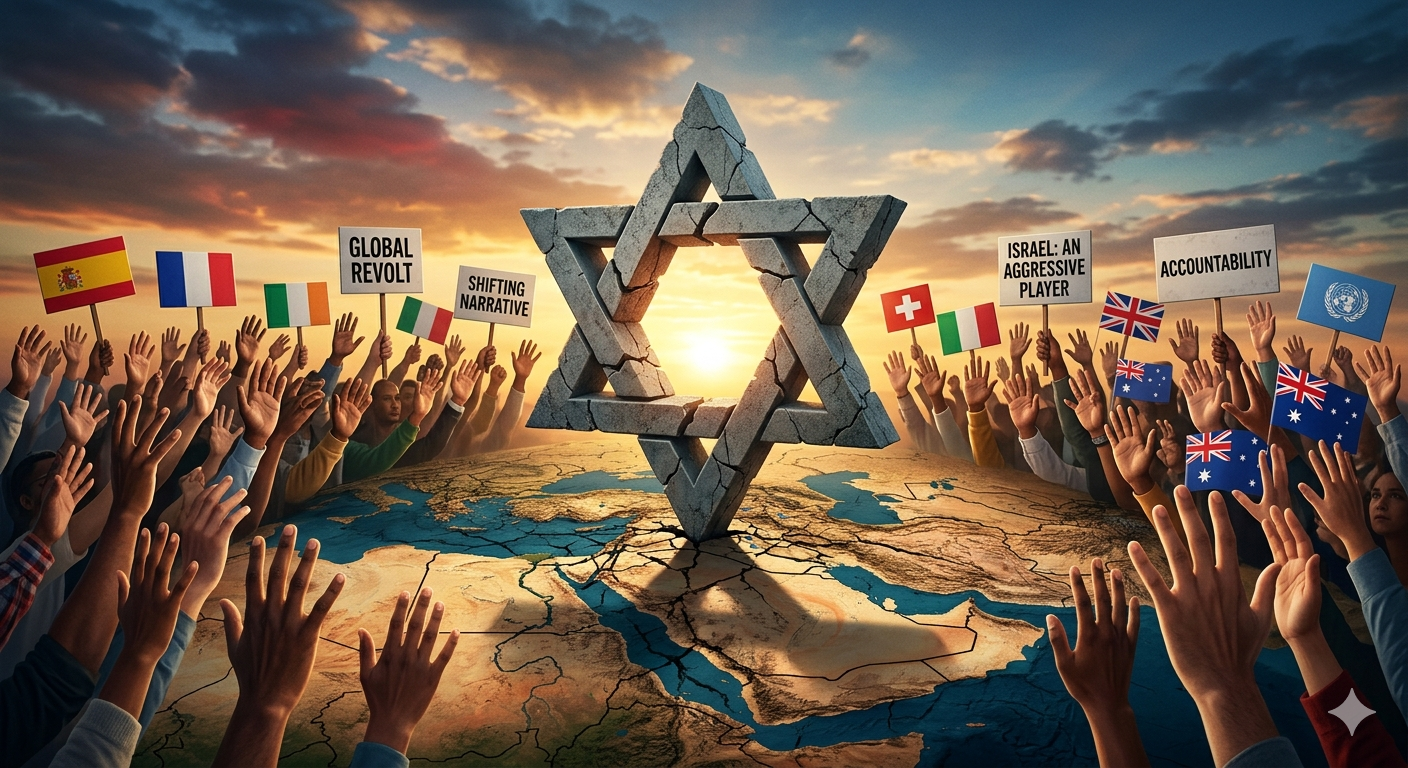
For decades, the international perspective on the Middle East has heavily positioned Israel as a vulnerable state acting out of necessity to defend itself against hostile neighbors. However, recent geopolitical developments and escalating military actions are fundamentally altering this perception. As international observers and allied nations reassess their stances, the long-held narrative of Israel acting purely in self-defense is facing unprecedented global scrutiny.
The Fading Defensive Stance
Early in the year, prominent US political figures projected swift resolutions to Middle Eastern conflicts, anticipating a reassertion of American dominance in the region. Instead, the illusion of unchecked US hegemony has been tested, and alongside it, the global perception of Israel has drastically transformed.
The ongoing regional conflicts have steadily eroded the defensive narrative that the Israeli government has historically utilized to justify its military maneuvers. Increasingly, the international community is viewing the state not as a besieged defender, but as an aggressive player with expansionist ambitions, fueled by rhetoric from leadership regarding the administration of territories in Gaza, Lebanon, and Syria.
Disregarding Ceasefire Efforts
The alienation of Israel from global sympathy has been accelerated by its approach to international peace agreements. Even amid US-brokered ceasefires, particularly concerning Lebanon, the current administration has continued aggressive military operations. Public defiance of calls for peace and the continuation of bombardments—resulting in a high toll on civilians, medical personnel, and journalists—have caused support bases to fracture significantly.
Changing Tides in the United States
The unconditional backing Israel once enjoyed in the United States is visibly shifting. Recent data, including figures from Pew Research, indicates that a growing percentage of Americans no longer view the nation’s actions favorably. The scale and severity of the ongoing military campaigns have drawn sharp criticism. Most notably, even steadfast conservative commentators and political loyalists who previously championed pro-Israel US policies are now publicly denouncing the government’s actions, signaling a profound rift in the American political landscape.
Legislation and Human Rights Concerns
Adding to the international outrage is the implementation of highly controversial domestic laws and mounting evidence of human rights violations. Legislation allowing for the execution of Palestinians convicted of “terrorism” in military courts—a broad categorization that can include acts of protest—has drawn severe backlash. Because this law applies to Palestinians in the occupied West Bank but not to Israeli citizens, organizations like Amnesty International, Human Rights Watch, and the UN have condemned it as deeply discriminatory.
Furthermore, reports of severe misconduct by military forces have become widespread, often exacerbated by footage shared directly on social media by the soldiers themselves. Disturbing accounts of civilian infrastructure destruction, the mistreatment of displaced families, and reports of severe detainee abuse have shocked the global conscience. Recent UN Special Rapporteur reports have explicitly highlighted that systematic abuse, forced displacement, and infrastructural destruction are becoming deeply entrenched practices.
Territorial Expansion and Settler Violence
The overarching trajectory of these military campaigns points toward aggressive territorial expansion. Under the stated objective of eliminating militant threats, land confiscations and military offensives continue to push borders outward. The incursion into Southern Lebanon, aimed at flattening border villages to create buffer zones, mirrors the devastating tactics deployed in Gaza.
Simultaneously, violence in the occupied West Bank has reached unprecedented levels. Extremist settlers frequently act with impunity, destroying property and displacing communities in direct defiance of international law and rulings by the International Court of Justice.
The Call for International Accountability
The global community is increasingly reacting to these realities. Nations that previously maintained diplomatic silence—including Spain, France, Ireland, Italy, and Switzerland—are now vocally condemning these actions.
The era of mere diplomatic reprimands appears to be ending. Human rights advocates and international legal experts are now demanding tangible consequences, such as widespread sanctions, to halt the ongoing violence. The current crisis has evolved beyond a regional conflict; it is now viewed as a critical test of the international community’s willingness to enforce global human rights standards and hold allied nations accountable.