




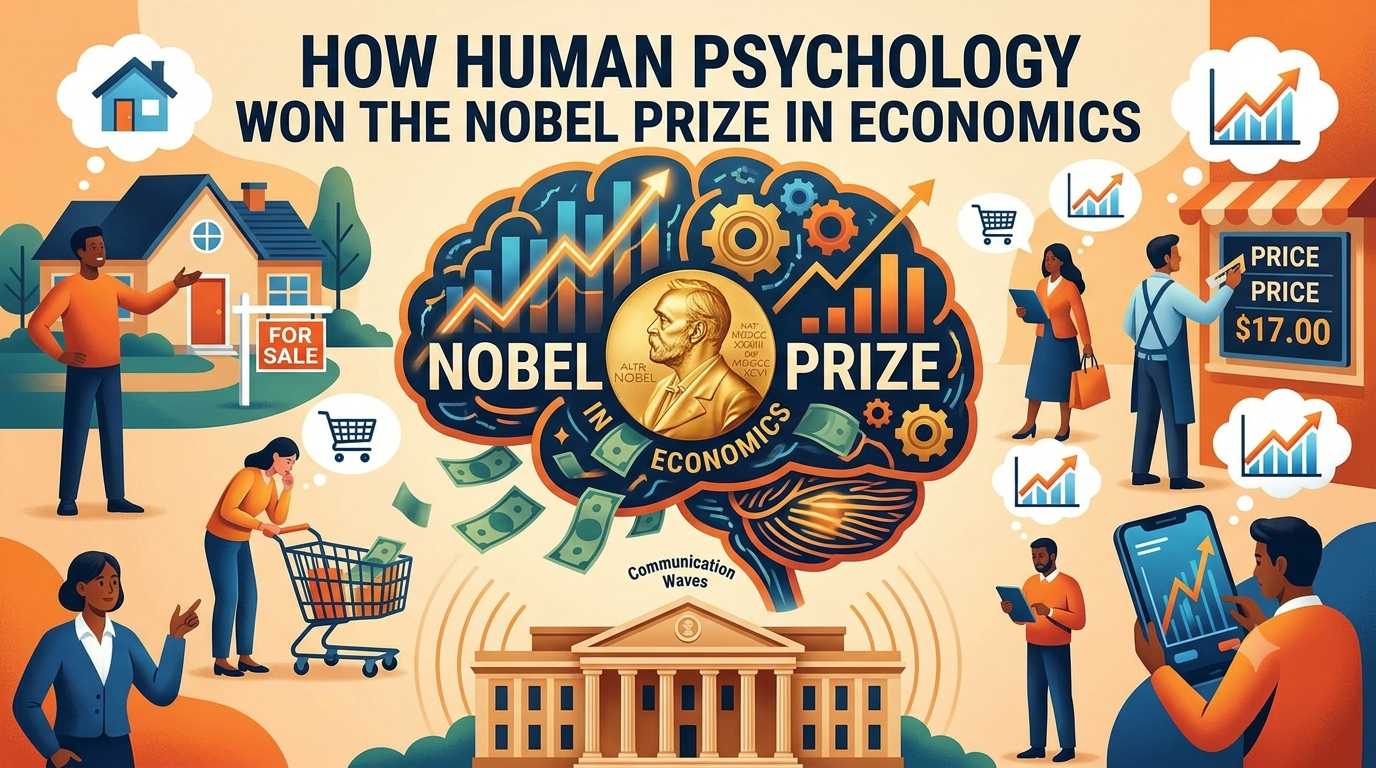
Have you ever noticed how your hopes and fears about the future affect the way you spend money today? It turns out, this basic human behavior is the secret to understanding the entire economy.
This simple truth is why two American economists, Robert E. Hall and Michael Woodford, were awarded the 2026 Nobel Prize in Economics. They proved that to fix big national money problems (macroeconomics), leaders first have to understand the everyday choices of ordinary people (microeconomics).
Here is a simple breakdown of what they discovered and why it matters.
The Old Problem: When the Usual Fixes Failed
For a long time, experts treated the economy like a machine. If the economy was slowing down and people were losing jobs, the government would just spend more money to create jobs. This worked perfectly during events like the Great Depression.
But in the 1970s, a major oil shortage caused a new kind of disaster known as “Stagflation.” This was a double-blow: things were getting incredibly expensive (inflation), but jobs were also disappearing (unemployment).
The old “machine” rules broke down. If the government tried to lower interest rates to create jobs, prices just went higher. If they raised rates to stop prices from rising, even more people lost their jobs. Economists realized they were missing a piece of the puzzle: human behavior.
Robert Hall: Why We Spend the Way We Do
Robert Hall looked closely at how regular people manage their daily spending. In the past, experts assumed that if your salary dropped today, you would immediately stop spending.
Hall pointed out that humans don’t work like that; we look at the future.
Fear of the Future: If you are terrified of losing your job next month, you are not going to take out a loan to buy a house today—even if the bank offers you an incredibly cheap interest rate.
Hope for the Future: On the flip side, if your salary drops this month, but you know a big promotion is coming next year, you probably won’t change your spending habits much.
Our spending isn’t just based on the cash in our wallets today; it is driven by our confidence in tomorrow.
Michael Woodford: The Power of Words
Michael Woodford focused on businesses and Central Banks (like the RBI in India or the Federal Reserve in the US). He brought two big ideas to the table:
Prices are “Sticky”: Prices don’t change every single day. Think of a local tea seller. If the cost of milk goes up slightly for a few days, the seller doesn’t immediately raise the price of a cup of tea. They keep the price steady because they already factored in small changes. Because prices take time to change, Central Banks have a small window of time to step in and stabilize the economy.
Words are as Powerful as Actions: Woodford showed that what a Central Bank says is just as important as what it does. If a bank leader simply steps up to a microphone and promises, “We will keep interest rates low for the next two years,” the stock market will often jump immediately. The actual rates haven’t changed yet, but the trust in that promise makes people and businesses confident enough to start spending and investing right away.
The Big Takeaway
The biggest lesson from the 2026 Nobel Prize winners is that a country’s economy is not a machine made of numbers; it is made of people.
To keep a country wealthy and stable, governments and banks can’t just blindly change tax rules or interest rates. They have to communicate clearly, build trust, and truly understand the daily hopes and fears of the common person.