


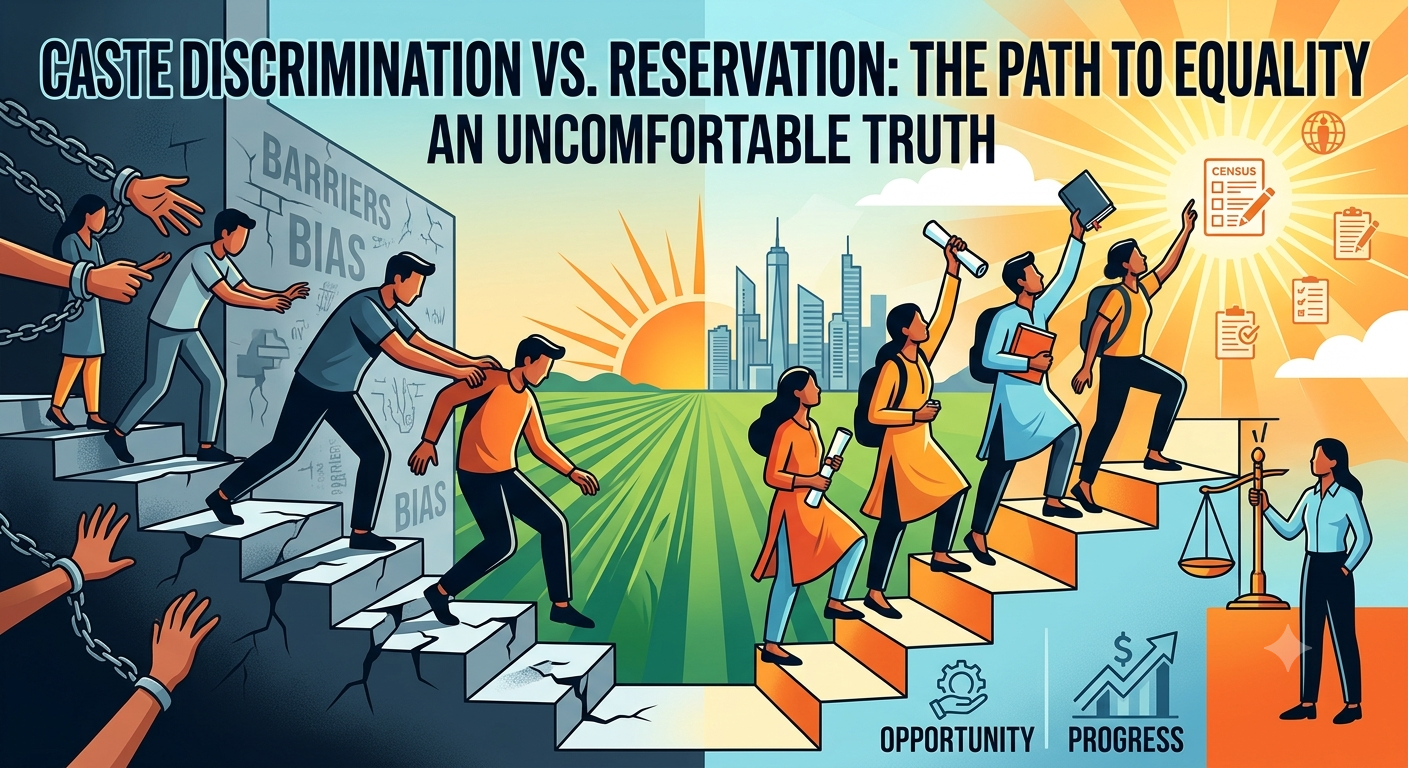
The debate over the reservation (quota) system in India is deeply emotional. While some argue that jobs and college seats should be based strictly on merit, others point out that severe social inequality makes quotas necessary. The ground reality shows that caste-based discrimination is still very common today.
High Crime Rates: Violence against Scheduled Castes (SCs) and Scheduled Tribes (STs) remains high, not just in rural villages but also in major, modern cities.
Honor Killings: Deep-rooted caste mindsets still lead to violence, especially against young people who choose to marry outside their caste.
Justice System Imbalance: A disproportionate number of prison inmates come from marginalized castes, many waiting for trials because they cannot afford lawyers.
Everyday Bias: Until a recent Supreme Court ban, even prison chores were divided by caste, with lower castes assigned cleaning duties and upper castes assigned cooking.
Education and Employment Gaps
Despite decades of the reservation system, true equality has not yet been achieved in schools and workplaces.
School Dropouts: While more students from marginalized backgrounds are going to school, they drop out much faster due to systemic poverty and a lack of support at home.
Empty Seats in Top Colleges: Elite educational institutions often struggle to fill the seats reserved for SC and ST students.
Job Disparities: In the highest-paying government roles, unreserved (general) categories hold the vast majority of jobs. Marginalized groups are mostly heavily represented in lower-tier or manual labor jobs.
How the Quota System is Changing
The reservation system was designed to correct centuries of historical wrongs, but it is constantly evolving through legal battles.
Expanding Quotas: Beyond the traditional quotas for SCs, STs, and OBCs, the government recently introduced a 10% reservation (EWS) specifically for economically weaker people in the general category.
The “Quota Within a Quota” Debate: The Supreme Court recently ruled that states can divide the SC/ST categories to ensure the absolute poorest get help first.
Wealth vs. Social Status: The central government argues that an income limit should not be used to cut SC/ST individuals out of the quota system. In India, a person’s caste can still lead to severe discrimination, regardless of how much money they make or how educated they are.
Looking Ahead: The 2027 Census
To fix these massive social issues, the government needs accurate data. Currently, policies are being made without knowing the exact population or financial status of individual castes.
The Digital Census: India plans to conduct a major caste census in 2027.
Data-Driven Equality: This census will map out exactly how educated and wealthy each community is, helping the government create fairer policies.
Ultimately, the reservation system is a temporary fix for a permanent problem. Quotas will only become unnecessary when society completely stops discriminating based on caste.
How do you think schools and communities can work together at the grassroots level to reduce caste prejudice among the next generation?
Comment below your answer…