


The Drive for Self-Sufficiency
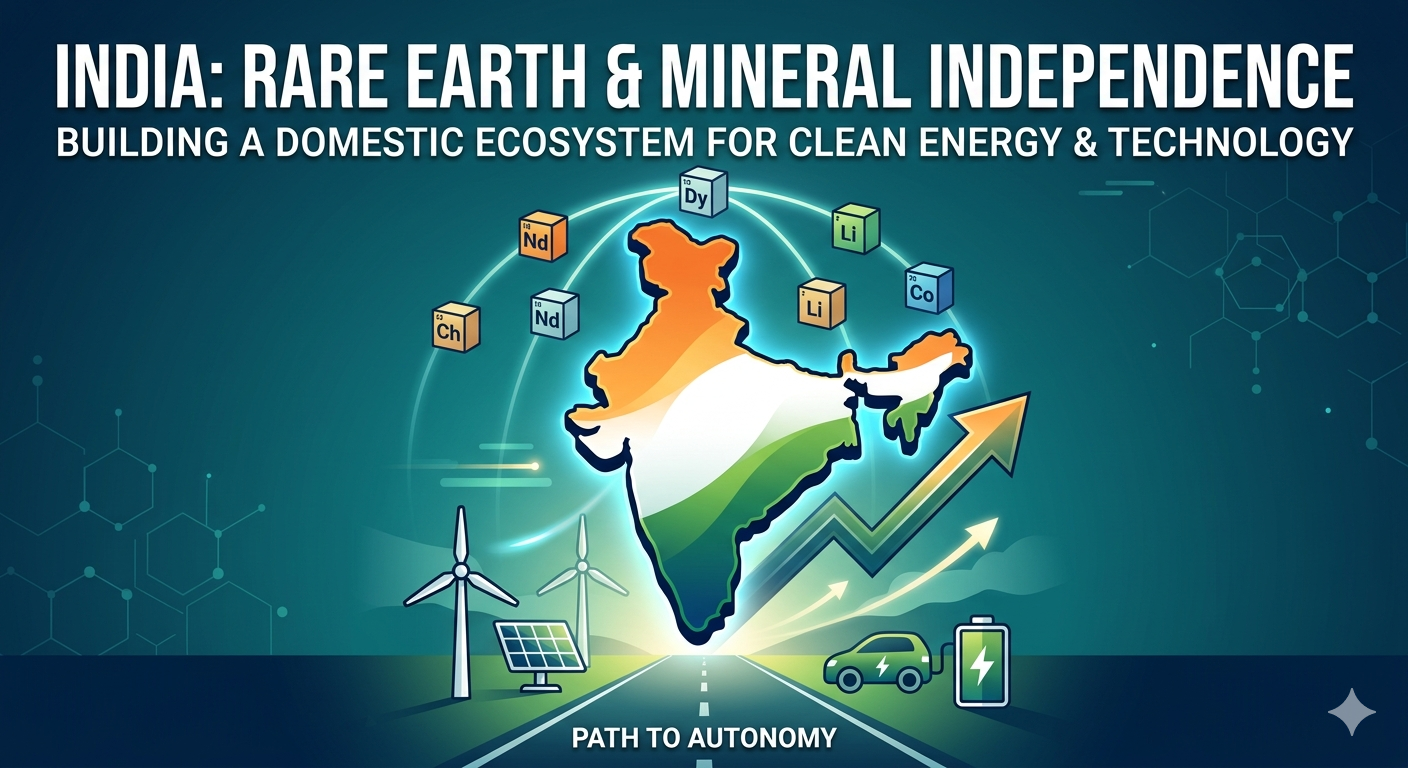
India is aggressively working to eliminate its reliance on foreign imports by building a robust domestic supply chain for critical materials. By focusing on rare earth elements and permanent magnets—materials that are absolutely vital for wind turbines, electric vehicles, aerospace, and advanced electronics—the country is accelerating its clean energy transition. This strategic pivot heavily supports broader national visions, including the realization of an Aatmanirbhar Bharat (Self-Reliant India), Viksit Bharat by 2047, and achieving Net Zero emissions by 2070.
Creating Corridors and Boosting Manufacturing
To fast-track this transition, the government has launched several major initiatives aimed at localizing the value chain:
Magnet Manufacturing Push: A massive ₹7,280 crore investment has been greenlit to establish an integrated manufacturing capacity of 6,000 Metric Tonnes Per Annum (MTPA) for permanent magnets, covering everything from raw oxide extraction to final product assembly.
Dedicated Mineral Corridors: As outlined in the 2026-27 Union Budget, India is establishing specialized “Rare Earth Corridors.” Spanning across mineral-abundant states like Tamil Nadu, Andhra Pradesh, Kerala, and Odisha, these zones will streamline mining, processing, and research.
Leveraging IREL’s Infrastructure: Indian Rare Earths Limited (IREL), which processes about 10 lakh tonnes of materials yearly and has been active since 1963, will be instrumental in bridging its existing refining operations with these newly minted corridors.
Beyond Minerals: 2026-27 Budget Highlights
The most recent budget also emphasized strengthening manufacturing capabilities across several other vital sectors:
Textile Modernization: A sweeping five-pillar program was introduced to support local weavers, modernize traditional clusters, and expand national fiber initiatives.
Container and Chemical Production: The government has allocated ₹10,000 crore over five years to build a globally competitive container manufacturing industry, alongside launching plug-and-play chemical parks to curb chemical imports.
Tech and Sports Innovations: To support local manufacturing precision, high-tech component tool rooms will be set up by CPSEs. Additionally, a new initiative will focus on making India a global supplier of high-quality, affordable sporting goods.
The “Panchamrit” Climate Pledges
Securing critical minerals is non-negotiable for meeting India’s international climate commitments, famously known as the “Panchamrit” goals. These targets include:
Slashing projected carbon emissions by 1 billion tonnes by 2030.
Reducing the overall carbon intensity of the Indian economy by over 45% by 2030.
Expanding non-fossil energy capacity to 500 GW by 2030.
Ensuring that half of the country’s energy demands are met by renewable sources by the end of the decade.
Reaching total Net Zero emissions by the year 2070.
Clarifying the Terms: Rare Earths vs. Critical Minerals
Though often lumped together, these two terms mean different things in the resource sector:
Rare Earth Elements (REEs): This refers to a specific family of 17 metals. They are famously difficult to process because they are typically found blended together in geological deposits and share nearly identical chemical properties.
Critical Minerals: This is an economic classification. It encompasses any mineral that is crucial for national security or the economy but faces a high risk of supply chain disruption. While all rare earth elements are classed as critical minerals, many critical minerals (like lithium or cobalt) are not rare earths.
The 2025 National Critical Mineral Mission
Historically reliant on imports—particularly from China—India launched the National Critical Mineral Mission in 2025 to safeguard its industrial future.
Domestic Exploration: The Geological Survey of India (GSI) is executing an aggressive timeline, targeting 1,200 separate mineral exploration projects through 2031.
Policy Overhauls: A crucial 2023 amendment to the Mines and Minerals Development and Regulation (MMDR) Act gave the Central Government exclusive rights to auction mining leases for 24 highly strategic minerals, streamlining the path from discovery to extraction.
Global Expansion: India is also looking beyond its borders to secure resources. Through the state-backed joint venture KABIL, the nation successfully acquired 1,573 hectares of land in Argentina for lithium mining and is actively evaluating similar prospects in Australia.
By pairing ambitious domestic exploration with smart legislative changes and international asset acquisitions, India is successfully laying the groundwork for an independent, resilient, and green technological future.